Last updated: September 26, 2026 · Originally published: March 21, 2026 · By Eternal Elixir Editorial
Quick answer: Many parents use tallow for baby skin, and plain tallow is a simple fat that sits on the skin like other balms. But no clinical trial has tested tallow on babies. Infant skin is thinner than adult skin, and trials of oils and moisturisers on newborns have been mixed: in the largest, daily moisturiser from birth did not lower the rate of eczema at age two and was linked to more skin infections. So keep a newborn’s skincare minimal, patch test anything new, and ask your GP or child health nurse before putting any balm on broken or very dry skin.
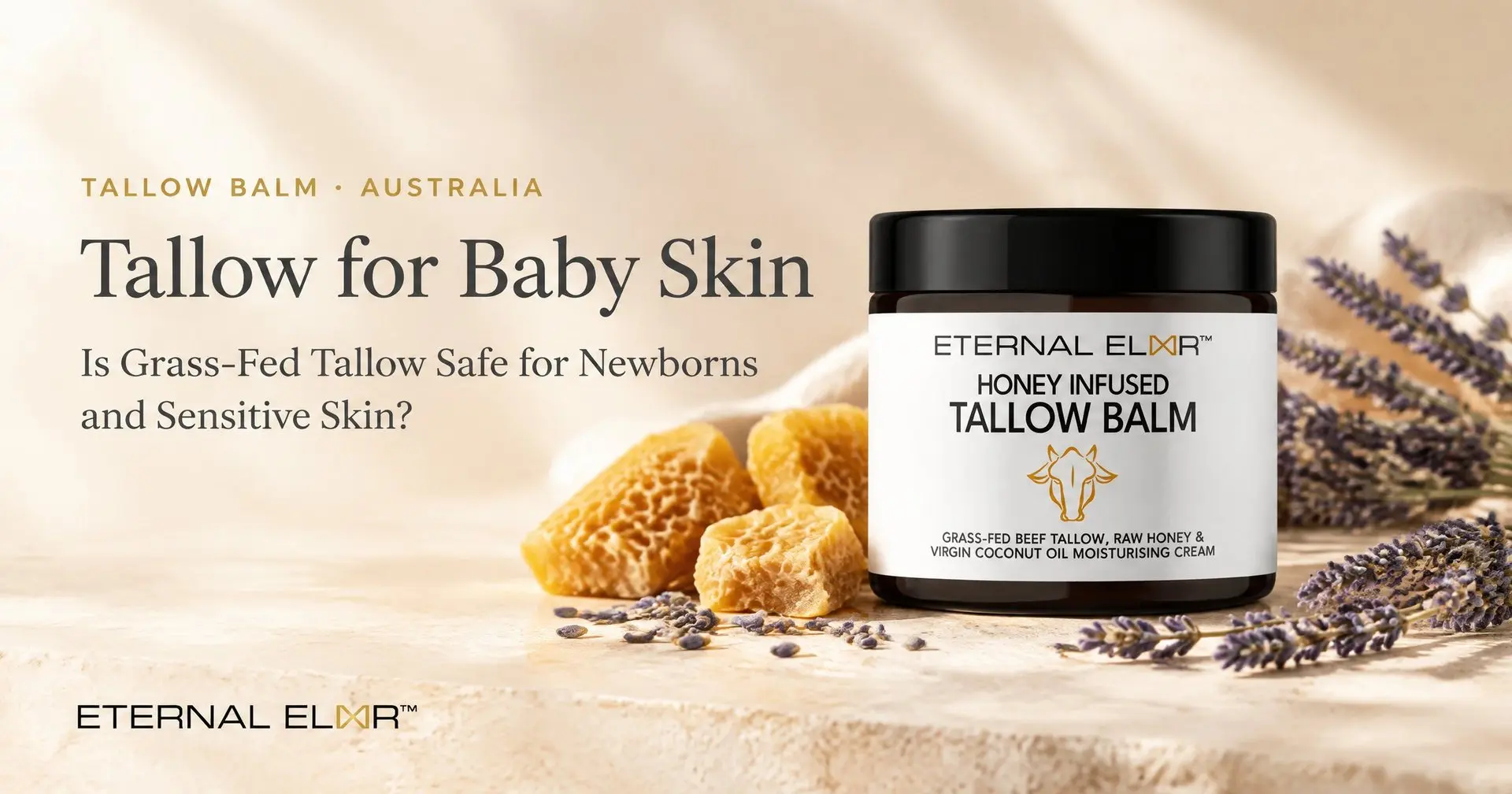
Our own Honey Infused Tallow Balm contains organic raw honey. Australian health advice is not to give honey to babies under 12 months, and a balm on a baby’s hands or face can end up in the mouth, so we don’t recommend our balm for babies under 12 months. It is our pick for parents’ own dry or sensitive skin and, after a patch test, for toddlers over 12 months: grass-fed tallow with organic raw honey, organic virgin coconut oil, organic raw beeswax and vitamin E, 60g for $29.99 ($0.50 a gram), sent from Sydney within 24 hours.
Eternal Elixir makes the Honey Infused Tallow Balm, so weigh our view with that in mind. This guide is general information, not medical advice. Every study is listed at the end, and the other balms’ details were read from each product’s own page in September 2026.
Table of contents
- 1. Can You Put Tallow on a Baby’s Skin?
- 2. Why Baby Skin Is Different from Adult Skin
- 3. What the Research Says About Oils and Moisturisers on Newborns
- 4. What Makes Tallow Suit Skin, and What Dermatologists Say
- 5. What Are the Negative Effects of Tallow on Skin?
- 6. What to Look for in a Baby-Safe Tallow Product
- 7. Tallow Balms for Babies and Sensitive Skin in Australia
- 8. Who Tallow Suits, and Who It Doesn’t
- 9. How to Use Tallow on an Older Baby or Toddler
- 10. Frequently Asked Questions
- 10.1. Can you put tallow on a baby’s skin?
- 10.2. Is tallow healthy for babies?
- 10.3. Why are dermatologists against tallow?
- 10.4. What are the negative effects of tallow on skin?
- 10.5. Can tallow cause allergic reactions in babies?
- 10.6. Is Eternal Elixir’s tallow balm safe for my baby?
- 10.7. What is the best tallow balm for sensitive skin?
- 11. The Verdict
- 12. Sources
Can You Put Tallow on a Baby’s Skin?
You can, and many families do, but it hasn’t been tested. There is no published trial of tallow on babies’ skin, so claims that it is “biologically better” for infants than other moisturisers go beyond the evidence. What we do have is research on infant skin itself and on oils and moisturisers used on newborns, and both point to a cautious approach:
- Use as little as you need, on intact skin, and only where the skin is dry.
- Choose a short ingredient list with no added fragrance or essential oils.
- Avoid honey products for babies under 12 months.
- Patch test first, and stop if you see redness or a rash.
- See your GP or child health nurse for skin that is cracked, weeping, spreading or not settling.
Why Baby Skin Is Different from Adult Skin
Infant skin looks similar to adult skin but is built differently. A study that compared the skin of 20 mothers with their children, aged 3 to 24 months, found the infants’ outer layer (the stratum corneum) was 30% thinner and the epidermis 20% thinner than their mothers’. The infants’ surface cells were also smaller, a sign that their skin renews faster (Stamatas, 2010).
The authors said these differences may help explain why infant skin behaves differently from adult skin. For parents, the practical point is simple: a product that suits your skin won’t necessarily suit your baby’s, and anything you apply meets a thinner, still-developing barrier. Our guide to how the skin barrier works explains the barrier in adults.
What the Research Says About Oils and Moisturisers on Newborns
Two trials are worth knowing before you put any balm on a newborn.
Daily moisturiser from birth (the BEEP trial)
This UK trial randomly assigned 1,394 newborns from families with a history of allergies either to a daily moisturiser for their first year or to standard skin-care advice alone. The main outcome was measured at age two: 23% of the moisturiser group and 25% of the others had developed eczema, a gap too small to rule out chance, so do not rely on a daily moisturiser to prevent it in your baby. Skin infections were more common in the moisturiser group in the first year, at 0.23 per child against 0.15. The authors concluded that families should not use daily moisturisers to try to prevent eczema in their newborn (Chalmers, 2020).
Olive oil, sunflower oil or no oil
A smaller pilot trial gave 115 healthy full-term newborns olive oil, sunflower oil or no oil twice a day for four weeks. Both oil groups had better skin hydration, but significantly less improvement in the structure of the fats between skin cells (the lipid layers of the barrier) than babies given no oil. The study wasn’t large enough to show whether that matters clinically, and the authors advised caution when recommending oils for newborn skin (Cooke, 2016).
Neither trial tested tallow. Many tallow balms, ours included, also contain plant oils such as coconut, olive or jojoba. The fair reading is that routine oiling and moisturising of newborns has not shown clear benefits, so there is no need to use a balm on a newborn unless the skin is dry and your health professional agrees.
What Makes Tallow Suit Skin, and What Dermatologists Say
Tallow is rendered beef fat. Two Australian dermatologists interviewed by the ABC in 2025 gave a balanced view. Dr Michael Freeman called tallow a biological compound with lots of fatty acids that is “relatively compatible with our skin”, noted that it contains vitamins A, D, E and K, and said it is best suited to dry, sensitive skin. Dr Mei-Heng Tan said that for oily or acne-prone skin “it may clog pores”, that raw tallow can carry impurities that may cause irritation or infection, and that some people are allergic or sensitive to it, so a patch test is a good idea (ABC News, 2025). Neither spoke about babies.
So the answer to “why are dermatologists against tallow?” is that most aren’t against it for dry skin. Their cautions are about oily skin, homemade or raw tallow, allergy and the lack of trials. For a longer look at sourcing, see our guide to why grass-fed sourcing matters for tallow skincare.
What Are the Negative Effects of Tallow on Skin?
- Blocked pores in oily or breakout-prone skin, per Dr Tan.
- Reactions to the other ingredients. Balms often add essential oils, honey, beeswax, nut oils such as sweet almond, or oat. Any of these can be a problem for a sensitive child.
- Impurities in home-rendered tallow. Use a finished product from a maker rather than fat you render in the kitchen.
- Heat and spoilage. Tallow softens in warm rooms and can go off if left open or used with dirty fingers. A rancid smell means it’s time for a new jar.
- For newborns, the moisturiser and oil trials above, which found no clear benefit from routine use and some reasons for caution.
What to Look for in a Baby-Safe Tallow Product
- A short ingredient list. Fewer ingredients means fewer things your baby could react to.
- No added fragrance or essential oils. Some baby balms add lavender or other oils, and some only infuse herbs into the tallow. Read the full list.
- No honey under 12 months. Honey-free products avoid the question entirely.
- Know your family’s allergies. Check for nut oils, oat and bee products if food allergies run in the family.
- A small jar you’ll finish. Some makers suggest using the balm within six to nine months of opening.
- A patch test. Put a small amount on a small area, such as the inside of the wrist or ankle, and wait a day before using it more widely. Two of the baby balms below tell you to do this.
Tallow Balms for Babies and Sensitive Skin in Australia
Prices are as of Sep 2026 and were read from each product’s own page. Price per gram or millilitre uses the size the page states.
| Product | Price (AUD) | Size | Price per g or mL | Ingredients | Added fragrance or essential oils | Age guidance | Buy |
|---|---|---|---|---|---|---|---|
| Eternal Elixir Honey Infused Tallow Balm | $29.99 | 60g | $0.50/g | Grass-fed beef tallow, organic raw beeswax, organic virgin coconut oil, organic raw honey, vitamin E | None | Not for babies under 12 months (contains honey) | View at Eternal Elixir |
| Naked Tallow Tallow Baby Body Balm | $29.00 | 45g | $0.64/g | Grass-fed beef tallow, coconut oil, cacao butter, candelilla wax, colloidal oat, jojoba oil, calendula-infused jojoba oil, vitamin E | None listed | Made for babies; patch test if baby has skin sensitivities | Naked Tallow |
| Pure Skin Adelaide Hills Tallow Cream, Sensitive and Baby | $29.70 | 50mL | $0.59/mL | Grass-fed and finished beef tallow, calendula-infused olive oil, arnica-infused jojoba oil | None (fragrance free, no essential oils) | Labelled for sensitive skin and babies | Pure Skin |
| Tallow by Zainab Nurture Baby Intensive Tallow Balm | $50.00 | Not stated | Not stated | Tallow infused with calendula, rose and lavender, jojoba oil, camellia oil, calendula-infused sweet almond oil, beeswax, shea butter, mango butter, colloidal oatmeal, vitamin E | None added (herbs infused into the tallow) | Newborns and all ages; always patch test first | Tallow by Zainab |
Ours has the lowest price per gram in the table and a five-ingredient list with no added fragrance, which is why it is our pick for adults and children over 12 months. For a baby under 12 months, the three baby-labelled balms are honey-free. Pure Skin’s has the shortest list, three ingredients, though one is olive oil, the oil in the newborn pilot trial above. Naked Tallow’s and Tallow by Zainab’s contain oat, and Tallow by Zainab’s also contains sweet almond oil, which matters if food allergies run in your family. None of these products, ours included, has been tested in a clinical trial.
Add Honey Infused Tallow Balm to cart · $29.99For adult skin, our comparison of the best tallow balms in Australia covers eight brands, and our guide to tallow balm for the face covers facial use.
Who Tallow Suits, and Who It Doesn’t
It may suit:
- Parents with dry or sensitive skin who want a short-ingredient balm for themselves, including hands that are washed often.
- Toddlers over 12 months with dry patches on intact skin, after a patch test.
- Families who prefer a few recognisable ingredients to a long list.
It is not a good fit for:
- Routine use on newborns, unless your GP or child health nurse suggests a balm for dry skin.
- Babies under 12 months, if the product contains honey, as ours does.
- Skin that is broken, weeping, crusted or looks infected. See your GP.
- Oily or breakout-prone skin, and anyone who has reacted to tallow, beeswax or honey before.
How to Use Tallow on an Older Baby or Toddler
- Patch test first and wait a day.
- Start with clean, dry skin, ideally after a bath.
- Warm a pea-sized amount between your fingers until it melts.
- Press a thin layer onto the dry areas only. A little goes a long way.
- Keep it away from the eyes, and wash your hands afterwards.
- Store the jar somewhere cool. In an Australian summer it may soften or melt, and a clean spatula keeps it fresher.
For the nappy area, use the barrier cream your pharmacist or child health nurse recommends, and ask them if redness doesn’t settle within a few days. For your own routine, our tallow and honey skincare routine is a good starting point, and our guide to tallow for very dry, reactive adult skin covers when to see a doctor first. If you’re weighing tallow against plant-oil moisturisers, read tallow versus seed oils.
Frequently Asked Questions
Can you put tallow on a baby’s skin?
Many parents do, but tallow hasn’t been tested on babies in a clinical trial. If you use it, choose a honey-free, fragrance-free balm with few ingredients, patch test first, and use it only on dry, intact skin. Ask your GP or child health nurse before using any balm on a newborn.
Is tallow healthy for babies?
There isn’t evidence either way for tallow specifically. Trials of daily moisturiser and of olive and sunflower oils in newborns found no clear benefit from routine use, and some reasons for caution, so less is usually more in the first weeks.
Why are dermatologists against tallow?
Most aren’t against it for dry skin. Australian dermatologists interviewed by the ABC said it is relatively compatible with skin and suits dry, sensitive skin, but may clog pores in oily or acne-prone skin, and that raw tallow can carry impurities. They also recommend a patch test because allergy is possible.
What are the negative effects of tallow on skin?
Blocked pores in oily skin, reactions to added ingredients such as essential oils, honey, beeswax, nut oils or oat, impurities in home-rendered tallow, and spoilage if the jar gets warm or dirty.
Can tallow cause allergic reactions in babies?
Yes, any skincare can. Allergy to tallow itself is possible, and baby balms often add ingredients such as oat, sweet almond oil or beeswax. Patch test on a small area and wait a day, and stop and see your GP if a rash, swelling or hives appear.
Is Eternal Elixir’s tallow balm safe for my baby?
We don’t recommend it for babies under 12 months because it contains raw honey. For children over 12 months, patch test first and use it on dry, intact skin. It is our pick for parents’ own dry or sensitive skin.
What is the best tallow balm for sensitive skin?
For adults and children over 12 months, our pick is Eternal Elixir Honey Infused Tallow Balm, which we make: grass-fed tallow, raw honey, coconut oil, beeswax and vitamin E, no added fragrance, 60g for $29.99. For a baby under 12 months, choose a honey-free, fragrance-free balm with a short ingredient list.
Add Honey Infused Tallow Balm to cart · $29.99
The Verdict
Tallow is a reasonable, simple moisturiser for dry skin, but it has never been tested on babies, and newborn trials of oils and moisturisers argue for a light touch. If you use tallow on your baby, pick a honey-free, fragrance-free balm with few ingredients, patch test, keep to dry intact skin, and ask your GP or child health nurse about anything that looks sore.
Our pick for parents and children over 12 months: Eternal Elixir Honey Infused Tallow Balm, 60g for $29.99, five ingredients and no added fragrance, sent from Sydney within 24 hours. Because it contains raw honey, it is not for babies under 12 months.
More reading: the full Eternal Elixir range.
Sources
- Stamatas GN, Nikolovski J, Luedtke MA, Kollias N, Wiegand BC. Infant skin microstructure assessed in vivo differs from adult skin in organization and at the cellular level. Pediatric Dermatology. 2010;27(2):125-131. PubMed 19804498
- Chalmers JR, Haines RH, Bradshaw LE, et al. Daily emollient during infancy for prevention of eczema: the BEEP randomised controlled trial. The Lancet. 2020;395(10228):962-972. PubMed 32087126
- Cooke A, Cork MJ, Victor S, et al. Olive oil, sunflower oil or no oil for baby dry skin or massage: a pilot, assessor-blinded, randomized controlled trial (the OBSeRvE study). Acta Dermato-Venereologica. 2016;96(3):323-330. PubMed 26551528
- Chisholm A. Dermatologists share their verdict on beef tallow in skincare. ABC News, 21 March 2025. abc.net.au
- Botulism: key facts and prevention (honey and babies under 12 months). healthdirect Australia. healthdirect.gov.au
- Product pages read in September 2026: Naked Tallow Tallow Baby Body Balm, Pure Skin Adelaide Hills Tallow Cream, Sensitive and Baby and Tallow by Zainab Nurture Baby Intensive Tallow Balm.
- Eternal Elixir Honey Infused Tallow Balm product page and pack (net weight 60g).