Last updated: September 28, 2026 · Originally published: March 21, 2026 · By Eternal Elixir Editorial
Quick Answer
How long does berberine take to work? Weeks for blood glucose, about three months for most other markers. In human trials, fasting blood glucose started to move within the first few weeks, while HbA1c, cholesterol, triglycerides and waist size were judged after 12 to 16 weeks. Stomach side effects, if they happen, usually show up first. The trials used 1,000mg to 1,500mg a day, taken with meals. Our pick is Eternal Elixir Berberine HCl 500mg: 500mg per capsule, 90 capsules for $49.99.
Eternal Elixir makes Berberine HCl 500mg, so read this as our pick with the evidence shown. Berberine can change how some medicines work, so talk to your doctor first if you take any.
People who start berberine usually want to know when they’ll see a difference, and the honest answer depends on what you are measuring. This guide sets out a realistic timeline by health goal, using the human trials rather than marketing claims: blood glucose, HbA1c, cholesterol and triglycerides, waist size and weight, and the stomach side effects that tend to come first. It also covers what speeds things up or slows them down, and when to get a blood test.
Table of contents
- 1. Berberine Timeline at a Glance
- 2. How Berberine Works, and Why It Isn’t Instant
- 3. Blood Glucose: The First Few Weeks to Three Months
- 4. Cholesterol and Triglycerides: One to Six Months
- 5. Waist Size and Weight: Small Changes Over Months
- 6. Stomach Side Effects: Usually the First Thing You Notice
- 7. What Speeds Up or Slows Down Results
- 8. When to Get a Blood Test
- 9. Our Berberine HCl 500mg
- 10. Berberine Timeline: Frequently Asked Questions
- 10.1. How long does berberine take to work for blood sugar?
- 10.2. How long does berberine take to lower cholesterol?
- 10.3. How long does berberine take to work for weight loss?
- 10.4. Will I feel berberine working?
- 10.5. Why am I not seeing results after four weeks?
- 10.6. Can I take berberine with metformin?
- 10.7. How long can you take berberine for?
- 11. The Bottom Line
- 12. Sources
Berberine Timeline at a Glance
| Goal or effect | Earliest change seen in trials | When trials judged the result | Daily amount in trials |
|---|---|---|---|
| Stomach side effects | Early in treatment, often short-lived | Recorded across the trial | 900mg to 1,500mg |
| Fasting and after-meal blood glucose | From week 1 in one uncontrolled study | 3 to 4 months | 1,000mg to 1,500mg |
| HbA1c (average glucose over about three months) | Needs about three months to reflect a change | 3 to 4 months | 1,000mg to 1,500mg |
| LDL cholesterol and triglycerides | Trials ran from 4 weeks | 4 to 24 weeks, often 3 months | 900mg to 1,500mg |
| Waist size and weight | Not tracked week by week | About 12 to 16 weeks or longer | Varied by trial |
The trials gave berberine in divided doses, usually 500mg two or three times a day with meals. The sections below give the detail and the limits behind each row.
How Berberine Works, and Why It Isn’t Instant
Berberine is a yellow compound from plants such as barberry. In cell and animal studies it switches on AMPK, an enzyme that helps cells take up glucose and burn fat for fuel (Lee et al., 2006). Those are lab results. In people, what has been measured is the end result in blood tests, and blood markers such as HbA1c and cholesterol take weeks to months to settle at a new level. Our berberine handbook explains the AMPK research in more depth.
Berberine is also poorly absorbed. In a 2025 study of 44 healthy adults given a single 1,000mg dose, very little reached the blood, and women had 2.8 times the blood exposure of men (Blöcher et al., Clinical Pharmacology & Therapeutics). That is one reason results vary from person to person.
Blood Glucose: The First Few Weeks to Three Months
Blood glucose is where berberine has the most trials, and where changes show up soonest.
- Yin 2008: in 48 adults whose blood glucose was not well controlled on their existing treatment, adding 500mg of berberine three times a day lowered fasting and after-meal glucose from the first week to the end of the three-month study. This group had no placebo comparison, so the early drop is a signal, not proof. In a second group of 36 adults with newly found raised blood glucose, berberine and metformin had similar effects over three months.
- Zhang 2008: 116 adults with raised blood glucose and blood fats took 1,000mg a day or a placebo for three months. Fasting glucose, glucose after a test drink and HbA1c all fell more on berberine than on placebo.
- Ming 2021: 300 adults with newly found raised blood glucose were split into four groups for 16 weeks. The group on 500mg of berberine twice a day had fasting glucose 0.50 mmol/L lower than the placebo group. A clear HbA1c drop compared with placebo was seen only in the group taking berberine with a probiotic.
A 2024 review of 50 trials with 4,150 participants found the most common daily amount was 900mg to 1,500mg, and most treatment periods lasted one to three months (Wang et al., Frontiers in Pharmacology). So a fair expectation is that home glucose readings may start to shift within weeks, and a lab test at three months tells you more.
HbA1c reflects your average blood glucose over roughly the past three months, so it can’t show the full effect of anything you started six weeks ago. If you take any medicine that lowers blood glucose, including metformin or insulin, talk to your doctor before starting berberine, because the effects can add together. Our comparison of berberine vs metformin covers how the two differ.
Cholesterol and Triglycerides: One to Six Months
A 2023 review pooled 18 placebo-controlled trials with 1,788 adults, most run in mainland China and Hong Kong. The trials used 900mg to 1,500mg a day for 4 to 24 weeks. Against placebo, berberine lowered LDL cholesterol by 0.46 mmol/L and triglycerides by 0.34 mmol/L, which the authors described as small reductions (Blais et al., Drugs, 2023). In the Zhang trial above, LDL cholesterol and triglycerides had both fallen more than on placebo at three months.
For lipids, plan on a blood test after about three months of steady use. A test at four weeks may be too early to show much.
Waist Size and Weight: Small Changes Over Months
Berberine is not a stimulant and doesn’t suppress appetite in the way a weight-loss medicine does. A 2025 review of 12 placebo-controlled trials with 889 adults with several raised metabolic markers found berberine reduced waist size by 3.27 cm and body mass index slightly compared with placebo (Liu et al., Frontiers in Pharmacology). The trials lasted from about 12 weeks to 16 weeks or longer. That is a modest change, and several trials also gave diet and exercise advice. Our article on berberine and weight goes through those studies.
Stomach Side Effects: Usually the First Thing You Notice
Most people feel nothing from berberine day to day, and the first thing they notice, if anything, is their stomach. In the Yin trials, 34.5% of patients had short-lived stomach side effects. In the Zhang trial, five people on berberine had mild to moderate constipation. The 2023 lipid review found stomach complaints in 2% to 23% of people on berberine against 2% to 15% on placebo, with no serious adverse events.
The trials gave berberine with meals. Our berberine side effects guide covers what to watch for, and our guide to berberine and gut health explains the gut bacteria research, including the changes measured in the Ming trial.
What Speeds Up or Slows Down Results
- Dose. The glucose and lipid trials used 1,000mg to 1,500mg a day. Lower amounts have less evidence behind them. Our berberine dosage guide sets out the trial doses in detail.
- Consistency. Every trial measured daily use over weeks. Missed days make any change harder to see.
- Diet and activity. Several trials gave diet and exercise advice alongside berberine, and the results reflect both.
- Your body. Absorption differs between people, and between men and women, as the 2025 absorption study showed.
- The product. Check the amount of berberine per capsule and the serve on the label. Our berberine HCl label guide and our general guide to reading supplement labels explain what the numbers mean.
When to Get a Blood Test
If you are taking berberine for blood glucose or blood fats, ask your GP for a baseline blood test before you start, then repeat the same tests after about three months. Useful markers are fasting glucose, HbA1c, a full lipid panel (total cholesterol, LDL, HDL and triglycerides) and, as a routine check, liver function. Comparing the two results is more reliable than judging by how you feel.
Our Berberine HCl 500mg
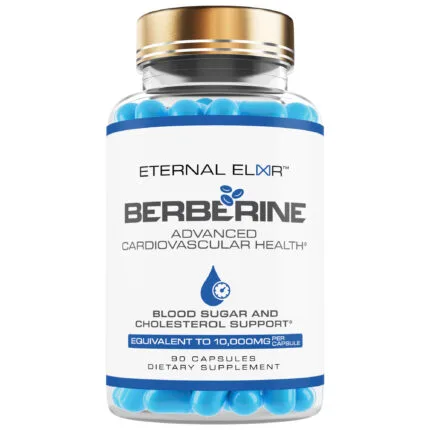
Eternal Elixir Berberine HCl 500mg contains 500mg of berberine HCl per capsule, 90 capsules to a bottle, for $49.99. That is $0.56 a capsule. The label serve is one capsule a day on an empty stomach, or as directed by your doctor, which gives 90 serves per bottle. The trials above used 1,000mg to 1,500mg a day with meals, so talk to your doctor about the right amount for you and follow the label. Orders over $100 ship free from Sydney.
Add Berberine HCl 500mg to cart · $49.99For how our berberine compares with others sold in Australia, see our berberine comparison. If you take prescription medicines, read our guide to berberine drug interactions first. You can also browse the full Eternal Elixir range.
Berberine Timeline: Frequently Asked Questions
How long does berberine take to work for blood sugar?
Fasting blood glucose started to fall from the first week in one uncontrolled study, and placebo-controlled trials judged the result at three to four months. HbA1c needs about three months to reflect a change.
How long does berberine take to lower cholesterol?
The lipid trials ran for 4 to 24 weeks, and a blood test after about three months is a sensible first check. The average drop in LDL cholesterol against placebo was 0.46 mmol/L, which is small.
How long does berberine take to work for weight loss?
The trials that measured waist size lasted about 12 to 16 weeks or longer and found modest changes, averaging 3.27 cm off the waist compared with placebo. Berberine works best alongside changes to diet and activity.
Will I feel berberine working?
Probably not. Berberine doesn’t give an energy hit or a feeling you can notice. The changes the trials measured were in blood tests. The most common thing people feel is stomach upset in the first weeks.
Why am I not seeing results after four weeks?
Four weeks is early for HbA1c, cholesterol and waist size, which trials judged at three months or later. Check that you are taking it every day as the label directs, and review your diet and activity. If nothing has changed on a blood test at three months, talk to your GP.
Can I take berberine with metformin?
Only with your doctor’s advice. Both lower blood glucose, so together they could push it too low. Never change a prescribed medicine because you have started a supplement.
How long can you take berberine for?
Most trials lasted one to six months, and longer-term safety data is limited. Don’t take berberine if you are pregnant or breastfeeding, and check with your doctor before long-term use.
The Bottom Line
Berberine is slow, and it is measured in blood tests, not felt. Glucose readings may shift within weeks, while HbA1c, cholesterol, triglycerides and waist size need about three months of steady daily use before a fair judgement. Get a baseline test, take it consistently, and retest at three months. If you want to try it, our pick is Eternal Elixir Berberine HCl 500mg.
More berberine reading: berberine research in women.
Sources
- Yin J, Xing H, Ye J. Efficacy of berberine in patients with type 2 diabetes mellitus. Metabolism. 2008;57(5):712-717. PubMed 18442638
- Zhang Y, Li X, Zou D, et al. Treatment of type 2 diabetes and dyslipidemia with the natural plant alkaloid berberine. Journal of Clinical Endocrinology & Metabolism. 2008;93(7):2559-2565. PubMed 18397984
- Ming J, Yu X, Xu X, et al. Effectiveness and safety of Bifidobacterium and berberine in human hyperglycemia and their regulatory effect on the gut microbiota. Genome Medicine. 2021;13:125. PubMed 34365978
- Wang J, Bi C, Xi H, Wei F. Effects of administering berberine alone or in combination on type 2 diabetes mellitus: a systematic review and meta-analysis. Frontiers in Pharmacology. 2024;15:1455534. PubMed 39640489
- Blais JE, Huang X, Zhao JV. Overall and sex-specific effect of berberine for the treatment of dyslipidemia in adults: a systematic review and meta-analysis of randomized placebo-controlled trials. Drugs. 2023;83(5):403-427. PubMed 36941490
- Liu D, Zhao H, Zhang Y, et al. Efficacy and safety of berberine on the components of metabolic syndrome: a systematic review and meta-analysis of randomized placebo-controlled trials. Frontiers in Pharmacology. 2025;16:1572197. PubMed 40740996
- Blöcher JA, Meyer-Tönnies MJ, Morof F, et al. Sex-dependent effects of CYP2D6 on the pharmacokinetics of berberine in humans. Clinical Pharmacology & Therapeutics. 2025;117(1):250-260. PubMed 39488825
- Lee YS, Kim WS, Kim KH, et al. Berberine, a natural plant product, activates AMP-activated protein kinase with beneficial metabolic effects in diabetic and insulin-resistant states. Diabetes. 2006;55(8):2256-2264. PubMed 16873688
- Eternal Elixir product page: Berberine HCl 500mg.