Last updated: November 1, 2026 · Originally published: August 12, 2025 · By Eternal Elixir Editorial
Methylene blue capsules are sold for energy, mood and focus because of what methylene blue does inside mitochondria, the part of the cell that makes energy. First made in 1876 as a dye, the compound is now studied for how it moves electrons in brain cells. The honest summary: the mechanism is well described in lab and animal work, a few small human trials have used doses far higher than one capsule, and no trial has tested a 10 mg daily capsule for focus or mood. This guide covers what the research shows, what it doesn’t, and how to take a capsule safely.
Unlike many supplement ingredients that work through indirect pathways, methylene blue interacts directly with the electron transport chain, the process that generates adenosine triphosphate (ATP), the cell’s energy currency. It can accept and donate electrons at the points where energy production happens, acting as a shuttle for the electrons that power brain and body cells. Most of what is known about this comes from cell and animal studies, and human data are limited.
What does this mean if you’re thinking of trying capsules? Take the label dose, one capsule a day. Keep a short weekly note of your energy, sleep and mood so you can judge for yourself whether it helps. Stop and talk to your doctor if anything feels wrong, and check with them first if you take any prescription medicine.
Table of contents
Quick Summary
The mechanism is well described, but the human evidence for focus and mood comes from a few small trials at 195 mg a day or a single 280 mg dose, not 10 mg. Our capsules contain 10 mg each, 60 per bottle, taken one a day. Methylene blue is not for anyone on serotonergic medicines, anyone with G6PD deficiency, or during pregnancy or breastfeeding. Expect blue or green urine.
What Is Methylene Blue?
Methylene blue is a small-molecule organic compound with a distinctive chemical structure that lets it take part in many chemical reactions in the body. Formally known as methylthioninium chloride, it is a cationic phenothiazinium dye capable of crossing the blood-brain barrier, a feature that distinguishes it from many other bioactive compounds aimed at brain health.
At the molecular level, methylene blue functions as a redox-active molecule. This means it readily moves between oxidised and reduced forms, passing electrons between many chemical systems. In the brain and throughout the body’s cells, this electron-shuffling capacity is the property researchers study. Lab and animal work suggests low and high doses behave differently, so more is not automatically better.
The blue colour that characterises methylene blue is itself a consequence of its chemical structure. When reduced (in its leuco form), it becomes colourless, and when oxidised, it returns to blue. The colour change is a visible representation of the compound’s capacity to move electrons back and forth. It is the same electron transfer that researchers study in mitochondria.
Not sure which one fits you?
Finish the quiz for a free gift worth up to $44.99, plus a personal 20% code for your first order.
How Methylene Blue Supports Mitochondrial Energy
Mitochondria are the powerhouses of cells, and their main function is to convert nutrients and oxygen into usable energy in the form of ATP. This process involves a series of enzyme complexes (numbered I through IV) that form the electron transport chain. Each complex passes electrons along like a relay team until they reach the final station, where they combine with oxygen to form water. Along this path, the energy released pumps protons across the inner mitochondrial membrane, creating a gradient that drives ATP synthase, the enzyme responsible for making ATP itself.
When the electron transport chain runs well, energy production is efficient and cell respiration proceeds smoothly. With stress and ageing it can run less smoothly. Electrons may leak from the chain early and form reactive oxygen species (ROS), which adds to oxidative stress, or the early complexes can slow the whole energy-generating process.
Methylene blue can act as an alternative electron carrier, a bypass lane within the electron transport chain. In lab studies it takes electrons from NADH and passes them directly to cytochrome c, skipping the early complexes and increasing the activity of complex IV, while limiting oxidative stress (Tucker et al., 2018). It works alongside the existing machinery rather than replacing it. These findings come from cells and animals: they show a mechanism, not a measured energy boost in people.
That mechanism is why methylene blue is marketed for energy and focus. Brain cells use a lot of ATP, so supporting mitochondrial output is the theory behind the claims. Some users say they feel more alert and energised. That is anecdote rather than trial evidence, and no human study has measured ATP output after a 10 mg capsule.
Methylene Blue for Mood and Cognitive Performance
Human evidence is thin. The best-known trial is a randomised, double-blind crossover study published in the British Journal of Psychiatry (Alda et al., 2017). It enrolled 37 patients who were already on prescription medication under psychiatric care and compared 195 mg of methylene blue a day with a 15 mg dose used as the placebo. Mood rating scores improved on 195 mg; the effect on cognitive tests was not significant. It was a medical trial in a patient group at many times the dose in one of our capsules, so it does not tell you what a 10 mg supplement does in a healthy adult.
Researchers point to several mechanisms that could affect mood. Beyond its effect on energy production in neurons, the compound acts as a potent, reversible monoamine oxidase (MAO) inhibitor. This action preserves brain chemicals like serotonin, dopamine, and noradrenaline in synaptic spaces longer, amplifying their signalling effects. Also, methylene blue inhibits nitric oxide synthase and guanylate cyclase, enzymes involved in inflammation and stress-response paths within the nervous system. The MAO effect is also why methylene blue must never be combined with serotonergic medicines (see the safety section below).
For memory and attention, most of the work is in animals, where methylene blue has supported memory and the growth of new neurons in the hippocampus (Tucker et al., 2018). The main human study is a randomised, placebo-controlled brain-imaging trial in 26 healthy adults (Rodriguez et al., Radiology, 2016). One hour after a single 280 mg dose, brain activity rose during attention and short-term memory tasks, and correct answers during memory retrieval rose by 7%. That is one small trial of one dose, many times the amount in a capsule.
Users often describe sharper attention and better focus on complex tasks. Those reports fit the mechanism, but they are self-reported and have not been tested at supplement doses.
Dosage Considerations for Methylene Blue Capsules
One of the most important points with methylene blue is its hormetic dose-response curve. In lab and animal studies, low and high doses have different, sometimes opposite, effects. More is not better.
There is no agreed supplement dose from human trials. The studies above used 195 mg a day and a single 280 mg dose under medical supervision; supplements contain far smaller amounts. Our label direction is one capsule (10 mg) a day. Don’t take more than the label says, and don’t work out your own dose from body weight.
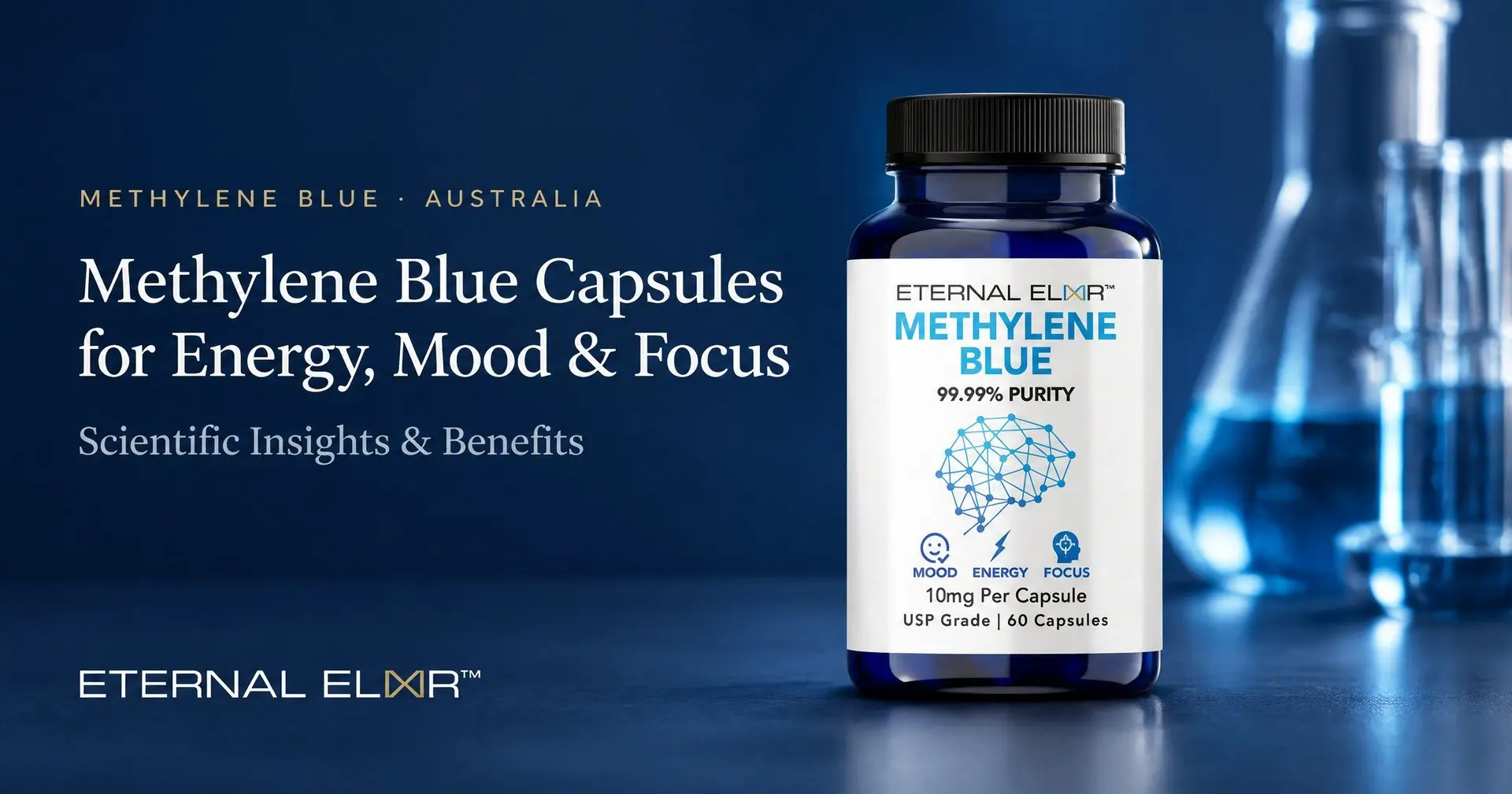
Eternal Elixir Methylene Blue Capsules contain 10mg per capsule and 60 capsules per bottle. At $59.99 per bottle, the cost is about $1.00 per 10mg capsule.
Timing can also matter. Some people find that taking methylene blue in the morning supports daytime alertness and focus, while others take it after lunch. Keep to one capsule a day and choose the time that suits you; if it affects your sleep, take it earlier in the day.
Safety and Side Effects
In the trials above, side effects at the doses used were mild and short-lived. That does not make methylene blue suitable for everyone, and the exclusions below matter more than the side effects.
The most common effect is cosmetic: urine can turn blue or green, and liquid forms can stain the tongue or fingers. This comes from the dye itself.
One interaction needs careful attention. Methylene blue is a monoamine oxidase inhibitor. Combined with serotonergic medicines, including selective serotonin reuptake inhibitors (SSRIs), SNRIs and monoamine oxidase inhibitor (MAOI) antidepressants, it can cause serotonin syndrome, a potentially serious reaction to too much serotonergic activity. Do not take methylene blue with these medicines.
If you take any prescription medicine, especially antidepressants, talk to your doctor before starting methylene blue. Do not take it if you have glucose-6-phosphate dehydrogenase (G6PD) deficiency, as it can cause haemolysis in people with this condition. It is also not for use during pregnancy or breastfeeding, or by anyone under 18.
Eternal Elixir’s Methylene Blue Safety Guide covers contraindications and interactions in more detail.
Not sure which one fits your routine? Answer a few quick questions and see the product that suits your goals, with its label serve and cost per day.
Finish it for a free gift worth up to $44.99 and a personal 20% code for your first order: unique to you, one use, valid 48h.
Find my routine + free giftFrequently Asked Questions
Can methylene blue caps improve focus?
It might, but the evidence is limited. In one small trial, a single 280 mg dose raised brain activity during attention and memory tasks and lifted correct answers during memory retrieval by 7% (Rodriguez et al., 2016). The proposed reasons are support for ATP production in neurons and slower breakdown of dopamine and noradrenaline. No trial has tested a 10 mg daily capsule for focus, so judge it on how you respond over a few weeks at the label dose.
What dose of methylene blue is used for cognitive support?
There is no established supplement dose. Human studies used 195 mg a day or a single 280 mg dose under medical supervision. Our capsules contain 10 mg each, and the label direction is one capsule a day; don’t exceed it. Talk to your doctor before starting if you take any prescription medicine.
Are there any side effects of methylene blue supplement use?
The most common effect is blue or green urine, which is harmless and stops after you stop taking it. In trials, side effects were mild and short-lived. The serious risk is an interaction: taken with SSRIs, SNRIs, MAOIs or other serotonergic medicines, methylene blue can cause serotonin syndrome. Anyone taking antidepressants or other psychiatric medicines should talk to their doctor first.
Related Reading
- The Methylene Blue Bible: Optimising Mitochondrial Energy and Cognitive Performance
- Methylene Blue Liquid vs Capsules
Eternal Elixir is an Australian supplement company. Orders are dispatched in 1 business day, come with a 30-day money-back guarantee, and Afterpay is available.
Sources
- Oz M, Lorke DE, Hasan M, Petroianu GA. Cellular and molecular actions of methylene blue in the nervous system. Medicinal Research Reviews. 2011;31(1):93-117. PubMed 19760660
- Tucker D, Lu Y, Zhang Q. From mitochondrial function to neuroprotection: an emerging role for methylene blue. Molecular Neurobiology. 2018;55(6):5137-5153. PubMed 28840449
- Alda M, McKinnon M, Blagdon R, et al. Methylene blue treatment for residual symptoms of bipolar disorder: randomised crossover study. British Journal of Psychiatry. 2017;210(1):54-60. PubMed 27284082
- Rodriguez P, Zhou W, Barrett DW, et al. Multimodal randomized functional MR imaging of the effects of methylene blue in the human brain. Radiology. 2016;281(2):516-526. PubMed 27351678
For a side-by-side comparison of methylene blue products sold in Australia, see our guide to the best methylene blue supplements in Australia.