Last updated: November 1, 2026 · Originally published: October 30, 2026 · By Eternal Elixir Editorial
VO2 max and longevity are linked by some of the strongest observational data in preventive health: in large cohorts, the fittest people die at a fraction of the rate of the least fit, and low cardiorespiratory fitness carries a higher risk than many traditional risk factors. The catch is that VO2 max is mostly built by training, not by swallowing a pill. This guide covers what the evidence actually shows, the numbers behind it, how to raise your VO2 max safely, and where supplements genuinely fit.
Quick answer: VO2 max is the maximum rate at which your body can use oxygen during hard exercise, measured in ml/kg/min. Large observational studies link higher cardiorespiratory fitness with lower all-cause mortality, with no upper limit of benefit seen in the largest cohort. The dose that moves the needle is regular aerobic training plus one or two hard sessions a week, and most people can add 10 to 15% to their VO2 max in a few months with structured intervals. Eternal Elixir Cellular Longevity Stack is our pick for the cellular side of ageing that training cannot fully cover, and it is not a substitute for the training itself.
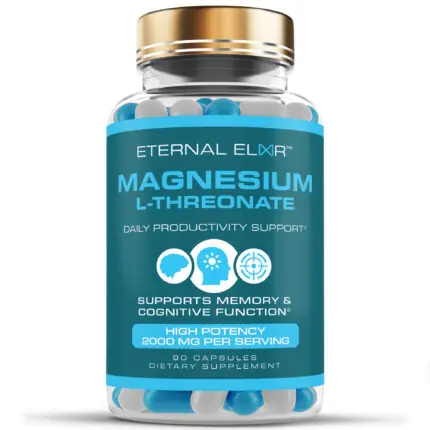
Eternal Elixir makes Magnesium L-Threonate; it is our pick here because recovery and sleep are the half of VO2 max training most people skip, and a consistent nightly magnesium L-threonate serve (2,000 mg per three capsules, A$59.99, $2.00 a day) is a practical anchor beside the training itself. We are upfront that it does not raise VO2 max. It supports the sleep side of recovery while you build the aerobic base.
Not sure which one fits you?
Finish the quiz for a free gift worth up to $44.99, plus a personal 20% code for your first order.
Table of contents
- 1. What VO2 max and longevity research actually shows
- 2. What VO2 max actually measures, and what counts as good
- 3. How to raise your VO2 max safely
- 4. Where Eternal Elixir Magnesium L-Threonate fits
- 5. High VO2 max populations, and runners versus strength athletes
- 6. VO2 max and longevity: frequently asked questions
- 7. The bottom line
What VO2 max and longevity research actually shows
If you already train easy cardio most days, our zone 2 training for longevity guide covers weekly minutes and talk-test cues. This page zooms out to VO2 max itself.
Start with the clearest study. Researchers analysed 122,007 adults who had been referred for treadmill exercise testing and followed them for a median of 8.4 years. Mortality fell steadily as measured fitness rose. The least fit group had the highest death rate, and the authors observed no upper limit of benefit, meaning the fittest people did best of all (Mandsager et al., JAMA Netw Open, 2018).
That is an observational association, so it shows that fitter people live longer on average. It does not prove that raising your own VO2 max adds years to your life, though the direction of the evidence is consistent. A second large cohort of 4,564 veterans found that each 1-metabolic-equivalent increase in exercise capacity was associated with a 12% reduction in mortality risk, after adjusting for age and other factors (Kokkinos et al., J Am Coll Cardiol, 2010).
Why does fitness track so tightly with lifespan? VO2 max is a composite measure.
It reflects how well your heart pumps, how dense your muscle mitochondria are, how efficiently your blood vessels deliver oxygen and how well your lungs exchange gases. When all of those systems are working well, the same physiology tends to protect against the chronic conditions that shorten life. Low fitness, by contrast, often sits alongside poor metabolic health, higher blood pressure and reduced activity.
The evidence level here is strong for the association and moderate for causation. We have decades of cohort data showing fitter people live longer. We have less direct trial evidence that a specific VO2 max increase produces a specific number of extra years, because running a randomised trial of exercise for decades is impractical. What we do have is consistent animal and human training data showing that aerobic exercise changes the biology of ageing in the expected direction.
What VO2 max actually measures, and what counts as good
VO2 max is expressed in millilitres of oxygen per kilogram of body weight per minute (ml/kg/min). A higher number means your body can use more oxygen during maximal effort. Elite male endurance athletes often score in the 70s or 80s. Healthy untrained adults typically sit far lower, and the range varies widely by age and sex.
Michael Phelps reportedly recorded a VO2 max in the low 70s, and cross-country skiers and cyclists routinely exceed 80. You do not need an elite number to benefit. The mortality data shows benefit at every step up the fitness ladder, so moving from the bottom quartile to the middle is meaningful even if you never approach athlete territory.
A rough guide for untrained adults: a VO2 max in the 30s for men and high 20s for women in midlife is around average. Anything above 40 for a man or 35 for a woman in their 40s is above average. These are approximations, because lab protocols and wearable estimates differ. The trend over time matters more than a single reading.
How VO2 max changes with age
VO2 max declines with age in almost everyone, typically by around 1% a year after about age 30, and faster after 60. The decline is not inevitable at that rate. People who keep training hard maintain a much higher share of their peak, and masters athletes in their 60s and 70s routinely score well above sedentary peers half their age. That is one of the most encouraging findings in the field: the slope of decline is partly a choice.
How to raise your VO2 max safely
The training that raises VO2 max is well established. Sustained moderate aerobic work builds the base, and high-intensity intervals produce the largest gains per unit of time. A review of training studies found that interval training generally lifts VO2 max more than continuous training at matched volume, and that the intensity of the work is the main driver of adaptation (MacInnis and Gibala, J Physiol, 2017).
A practical weekly structure looks like this: two or three easy aerobic sessions of 30 to 60 minutes at a conversational pace, one or two interval sessions of four to six hard efforts lasting two to four minutes with recovery between, and two strength sessions. The easy work builds the aerobic engine and the intervals push the ceiling. Together they cover the 150 to 300 minutes of moderate activity a week that public health guidelines recommend.
Progress takes weeks to months, not days. Most people who train consistently see measurable gains in eight to twelve weeks. Track something simple, such as your pace at a fixed heart rate on the same route, rather than chasing a wearable number that jumps around with sleep, hydration and heat.
| Training approach | Weekly structure | Expected VO2 max effect | Who it suits |
|---|---|---|---|
| Base building only | 4 to 5 easy sessions of 40 to 60 minutes | Modest gains, strong aerobic foundation | Beginners, people returning from injury |
| Base plus intervals (our recommendation) | 3 easy sessions plus 1 to 2 interval sessions | Largest gains for time invested | Most healthy adults with a training history |
| High-volume endurance | 8 to 12 sessions a week, mostly easy | Large gains, high time cost | Experienced athletes with recovery capacity |
If you are new to hard training, build the easy base for four to six weeks before adding intervals. Check with your GP first if you have a heart condition, high blood pressure or joint problems, and never add intensity and volume in the same week.
Where Eternal Elixir Magnesium L-Threonate fits
Training is the primary lever for VO2 max, and no supplement replaces it. What helps is protecting the recovery half of the week so you can repeat the sessions. Eternal Elixir Magnesium L-Threonate is our primary pick: 2,000 mg of magnesium L-threonate per three-capsule serve (about 144 mg of elemental magnesium), 90 capsules per bottle and 30 serves at A$59.99, which works out to $2.00 a day.
The evidence is early but relevant to sleep quality. In a 21-day randomised, double-blind, placebo-controlled trial, 80 adults aged 35 to 55 with self-reported sleep problems took 1 g a day of magnesium L-threonate or placebo. The magnesium group kept good sleep quality and daytime functioning while the placebo group declined, and it scored better on ring-tracked deep and REM sleep (Hausenblas et al., Sleep Med X, 2024). Three authors are affiliated with the ingredient supplier and the studied dose differs from our 2,000 mg serve, so read it as a promising signal rather than settled science.
No trial has tested magnesium L-threonate on VO2 max directly, so we position it for sleep quality beside training, not as a performance booster. Take three capsules daily with a meal; the evening meal suits most people. Every batch is third-party lab tested for purity, the current batch certificate of analysis is available on request, and orders are dispatched in 1 business day.
Who it suits, and who it does not
It suits people doing three or more aerobic sessions a week whose sleep is the weak link, people who train in the evening and want a wind-down anchor, and anyone comfortable judging an early evidence base for themselves. It does not suit anyone expecting a sedative effect on night one or a shortcut around the training itself. Check with your GP first if you have kidney problems, take prescription medicines, or are pregnant or breastfeeding.
Saffron as the second option
If mood support matters to you as much as sleep, Eternal Elixir Saffron Extract is the secondary choice: 30 mg of affron per capsule, one capsule daily with a meal, 90 serves at A$49.99, or $0.56 a day. In a 28-day randomised trial, 63 adults aged 18 to 70 with self-reported poor sleep took 14 mg twice daily, and saffron improved sleep-quality ratings more than placebo (Lopresti et al., J Clin Sleep Med, 2020). The extract maker funded the trial, and its twice-daily dose differs from our once-daily serve.
Recovery supports compared by cost per day
| Option | Price (as of Oct 2026) | Pack / serves | Focus | Who it suits | Buy |
|---|---|---|---|---|---|
| Eternal Elixir Magnesium L-Threonate (our pick) | $59.99 | 90 capsules, 30 serves | Sleep quality beside training | People building an aerobic base whose nights are the weak link | View Magnesium L-Threonate |
| Eternal Elixir Saffron Extract | $49.99 | 90 capsules, 90 serves | Mood and sleep ratings | People who want mood support with sleep | View Saffron |
| Eternal Elixir Korean Panax Ginseng | $44.99 | 90 capsules | Daytime vitality support | People who prefer a daytime botanical | View Ginseng |
Add Magnesium L-Threonate to cart · $59.99
For the wider picture on ageing habits, see our healthy ageing guide and our grip strength and longevity guide. If evenings feel restless after hard sessions, start with how to get more deep sleep.
High VO2 max populations, and runners versus strength athletes
Norwegians and other Nordic populations often post high VO2 max values, and the reason is cultural rather than genetic. Cross-country skiing, cycling and outdoor endurance sport are embedded in daily life from childhood, so aerobic capacity is built over decades. The Norwegian training model, popularised by researchers such as Stephen Seiler, also formalised the 80/20 split: about 80% of training at low intensity and 20% hard (Seiler, Int J Sports Physiol Perform, 2010).
That pattern is a useful template for anyone. Most of your week should be easy enough to hold a conversation. A small share should be genuinely hard. The population-level numbers reflect lifetimes of that habit, not a secret supplement.
Do runners live longer than bodybuilders?
The short answer is that endurance training tends to produce higher VO2 max and stronger mortality associations, while resistance training matters for muscle mass, bone density and metabolic health. Neither should replace the other. A 2022 study of over 400,000 US adults found that aerobic activity and muscle-strengthening activity were each associated with lower mortality, and doing both was associated with the lowest risk (Momma et al., Br J Sports Med, 2022).
So the runner-versus-bodybuilder framing misses the point. The best longevity profile is a mix: enough aerobic work to keep VO2 max high, enough strength work to keep muscle and bone, and enough recovery to sustain both. Our guide on magnesium for brain health covers one recovery angle, and our berberine guide covers the metabolic side that training also influences.
VO2 max and longevity: frequently asked questions
Is VO2 max the biggest predictor of longevity?
It is one of the strongest single predictors found in observational data. In the 122,007-person cohort, low fitness carried a higher mortality risk than many traditional risk factors, and the fittest group did best with no upper limit of benefit seen. That does not make it the only predictor, because diet, sleep, smoking and strength all matter too, but cardiorespiratory fitness sits near the top of the list.
What is Michael Phelps’ VO2 max?
Reports put Michael Phelps’ VO2 max in the low 70s, which is high but not the highest recorded. Elite cross-country skiers and cyclists often exceed 80. The exact figure depends on the test protocol and when it was measured, so treat reported athlete numbers as indicative rather than precise.
Do runners live longer than bodybuilders?
Endurance training tends to produce higher VO2 max and stronger mortality associations, but the best profile combines aerobic and strength work. A large study of US adults found that doing both was associated with the lowest mortality risk, so the answer is not one or the other but both, with enough recovery to sustain the routine.
What are the benefits of a high VO2 max?
A high VO2 max reflects a heart, circulation and metabolism that work efficiently. In observational data it tracks with lower all-cause mortality, and practically it means everyday tasks and harder efforts feel easier. It reflects physiology that underpins healthy ageing; it is not a medical treatment for any condition.
Why do Norwegians have such high VO2 max?
Culture and training history, not genetics alone. Endurance sport is embedded in daily life from childhood, and the Norwegian training model formalised an 80/20 split of easy and hard work. Decades of that habit produce population-level fitness that reflects lifestyle rather than a secret ingredient.
What is a good VO2 max by age?
Rough guides for untrained adults: a VO2 max in the 30s for men and high 20s for women in midlife is around average, and above 40 for a man or 35 for a woman in their 40s is above average. Lab protocols and wearable estimates differ, so track your own trend over time rather than comparing a single reading to a chart.
The bottom line
VO2 max and longevity are linked by strong observational evidence: fitter people live longer on average, and the largest cohort saw no upper limit of benefit. The lever is training, specifically a base of easy aerobic work plus one or two hard interval sessions a week, sustained over months. Supplements do not raise VO2 max, but recovery support can help you repeat the sessions.
Eternal Elixir Magnesium L-Threonate is our pick for the sleep side of that job at A$59.99 ($2.00 a day), with saffron as the secondary option when mood support matters too. For the wider picture, see our zone 2 training for longevity guide.
Add Magnesium L-Threonate to cart · $59.99
Sources
- Mandsager K et al. Association of cardiorespiratory fitness with long-term mortality among adults undergoing exercise treadmill testing. JAMA Netw Open, 2018.
- Kokkinos P et al. Exercise capacity and mortality in black and white men. J Am Coll Cardiol, 2010.
- MacInnis MJ, Gibala MJ. Physiological adaptations to interval training and the role of exercise intensity. J Physiol, 2017.
- Seiler S. What is best practice for training intensity and duration distribution in endurance athletes? Int J Sports Physiol Perform, 2010.
- Momma H et al. Muscle-strengthening activities and risk of mortality among US adults. Br J Sports Med, 2022.
Comparing NAD+ and longevity supplements? Answer a few quick questions and see the product that suits your goals, with its label serve and cost per day.
Finish it for a free gift worth up to $44.99 and a personal 20% code for your first order: unique to you, one use, valid 48h.
Find my routine + free gift