Last updated: September 27, 2026 · Originally published: March 21, 2026 · By Eternal Elixir Editorial
Quick answer: Fadogia agrestis is a West African shrub sold as a testosterone supplement, and the hype has run well ahead of the research. Every study of what it does to hormones was done in male rats. In those rats, a stem extract raised testosterone within five days, but 28 days at the same doses changed markers of testicular, liver and kidney function in ways the researchers called adverse. No clinical trial of fadogia agrestis in people had been published when we searched PubMed in September 2026. If you want a testosterone-support herb with placebo-controlled trials in people, tongkat ali is the better-studied choice. Our Tongkat Ali + Fadogia capsules are sold out and we don’t stock fadogia on its own, so our pick for the same goal is Eternal Elixir Tongkat Ali 200:1 Extract 2000mg.
Eternal Elixir makes Tongkat Ali 200:1 Extract 2000mg, and it is our recommendation in this article, so weigh that when you read it. Tongkat ali is a different plant from fadogia agrestis, and the studies behind it don’t tell you anything about fadogia. This article sets out what the fadogia research shows, what it doesn’t, and where the popular claims came from.
Table of contents
- 1. Fadogia agrestis at a glance
- 2. What is fadogia agrestis?
- 3. What does fadogia agrestis do? The animal research
- 4. Does fadogia agrestis actually increase testosterone in people?
- 5. What are the potential dangers of fadogia agrestis?
- 6. Where the hype came from: the 600mg dose
- 7. Tongkat ali or fadogia agrestis: which is better?
- 8. If you still want to try fadogia agrestis
- 9. The bottom line on fadogia agrestis
- 10. Frequently asked questions about fadogia agrestis
- 10.1. What does fadogia agrestis do to you?
- 10.2. Does fadogia agrestis actually increase testosterone?
- 10.3. What is better, tongkat ali or fadogia agrestis?
- 10.4. What are the potential dangers of fadogia agrestis?
- 10.5. Is fadogia agrestis safe to take long term?
- 10.6. Can women take fadogia agrestis?
- 11. Sources
Fadogia agrestis at a glance
- What it is: a small shrub in the coffee family (Rubiaceae) whose stem is used in traditional medicine in Nigeria and other parts of West Africa.
- What’s been studied: a water extract of the stem, given to male rats at 18, 50 and 100mg per kg of body weight.
- What happened in rats: testosterone and mating behaviour rose within five days (Yakubu 2005). Over 28 days, the same doses altered testicular function markers (Yakubu 2008) and disturbed liver and kidney cell membranes (Yakubu 2009).
- Human trials: none published. A PubMed search for “fadogia” returned 20 records in September 2026, and none was a trial in people.
- Product quality: when US researchers analysed 17 supplements claiming to contain fadogia agrestis, five had none of the plant’s marker compounds they could detect (Avula 2019).
What is fadogia agrestis?
Fadogia agrestis (sometimes listed as Vangueria agrestis) is a flowering shrub found in Nigeria and other parts of Africa. In Nigerian folk medicine the stem is used as an aphrodisiac, which is what the University of Ilorin team behind almost all of the published animal work set out to test. Researchers at the University of Mississippi note it is also used in traditional African medicine for pain.
Chemically, the stem extract contains alkaloids and saponins, with smaller amounts of anthraquinones and flavonoids (Yakubu 2005). Nobody has shown which compound, if any, is responsible for the effects seen in rats. That matters for buyers. Without a known active compound, there is nothing to standardise a supplement to, so two products that both say “fadogia agrestis 600mg” can contain quite different things.
What does fadogia agrestis do? The animal research
Three studies from the same Nigerian research group account for most of what is known. They used the same water extract of the stem and the same three doses in male rats.
| Study | Animals and dose | How long | What they found |
|---|---|---|---|
| Yakubu 2005, Asian Journal of Andrology | Male rats, 18, 50 or 100mg/kg a day | 5 days | Serum testosterone rose at all three doses, in a pattern that suggested more with higher doses. Mounting and intromission frequency rose. |
| Yakubu 2008, Journal of Ethnopharmacology | Male rats, 18, 50 or 100mg/kg a day | 28 days, then 10 days off | Changes in testicular enzymes, cholesterol and protein at every dose. The authors called these “indications of adverse effects” on testicular function. Rats recovered on some measures, mainly at the lowest dose. |
| Yakubu 2009, Human & Experimental Toxicology | Male rats, 18, 50 or 100mg/kg a day | 28 days | No deaths or visible toxicity signs, but enzyme patterns and higher blood malondialdehyde suggested damage to liver and kidney cell membranes. |
The short version: in rats, fadogia agrestis did raise testosterone quickly, and it also changed the testes, liver and kidneys over a month. The authors of the 2008 paper suggested that the lowest dose, the one closest to folk use, did not cause permanent damage, because the rats recovered on some measures after ten days off.
Rat results don’t carry over to people in a straight line. Rats handle plant compounds differently, the doses are given per kilogram of body weight, and a five-day hormone rise says nothing about what happens to a man over weeks or months. These studies are a reason to be careful, not proof that fadogia works in people.
Does fadogia agrestis actually increase testosterone in people?
Nobody knows, because nobody has published a trial. We searched PubMed for “fadogia” in September 2026. It returned 20 records: the rat studies above, chemistry papers, a supplement quality analysis, ethnobotany surveys, veterinary reports on related Fadogia species that poison livestock, and a 2023 rat study. None tested fadogia agrestis in people.
What you will find online instead are personal reports, forum threads and podcast mentions. Some men say they feel a difference, and some say they notice nothing. Reports like these can’t separate the herb from the placebo effect, from other supplements taken at the same time, or from changes in sleep, training and diet. Until someone runs a controlled trial, any claim that fadogia raises testosterone in men by a given amount is a guess.
What are the potential dangers of fadogia agrestis?
The main concern is the one the rat studies raise. The same doses that increased testosterone over five days produced adverse changes in testicular function over 28 days, along with signs of stress on liver and kidney cell membranes. We don’t know whether the same would happen in people, at what dose, or after how long.
The second concern is what is in the bottle. In a 2019 analysis from the University of Mississippi, 12 of 17 supplements claiming to contain fadogia agrestis had detectable amounts of the plant’s phenolic marker compounds, and five had none (Avula 2019). That doesn’t prove the five were fake, but it does mean you can’t assume a label is accurate.
Given the gaps, these groups should not take fadogia agrestis, and should talk to a doctor before any testosterone-support supplement:
- anyone under 18
- anyone who is pregnant or breastfeeding
- men who are trying to conceive, since the rat studies found changes in testicular function
- anyone using testosterone or other hormone medicines, or any prescription medicine
- anyone with a liver or kidney condition
If you do take it and get blood tests through your GP, tell them what you are taking. For label doses and cycling questions, our fadogia agrestis dosage guide goes into detail.
Where the hype came from: the 600mg dose
Most people hear about fadogia agrestis from podcasts that pair it with tongkat ali. The best known is neuroscientist Andrew Huberman’s January 2023 episode on supplementation, where he said that at 600 milligrams a day “many people, not all, report” higher libido, sperm production and testosterone. In the same episode he said there is “a fairly extensive literature” showing fadogia “can be toxic to testicular cells” at very high doses, and he described cycling it, for example eight weeks on and two weeks off.
That is a fair summary of reports and animal data, not a trial result. The 600mg figure has since become the default on supplement labels, but no one has tested whether 600mg is effective or safe in people, and no cycling schedule has been studied. Treat the number as a convention.
Tongkat ali or fadogia agrestis: which is better?
On evidence, tongkat ali (Eurycoma longifolia) is well ahead. It has been tested in people in placebo-controlled trials, and fadogia has not.
| Tongkat ali | Fadogia agrestis | |
|---|---|---|
| Placebo-controlled trials in people | Yes, several | None published |
| Testosterone in men | A 2022 meta-analysis of five randomised trials found higher total testosterone with tongkat ali | Rats only |
| Longer-term safety data in people | 12-week trial with blood safety tests | None. 28-day rat studies found adverse changes |
| Known medicine interaction | Lowered absorption of propranolol in one study | Not studied |
The tongkat ali studies worth knowing:
- Leisegang 2022 reviewed nine studies and pooled five randomised trials. Men who took tongkat ali had significantly higher total testosterone than those on placebo.
- Chinnappan 2021 gave 105 men aged 50 to 70 with low testosterone 100mg or 200mg a day of a standardised water extract (Physta), or a placebo, for 12 weeks. Total testosterone rose compared with placebo in both extract groups, and blood safety tests showed no clinically relevant changes. The study was funded by Biotropics Malaysia, which employs two of the authors.
- Talbott 2013 gave 63 moderately stressed adults (32 men, 31 women) a tongkat ali root extract or a placebo for four weeks. Salivary cortisol exposure was 16% lower and testosterone status 37% higher in the tongkat ali group.
- Salman 2010 found that in 14 healthy young men, 200mg of a water extract taken with the blood-pressure medicine propranolol cut the medicine’s absorption (AUC) by 29%. If you take prescription medicines, talk to your doctor first.
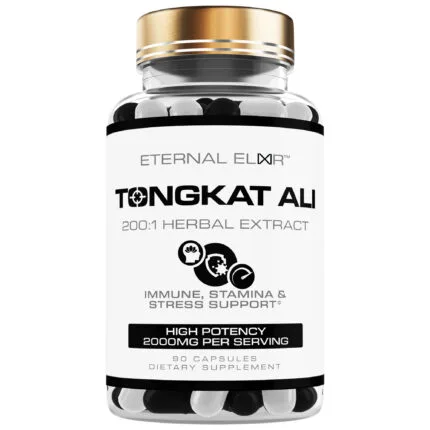
One caution about our own product. Those trials used standardised extracts at 100 to 200mg a day. Our Tongkat Ali is a 200:1 extract at 2,000mg per three-capsule serve, which is a different extract at a different amount, so the trial results don’t transfer to it directly. What it gives you is tongkat ali, the herb with human trials, in 90-capsule bottles.
Eternal Elixir Tongkat Ali 200:1 Extract 2000mg: 90 capsules, 30 serves of 2,000mg, $39.99 a bottle (down from $59.99), which is $1.33 a serve. The label says to take three capsules a day on an empty stomach. Two bottles save 10%, three save 15% and five save 20%. It ships from Sydney within 24 hours, with a 30-day money-back guarantee.
Who it suits: men who want testosterone and stamina support from the better-studied herb, in a bottle that lasts a month. Who it doesn’t suit: anyone who wants fadogia specifically, anyone on prescription medicines who hasn’t checked with their doctor, and anyone who doesn’t want to take three capsules a day.
Add Tongkat Ali 200:1 to cart · $39.99
For more on the herb itself, see tongkat ali benefits and the research and our comparison of the best tongkat ali supplements in Australia.
If you still want to try fadogia agrestis
Some readers will want to try fadogia regardless. If that is you, reduce the unknowns where you can:
- Pick a label that states the extract. Look for the plant part (stem), the extract ratio and the milligrams per capsule. Skip proprietary blends that hide the fadogia dose.
- Don’t go above the label dose. The rat studies found adverse changes at every dose tested over 28 days.
- Keep it short. No cycling schedule has been tested, so shorter use means less unknown exposure.
- Tell your GP. If you have blood tests, your doctor can decide what to check.
- Stop if you notice anything unusual and see a doctor.
We compare the fadogia products sold in Australia, with prices and doses, in our best fadogia agrestis supplements in Australia guide. For how fadogia fits into the popular tongkat ali stack, see our guide to tongkat ali and fadogia, and for sleep, training and diet first, our step-by-step testosterone protocol for men over 35.
The bottom line on fadogia agrestis
Fadogia agrestis raised testosterone in rats within days and harmed testicular function markers in rats within a month. It has never been tested in a published human trial, and some supplements sold as fadogia don’t contain detectable amounts of the plant’s marker compounds. Tongkat ali has the human trials that fadogia lacks, which is why it is our pick for the same goal. For more options for men, see our roundup of the best supplements for men over 40 in Australia or browse the full Eternal Elixir range.
Frequently asked questions about fadogia agrestis
What does fadogia agrestis do to you?
Nobody knows for certain in people, because it hasn’t been tested in a published human trial. In male rats, a stem extract raised testosterone and mating behaviour within five days, and over 28 days the same doses changed markers of testicular, liver and kidney function in ways the researchers called adverse.
Add Tongkat Ali 200:1 to cart · $39.99
Does fadogia agrestis actually increase testosterone?
It did in rats. In people there is no published trial, only personal reports, so any figure for how much it raises testosterone in men is unproven. Tongkat ali, by contrast, raised total testosterone compared with placebo in a 2022 meta-analysis of five randomised trials.
What is better, tongkat ali or fadogia agrestis?
On the evidence, tongkat ali. It has placebo-controlled trials in people, including a 12-week study in 105 men aged 50 to 70, while fadogia has only rat studies. Tongkat ali can lower the absorption of some medicines, so check with your doctor if you take any.
What are the potential dangers of fadogia agrestis?
In rats, 28 days at every dose tested produced adverse changes in testicular function and signs of stress on liver and kidney cell membranes. Human safety data doesn’t exist. Product quality is another risk: five of 17 supplements in one analysis had no detectable fadogia marker compounds. Don’t take it if you are under 18, pregnant, breastfeeding, trying to conceive or taking hormone or prescription medicines without talking to your doctor.
Is fadogia agrestis safe to take long term?
There is no evidence either way in people. The longest studies ran for 28 days in rats and found adverse changes, and no cycling schedule has been tested. If you choose to take it, keep to the label dose, keep the course short and tell your GP.
Can women take fadogia agrestis?
It has not been studied in women or in female animals. All the hormone research was done in male rats, so there is no basis for recommending it to women, and it should not be taken during pregnancy or breastfeeding.
Sources
- Yakubu MT, Akanji MA, Oladiji AT. Aphrodisiac potentials of the aqueous extract of Fadogia agrestis (Schweinf. Ex Hiern) stem in male albino rats. Asian J Androl. 2005;7(4):399-404. PubMed 16281088
- Yakubu MT, Akanji MA, Oladiji AT. Effects of oral administration of aqueous extract of Fadogia agrestis (Schweinf. Ex Hiern) stem on some testicular function indices of male rats. J Ethnopharmacol. 2008;115(2):288-292. PubMed 18023305
- Yakubu MT, Oladiji AT, Akanji MA. Mode of cellular toxicity of aqueous extract of Fadogia agrestis (Schweinf. Ex Hiern) stem in male rat liver and kidney. Hum Exp Toxicol. 2009;28(8):469-478. PubMed 19755438
- Avula B, Bae JY, Raman V, et al. Quantification of phenolic compounds from Fadogia agrestis and dietary supplements using UHPLC-PDA-MS. Planta Med. 2019;85(2):145-153. PubMed 30170324
- Leisegang K, Finelli R, Sikka SC, et al. Eurycoma longifolia (Jack) improves serum total testosterone in men: a systematic review and meta-analysis of clinical trials. Medicina (Kaunas). 2022;58(8):1047. PubMed 36013514
- Chinnappan SM, George A, Pandey P, et al. Effect of Eurycoma longifolia standardised aqueous root extract (Physta) on testosterone levels and quality of life in ageing male subjects: a randomised, double-blind, placebo-controlled multicentre study. Food Nutr Res. 2021;65. PubMed 34262417
- Talbott SM, Talbott JA, George A, Pugh M. Effect of Tongkat Ali on stress hormones and psychological mood state in moderately stressed subjects. J Int Soc Sports Nutr. 2013;10(1):28. PubMed 23705671
- Salman SA, Amrah S, Wahab MS, et al. Modification of propranolol’s bioavailability by Eurycoma longifolia water-based extract. J Clin Pharm Ther. 2010;35(6):691-696. PubMed 21054461
- Huberman A. Developing a rational approach to supplementation for health and performance. Huberman Lab podcast, January 2023. hubermanlab.com
- PubMed search for “fadogia”, September 2026: pubmed.ncbi.nlm.nih.gov