Last updated: September 26, 2026 · Originally published: May 13, 2026 · By Eternal Elixir Editorial
Quick Answer
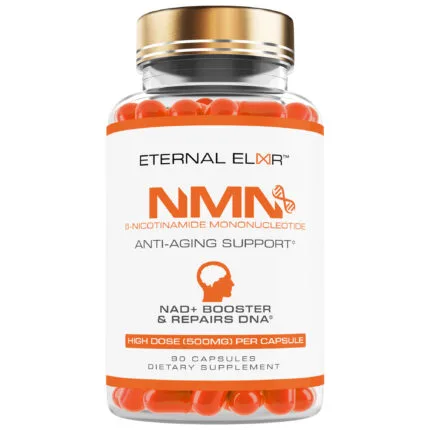
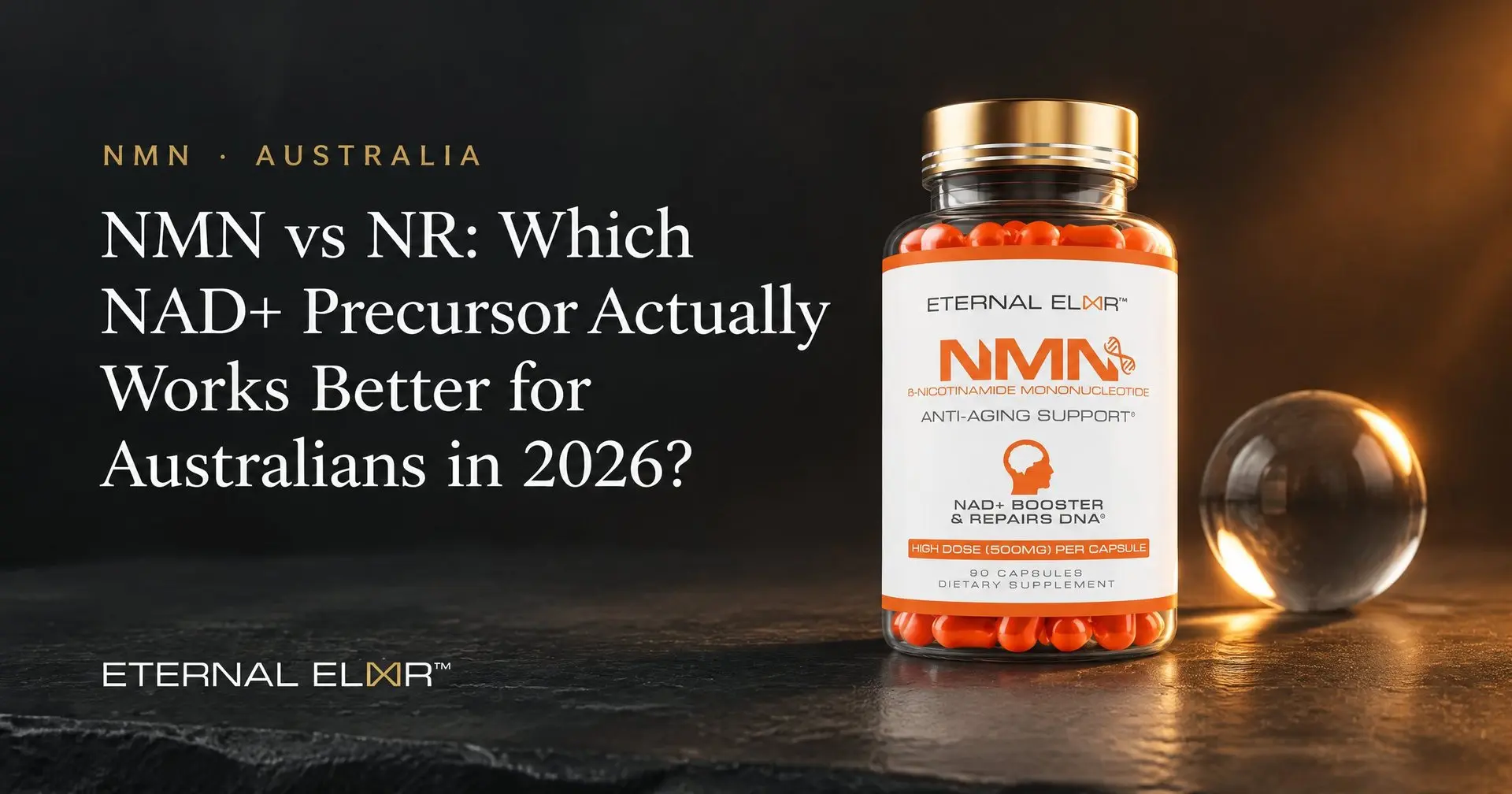
NMN and NR raise NAD+ about equally, and our pick is Eternal Elixir NMN 500mg. The only head-to-head human trial we found, published in 2026, gave healthy adults 1,000mg a day of NMN or NR for 14 days and found both raised blood NAD+ to a similar degree. NR has more trials overall. NMN has a dose-ranging trial whose doses bracket our 500mg capsule, with better walking-test results than placebo. Our NMN is 90 capsules for $59.99, one a day, which is $0.67 a day. If you’d rather have the ingredient with the longer trial record, our Pure NR 500mg is the same price.
Eternal Elixir makes both products, so read this as our pick with the working shown. Competitor prices were read from each live listing on 25 and 26 September 2026.
NMN (nicotinamide mononucleotide) and NR (nicotinamide riboside) are the two best-known NAD+ precursors, and they are sold to the same buyer with competing claims. NR’s makers point to its longer research record. NMN’s sellers point to its shorter route to NAD+. This guide sets out what human trials of NMN vs NR have actually measured, what each costs in Australia, and how to choose.
Table of contents
- 1. NMN vs NR at a Glance
- 2. What NAD+ Precursors Are
- 3. The Only Head-to-Head Trial
- 4. NMN in Human Trials
- 5. NR in Human Trials
- 6. NMN and NR Supplements in Australia Compared
- 7. Looking for an AgeMate Equivalent in Australia?
- 8. Our NMN and NR: What’s on the Label
- 9. Should You Take NMN or NR?
- 10. Can You Take NMN and NR Together?
- 11. Side Effects and Safety
- 12. Frequently Asked Questions
- 13. The Bottom Line
- 14. Sources
NMN vs NR at a Glance
| Factor | NMN | NR |
|---|---|---|
| Route to NAD+ | One step from NAD+ inside the cell | Converted to NMN first, then to NAD+ |
| Head-to-head result (2026) | Raised blood NAD+ | Raised blood NAD+ to a similar degree |
| Daily amounts in human trials | 250mg to 2,000mg | 100mg to 2,000mg |
| Longest-standing evidence | Dose-ranging and safety trials, mostly since 2021 | Dose, safety and physiology trials going back to the late 2010s |
| Muscle function in over-60s | No clear benefit in a 2025 meta-analysis | No clear benefit in the same meta-analysis |
| Eternal Elixir product | NMN 500mg, 90 capsules, $59.99 | Pure NR 500mg, 90 capsules, $59.99 |
The short version: in people, the route matters less than the marketing suggests. Both raise NAD+ in blood. Neither has been shown to slow ageing or to improve strength in older adults. The choice comes down to the evidence you find more convincing, the dose and the price.
What NAD+ Precursors Are
NAD+ (nicotinamide adenine dinucleotide) is a molecule every cell uses to turn food into energy and to run enzymes involved in cell maintenance. You can’t usefully swallow NAD+ itself, so supplements supply precursors that the body turns into NAD+. The main NAD precursors are forms of vitamin B3: nicotinic acid (niacin), nicotinamide, NR and NMN.
On paper NMN is one step closer to NAD+ than NR. In practice the picture is messier. The 2026 head-to-head trial found that NR and NMN taken by mouth seem to work partly through gut bacteria, which convert them to nicotinic acid, another NAD+ precursor, before the body builds NAD+ from it (Christen et al., Nature Metabolism, 2026). That would explain why the two perform so similarly in people.
The Only Head-to-Head Trial
Until 2026 there was no direct human comparison, and we found no other since. In the Christen trial, 65 healthy adults aged 18 to 50 (average age about 35) took 1,000mg of NR, 1,000mg of NMN, 500mg of nicotinamide or a placebo every day for 14 days. NR and NMN raised whole-blood NAD+ to a comparable degree. Nicotinamide only caused a short-lived rise after each dose. The trial was open-label, ran for two weeks and was run by Nestlé researchers, so it answers one narrow question well: both ingredients lift blood NAD+ by a similar amount at the same dose.
Add NMN 500mg to cart · $59.99NMN in Human Trials
- Dose-ranging. In a 60-day trial, 80 healthy middle-aged adults took 300mg, 600mg or 900mg of NMN a day or a placebo. All three doses raised blood NAD+, most at 600mg and 900mg, and walking distance in a six-minute test rose more than with placebo in every NMN group. No safety problems were found (Yi et al., GeroScience, 2023).
- Older men. In 42 men aged 65 and over, 250mg a day for up to 12 weeks raised blood NAD+. Gait speed and grip results were only “nominally” better, and body composition didn’t change (Igarashi et al., npj Aging, 2022).
- Safety. In 31 healthy adults aged 20 to 65, 1,250mg a day for four weeks caused no changes beyond normal variation in blood, urine and body measures (Fukamizu et al., Scientific Reports, 2022). The NMN supplier funded that study. A 2026 meta-analysis of 15 randomised trials, at 250mg to 2,000mg a day for 14 days to 24 weeks, found NMN did not increase adverse events or raise the liver enzymes ALT and AST (Yang et al., Nutrients, 2026).
For more, see our NMN dosage guide and our comparison of NMN vs NAD+ supplements.
NR in Human Trials
- Dose-response. In an eight-week trial of 140 healthy overweight adults, 100mg, 300mg and 1,000mg of NR a day raised whole-blood NAD+ by 22%, 51% and 142% within two weeks, and the rises held. There was no flushing, and adverse events didn’t differ from placebo (Conze et al., Scientific Reports, 2019).
- Middle-aged and older adults. In a six-week crossover trial in healthy adults aged 55 to 79, 500mg of NR twice a day was well tolerated and raised NAD+ metabolism. The authors suggested future trials look at blood pressure and arterial stiffness (Martens et al., Nature Communications, 2018).
- Muscle and metabolism. In 12 men aged 70 to 80, 1g a day for 21 days raised the NAD+ metabolome in muscle (Elhassan et al., Cell Reports, 2019). In 40 sedentary men aged 40 to 70 with a BMI above 30, 2,000mg a day for 12 weeks did not improve insulin sensitivity (Dollerup et al., American Journal of Clinical Nutrition, 2018).
A 2025 meta-analysis of randomised trials in adults with an average age over 60 found that neither NMN nor NR improved muscle mass, grip strength or gait speed, and concluded the evidence doesn’t support either for preserving muscle (Prokopidis et al., Journal of Cachexia, Sarcopenia and Muscle, 2025).
What hasn’t been shown
- Neither NMN nor NR has been shown to slow ageing or extend lifespan in people.
- Raising blood NAD+ is well established for both. Turning that into a benefit you can feel is not.
- Most trials ran for weeks to a few months. Long-term safety beyond that isn’t known.
NMN and NR Supplements in Australia Compared
Prices are as of Sep 2026, read from each listing. Cost per day uses each brand’s own serving size. Eternal Elixir makes the first two products and they are our picks. Every other row is described from its own listing.
| Product | Price (AUD) | Pack | Serve and dose | Cost per day | Buy |
|---|---|---|---|---|---|
| Eternal Elixir NMN 500mg (our pick) | $59.99 | 90 capsules | 1 capsule: NMN 500mg | $0.67 | Buy |
| Eternal Elixir Pure NR 500mg | $59.99 | 90 capsules | 1 capsule: NR 500mg | $0.67 | Buy |
| Bulk Nutrients NMN Capsules | $79.00 | 120 capsules | 1 to 2 capsules: NMN 500mg each | $0.66 at 1 a day | Bulk Nutrients |
| Bioglan NMN 500 | $42.49 | 30 capsules | 1 capsule: NMN 500mg | $1.42 | Chemist Warehouse |
| Naturecan NR | $72.00 | 90 capsules | 1 capsule: NR 300mg | $0.80 | Naturecan |
| Melrose FutureLab NAD+ Booster | $45.32 | 30 capsules | 1 capsule: NR chloride 300mg + DMG 150mg | $1.51 | Chemist Warehouse |
| Tru Niagen 300mg | $61.95 | 30 capsules | 1 capsule: NR chloride 300mg | $2.07 | Pharmacy Online |
| AgeMate Daily Longevity Blend | $79.00 (subscription) | 30 serves (powder) | 1 scoop: NMN 500mg + 14 other actives | $2.63 | AgeMate |
What the table shows:
- Our NMN and NR cost the same, $0.67 a day for 500mg, in 90-capsule bottles shipped from Sydney. Our NR is the cheapest NR per milligram in the table.
- Bulk Nutrients NMN costs about the same per 500mg ($0.66), and less if you buy four tubs at $67.00 each. Shipping is a flat $9.
- Bioglan NMN 500 is sold at Chemist Warehouse. Its listing says it isn’t recommended for more than 12 weeks.
- Tru Niagen is the NR brand behind much of the research (it supplied the NR in the head-to-head trial), and it is the dearest NR here per milligram. Melrose’s NAD+ Booster adds DMG to 300mg of NR, and Naturecan’s NR ships from the UK.
- AgeMate is a drink powder with 500mg of NMN plus 14 other actives, so it isn’t a like-for-like price comparison with a single-ingredient capsule.
For a wider comparison, see our guides to the best NMN supplements in Australia and the best NAD+ supplements in Australia.
Looking for an AgeMate Equivalent in Australia?
AgeMate’s Daily Longevity Blend is a powder: one 3.325g scoop gives 500mg of CellVive NMN alongside glycine (1.1g), magnesium citrate (300mg, which supplies about 46mg of magnesium), vitamin C, L-theanine and other ingredients. A single subscription is $79.00 for 30 serves, or $2.63 a serve, and the label says to use it daily for up to 12 weeks.
If what you want from AgeMate is the NMN, one of our NMN 500mg capsules gives the same 500mg for $0.67 a day. It won’t replace the other ingredients in the blend. If you want the drink format and the full mix, AgeMate is the product that does that. Our comparisons of Melrose FutureLab alternatives and Renue by Science alternatives cover other brands Australians compare.
Our NMN and NR: What’s on the Label
Both come in 90-capsule bottles, one capsule a day, preferably in the morning, and both ship from Sydney with free shipping over $100.
- NMN 500mg: 500mg of NMN per capsule. That sits between the 300mg and 600mg doses in the Yi trial, and half the 1,000mg used in the head-to-head trial.
- Pure NR 500mg: 500mg of NR per capsule. That is more than the 300mg in the other NR capsules in the table, and half the 1,000mg used in several NR trials, including the head-to-head.
The product pages offer 10% off two bottles, 15% off three and 20% off five. Three bottles of NMN at 15% off is $152.97 for 270 days, about $0.57 a day.
Should You Take NMN or NR?
- Choose NMN if you want a dose inside the range of the NMN dose-ranging trial, where every dose beat placebo on a walking test, and you like that a 2026 meta-analysis of 15 trials found no rise in adverse events or liver enzymes. This is our pick.
- Choose NR if you put more weight on the longer and larger body of NR research, including the 140-person dose-response trial.
- Either will raise blood NAD+ by a similar amount at the same dose, based on the head-to-head trial. Neither has been shown to make you feel or perform differently in the long run.
If you’re weighing NMN against other longevity ingredients, see spermidine vs NMN and Ca-AKG vs NMN. For format, see NMN powder vs capsules, and for a routine built around NMN, our longevity supplement stack guide.
Can You Take NMN and NR Together?
No trial has tested NMN and NR taken together. They feed the same pathway, and the head-to-head trial suggests both end up working through a common route in the gut, so taking both mostly means taking more of one thing. We don’t see a reason to double up: pick one and take it consistently. If you want to add something that works differently, spermidine or pterostilbene are the usual additions, and our Cellular Longevity Stack bundles NMN with both. Don’t buy our NMN separately on top of the stack, because it already contains it.
Side Effects and Safety
In the trials above, both were well tolerated at the doses tested:
- NMN: the 2026 meta-analysis found no increase in overall, serious or system-specific adverse events and no significant rise in the liver enzymes ALT and AST, across 250mg to 2,000mg a day for up to 24 weeks. A four-week study at 1,250mg a day found no changes beyond normal variation.
- NR: in the eight-week dose trial, adverse events at 100mg to 1,000mg a day didn’t differ from placebo, and there was no flushing, the skin reaction niacin can cause.
Pharmacy NMN labels in Australia, such as Bioglan’s, say not to use the product for more than 12 weeks. Neither NMN nor NR has long-term safety data in pregnancy, breastfeeding or under-18s, so avoid both in those groups, and talk to your doctor first if you take prescription medicines.
Frequently Asked Questions
Should I take NR or NMN?
Either raises blood NAD+ by a similar amount at the same dose, according to the only head-to-head trial we found. Our pick is NMN, because a dose-ranging trial brackets our 500mg capsule and a 2026 meta-analysis found no safety signal. Choose NR if you prefer its longer research record. Our NMN and NR are the same price.
Add NMN 500mg to cart · $59.99
Is it safe to take NR and NMN together?
No trial has tested them together, and we found no reported interaction. Because they feed the same pathway, taking both mostly adds up to a higher total dose of one thing. Pick one, keep to the label serve, and talk to your doctor if you take prescription medicines.
What are the downsides of taking NMN?
The main downside is uncertainty rather than harm. Trials show NMN raises blood NAD+ and is well tolerated for up to 24 weeks, but it hasn’t been shown to slow ageing, and a 2025 meta-analysis found no muscle benefit in over-60s. Long-term safety beyond six months isn’t known, and pharmacy labels advise 12 weeks or less.
Is NMN toxic to the liver?
Not in the trials so far. A 2026 meta-analysis of randomised trials found NMN at 250mg to 2,000mg a day for up to 24 weeks did not significantly raise the liver enzymes ALT or AST. Longer-term data don’t exist yet.
What is the best NAD+ precursor in Australia?
Our pick is Eternal Elixir NMN 500mg: 500mg per capsule, 90 capsules for $59.99, or $0.67 a day, shipped from Sydney. Eternal Elixir makes it. If you prefer NR, our Pure NR 500mg is the same price and the cheapest NR per milligram we compared. Bulk Nutrients’ NMN costs about the same per 500mg if you buy four tubs.
Where can I buy an NR supplement in Australia?
Our Pure NR 500mg ships from Sydney. Chemist Warehouse sells Melrose FutureLab’s NAD+ Booster, Pharmacy Online sells Tru Niagen, and Naturecan’s NR ships from the UK.
Add Pure NR 500mg to cart · $59.99
The Bottom Line
NMN vs NR is closer than the marketing on either side suggests. The only head-to-head trial found they raise blood NAD+ by a similar amount at the same dose. NR has the longer research record, and NMN has a dose-ranging trial and a 2026 safety meta-analysis behind it. Our pick is Eternal Elixir NMN 500mg at $0.67 a day, and our Pure NR 500mg is there at the same price if you prefer NR.
Sources
- Christen S, Redeuil K, Goulet L, et al. The differential impact of three different NAD+ boosters on circulatory NAD and microbial metabolism in humans. Nature Metabolism. 2026;8(1):62-73. PubMed 41540253
- Yi L, Maier AB, Tao R, et al. The efficacy and safety of β-nicotinamide mononucleotide (NMN) supplementation in healthy middle-aged adults: a randomized, multicenter, double-blind, placebo-controlled, parallel-group, dose-dependent clinical trial. GeroScience. 2023;45:29-43. PubMed 36482258
- Igarashi M, Nakagawa-Nagahama Y, Miura M, et al. Chronic nicotinamide mononucleotide supplementation elevates blood nicotinamide adenine dinucleotide levels and alters muscle function in healthy older men. npj Aging. 2022;8:5. PubMed 35927255
- Fukamizu Y, Uchida Y, Shigekawa A, et al. Safety evaluation of β-nicotinamide mononucleotide oral administration in healthy adult men and women. Scientific Reports. 2022;12:14442. PubMed 36002548
- Yang et al. Safety and metabolism-related outcomes of oral nicotinamide mononucleotide supplementation in adults: a systematic review and meta-analysis. Nutrients. 2026. PubMed 42514320
- Conze D, Brenner C, Kruger CL. Safety and metabolism of long-term administration of NIAGEN (nicotinamide riboside chloride) in a randomized, double-blind, placebo-controlled clinical trial of healthy overweight adults. Scientific Reports. 2019;9:9772. PubMed 31278280
- Martens CR, Denman BA, Mazzo MR, et al. Chronic nicotinamide riboside supplementation is well-tolerated and elevates NAD+ in healthy middle-aged and older adults. Nature Communications. 2018;9:1286. PubMed 29599478
- Elhassan YS, et al. Nicotinamide riboside augments the aged human skeletal muscle NAD+ metabolome and induces transcriptomic and anti-inflammatory signatures. Cell Reports. 2019;28:1717-1728. PubMed 31412242
- Dollerup OL, et al. A randomized placebo-controlled clinical trial of nicotinamide riboside in obese men: safety, insulin-sensitivity, and lipid-mobilizing effects. American Journal of Clinical Nutrition. 2018. PubMed 29992272
- Prokopidis K, Moriarty F, Bahat G, et al. The effect of nicotinamide mononucleotide and riboside on skeletal muscle mass and function: a systematic review and meta-analysis. Journal of Cachexia, Sarcopenia and Muscle. 2025;16(3):e13799. PubMed 40275690
- Eternal Elixir product pages (label facts, directions, multi-bottle pricing): NMN 500mg, Pure NR 500mg.
- Competitor listings, read on 25 and 26 September 2026: Bulk Nutrients NMN, Bioglan NMN 500 (Chemist Warehouse), Naturecan NR, Melrose FutureLab NAD+ Booster (Chemist Warehouse), Tru Niagen (Pharmacy Online), AgeMate Daily Longevity Blend.