Last updated: September 28, 2026 · Originally published: March 21, 2026 · By Eternal Elixir Editorial
Quick answer: NAD+ decline by age is real in some human tissues but smaller, patchier and less certain than most supplement marketing suggests. Small studies have found lower NAD+ in older people’s skin, brain, liver and blood, with differences ranging from about 10% to 20% in the brain to much larger gaps in skin. A 2026 study of 299 healthy blood donors aged 18 to 70 found no change in whole-blood NAD+ with age. There is no evidence-based age to start supplementing. The human trials of NAD+ precursors have mostly enrolled adults from their 40s upwards, and in them NMN and NR raised NAD+ in the blood.
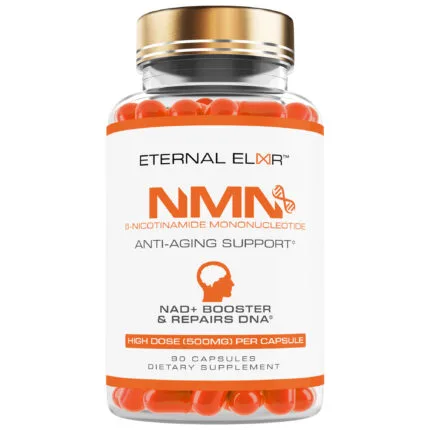
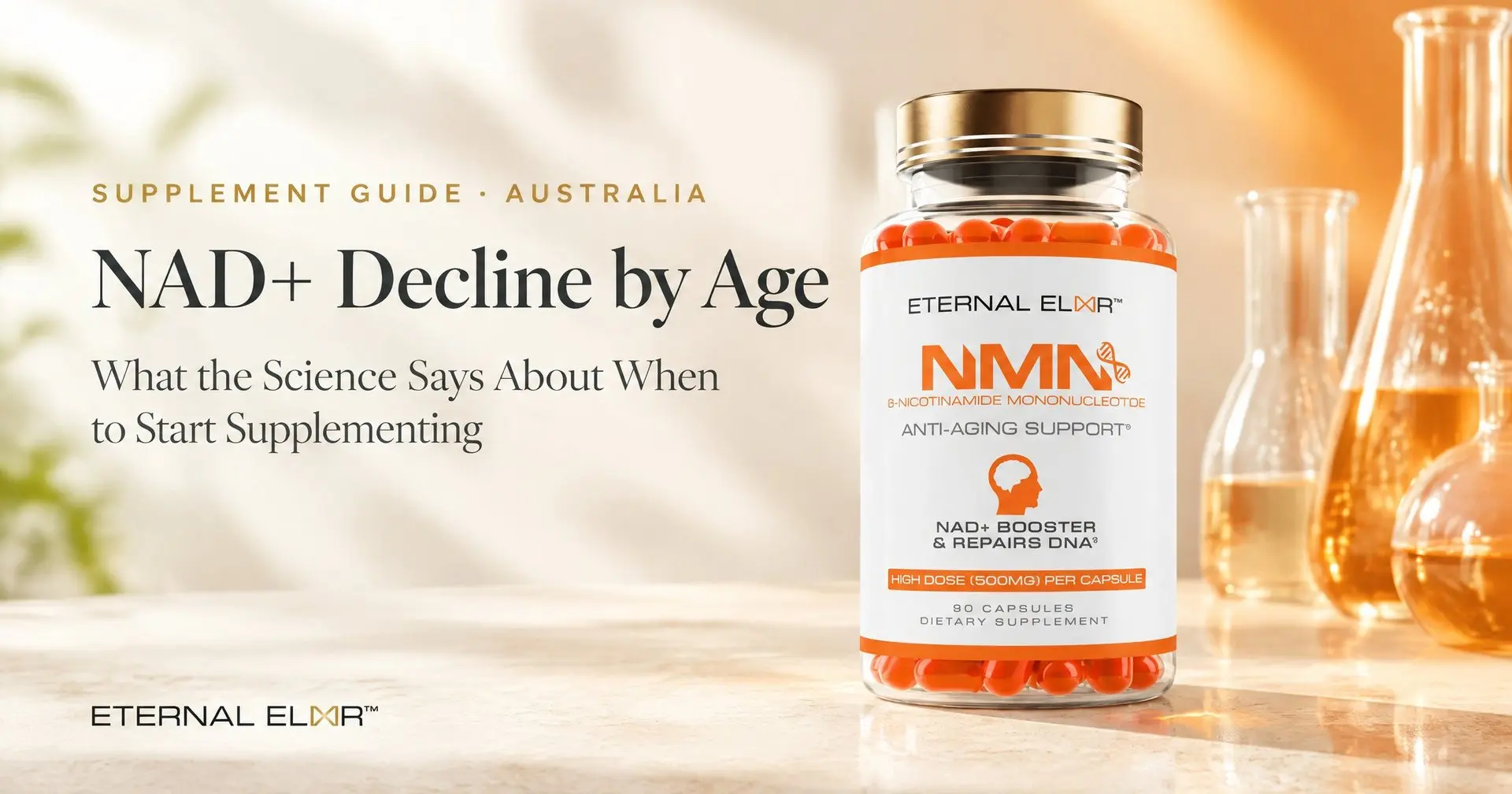
Our pick: if you want to raise your NAD+, Eternal Elixir NMN 500mg gives 500 mg of NMN in one capsule a day, 90 capsules to a bottle, at about $0.67 a day, shipped from Sydney within 24 hours. Eternal Elixir makes it, so read our recommendation with that in mind; the product comparison further down uses each seller’s own label.
Table of contents
- 1. How much does NAD+ fall with age? What human studies measured
- 2. NAD+ decline by decade: what the evidence supports
- 3. What else affects NAD+
- 4. So when should you start supplementing?
- 5. NMN vs NR: which NAD+ precursor?
- 6. How to raise NAD+ without supplements
- 7. How to take NMN or NR, and for how long
- 8. Safety
- 9. NAD+ and age: frequently asked questions
- 10. Sources
How much does NAD+ fall with age? What human studies measured
NAD+ (nicotinamide adenine dinucleotide) is a coenzyme every cell uses to turn food into energy, and enzymes such as the sirtuins and PARPs depend on it. The belief that it falls steadily with age comes mostly from animal work. In people, only a handful of small studies have measured it, and a 2022 review that pulled them together estimated the size of each difference (Peluso and colleagues, Nutrients):
| Where it was measured | Who was studied | Difference with age |
|---|---|---|
| Skin | 49 people aged from newborn to 77 | Lower with age in men and women; about 60% lower at 51 to 70 than at 30 to 50, with no further fall over 71 (only 5 people) |
| Cerebrospinal fluid | 70 people, split at age 45 | About 14% lower in the older group |
| Brain (scans) | 17 people aged about 20 to 60, and 16 people aged 26 to 78 | About 10% to 20% lower in the oldest in the first study; about 18% lower at 70 than at 25 in the second |
| Whole blood | 30 people, under 32 or over 75 | About 15% to 20% lower in the older group |
| Blood plasma | 19 people, aged 20 to 40 or 60 and over | About 80% to 90% lower in the older group, the largest gap reported, read from a published figure |
| Liver | 12 surgery patients, under 45 or over 60 | About 30% lower in the older group |
| Whole blood (2026) | 299 healthy blood donors aged 18 to 70 | No change with age |
Every one of these studies compared different people at one point in time, and most were tiny. The review’s authors concluded that the evidence for an overall fall in NAD+ with age “is very limited and often restricted to a single tissue or cell type”, especially in humans. The 2026 blood study, from a Helsinki team whose authors include co-founders of a blood NAD testing company, found NAD+ stayed level across ages 18 to 70 in healthy donors (Euro and colleagues, Redox Biology).
What about “NAD+ halves by middle age”?
You’ll often read that NAD+ drops by half between 40 and 60. We couldn’t find a human study that measured that. The large drops in the table come from skin, where the biggest fall was between young adulthood and middle age, and from one plasma study of 19 people. Brain and whole-blood studies found much smaller differences, and the largest blood study found none.
NAD+ decline by decade: what the evidence supports
- 20s and 30s: no study has defined a peak. Skin NAD+ was highest in newborns and already much lower in adults aged 30 to 50.
- 40s and 50s: brain and fluid studies suggest modest differences over these years. Nothing shows a sudden drop at a particular birthday.
- 60s and beyond: most human comparisons pit people over 60 or 75 against young adults, and several tissues were lower in the older groups, though the 2026 blood study found no difference up to 70.
Two people of the same age can differ more than two people decades apart, which is why the next section matters more than your birth year.
What else affects NAD+
- Fitness: in muscle samples from 57 people, NAMPT, the enzyme that recycles NAD+, was lower with age, and aerobic fitness (VO2 peak) was the best predictor of its level. Twelve weeks of training raised it in older adults by 28% with aerobic exercise and 30% with resistance training (de Guia and colleagues, 2019).
- DNA damage: PARP enzymes use up NAD+ when they respond to DNA damage. In the skin study, PARP activity rose with age in men and tracked lower NAD+ (Massudi and colleagues, 2012).
- Alcohol: breaking down alcohol converts NAD+ to its used form, NADH, in the liver.
- Illness: the 2026 blood study found different patterns of NAD and glutathione in several degenerative diseases than in healthy donors.
So when should you start supplementing?
There’s no evidence-based starting age, because no trial has tested NAD+ precursors by age group to see who benefits. What we do have is a set of short trials, mostly in middle-aged and older adults:
- NMN, ages 40 to 65: 80 healthy adults took placebo or 300 mg, 600 mg or 900 mg of NMN a day for 60 days. Blood NAD rose in every NMN group, walking distance in a six-minute test improved compared with placebo, and there were no safety issues (Yi and colleagues, 2023). One author works for an NMN manufacturer.
- NMN, older men: 250 mg a day for 6 or 12 weeks raised blood NAD+ compared with placebo, with small improvements in gait speed and grip that the authors say need larger studies to confirm (Igarashi and colleagues, 2022).
- NR, middle-aged and older adults: six weeks of NR was well tolerated and raised NAD+ metabolism compared with placebo (Martens and colleagues, 2018).
- NR, older men’s muscle: 12 men took 1 g of NR a day for 21 days. It raised markers of the NAD+ pathway in muscle but didn’t change how much energy their muscle mitochondria produced (Elhassan and colleagues, 2019).
In practice:
- Under 40 and healthy: there are no trials in your age group. Training, sleep and keeping alcohol low are the better-supported moves.
- 40 to 65: this is the age range the largest NMN trial studied, so the evidence applies most directly.
- Over 65: the trials in older men used 250 mg of NMN or 1 g of NR a day. Check with your doctor first, especially if you take regular medicines.
None of these trials showed that raising NAD+ slows ageing. They show that NMN and NR raise NAD+ markers in the blood over weeks, with some early and small functional signals. For more on dosing, see our NMN dosage guide and whether one 500mg capsule is enough.
NMN vs NR: which NAD+ precursor?
Both are NAD+ precursors derived from vitamin B3, and the body turns both into NAD+. NMN sits one step closer to NAD+ in the pathway, and NR one step further back. Each has raised blood NAD+ in placebo-controlled trials, and no large trial has compared them head to head, so neither has been shown to work better. Our full comparison is NMN vs NR, and if you’re weighing a precursor against NAD+ itself, read NMN vs NAD+.
NAD+ precursors in Australia compared
Prices as of Sep 2026, from each seller’s product page. Eternal Elixir makes NMN 500mg and Pure NR 500mg, and NMN is our pick; every figure for the other products comes from their own labels and listings.
| Product | Price | Capsules | Per capsule | Label serve | Cost per day | Bottle lasts | Buy |
|---|---|---|---|---|---|---|---|
| Eternal Elixir NMN 500mg (our pick) | A$59.99 | 90 | 500 mg NMN | 1 capsule, preferably in the morning | $0.67 | 90 days | View NMN |
| Eternal Elixir Pure NR 500mg | A$59.99 | 90 | 500 mg NR | 1 capsule, preferably in the morning | $0.67 | 90 days | View NR |
| Bulk Nutrients NMN Capsules | A$79.00 | 120 | 500 mg NMN | 1 to 2 capsules | $0.66 at 1 capsule | 120 days at 1 capsule | Bulk Nutrients |
| Tru Niagen 300mg (Pharmacy Online) | A$61.95 | 30 | 300 mg NR chloride | 1 capsule every morning | $2.07 | 30 days | Pharmacy Online |
Add NMN 500mg to cart · $59.99
At one capsule a day, Bulk Nutrients’ NMN costs a cent a day less than ours and its bottle lasts longer; it ships for a flat $9. Tru Niagen is the dearest per day and has the smallest dose per capsule, and Pharmacy Online ships free over $125. Where ours wins is a 500 mg capsule, one a day, from a 90-capsule bottle sent from Sydney within 24 hours with a 30-day money-back guarantee. For more NMN brands, see the best NMN supplements in Australia.
Suits you if you’re an adult in the age range the trials studied, want one capsule a day, and prefer a bottle that lasts three months.
Doesn’t suit you if you’re pregnant, breastfeeding or under 18, or you’re hoping a supplement will do the job of exercise and sleep.
How to raise NAD+ without supplements
- Train regularly, with both cardio and resistance work. In the study above, 12 weeks of either raised the NAD+ recycling enzyme in older adults’ muscle.
- Keep alcohol low, since your liver uses NAD+ to break it down.
- Protect your skin from the sun, because the enzymes that respond to UV damage in DNA use up NAD+.
- Eat enough protein and B3-containing foods, such as meat, fish, poultry and legumes, which supply the raw materials.
How to take NMN or NR, and for how long
Follow the label. Our NMN 500mg and Pure NR 500mg labels both say 1 capsule daily, preferably in the morning. The NMN trials used 250 mg to 900 mg a day, and the NR trials used up to 1 g, so one 500 mg capsule sits inside the studied range. Don’t take more than the label serve without talking to your doctor.
The trials lasted 3 to 12 weeks, so there’s little data on years of use. Our guide to whether NMN is safe long term covers what longer studies show. If you’re building a routine, how to build a complete longevity stack explains where NMN fits alongside resveratrol and spermidine, and pterostilbene vs resveratrol covers that choice. For more background, read our guide to NAD+ boosters.
Some people also pair NMN with methylene blue; our guide to stacking methylene blue with NMN covers it. Methylene blue is not for anyone taking SSRIs, SNRIs, MAOIs or other serotonergic medicines, because of the risk of serotonin syndrome, or for anyone with G6PD deficiency, who is pregnant or breastfeeding, or who is under 18. It can turn urine blue or green, and if you take any prescription medicine, talk to your doctor first.
Safety
- In the largest NMN trial, doses up to 900 mg a day for 60 days caused no safety issues, and the NR trials reported that it was well tolerated.
- Tru Niagen’s label says it isn’t recommended in pregnancy or breastfeeding, or for anyone 18 or under. We’d apply the same to NMN.
- If you take prescription medicines or have an ongoing medical condition, check with your doctor before starting.
You can browse the rest of our range in the Eternal Elixir shop.
NAD+ and age: frequently asked questions
At what age does NAD+ start to decline?
No human study has pinned down an age. Skin NAD+ was far lower in adults than in newborns, brain studies found about 10% to 20% lower levels between young adulthood and around 60 to 70, and a 2026 study of 299 healthy blood donors found no change in blood NAD+ between 18 and 70.
Should a 70 year old take NAD+?
It’s a decision to make with your doctor. Trials in older men found that 250 mg of NMN or 1 g of NR a day raised NAD+ markers without safety problems over a few weeks, but they didn’t show lasting health benefits. If you take regular medicines, check with your doctor or pharmacist first.
Add NMN 500mg to cart · $59.99
How do I restore my NAD+ levels?
Exercise is the best-supported free option: 12 weeks of aerobic or resistance training raised the enzyme that recycles NAD+ in older adults’ muscle. NMN and NR raised blood NAD+ in placebo-controlled trials. Keeping alcohol low also helps, because breaking it down uses NAD+.
Does NAD+ slow ageing?
That hasn’t been shown in people. Trials show NMN and NR raise NAD+ markers over weeks, with some small early changes in walking and grip, but no study has shown they slow ageing.
How long should you take an NAD+ supplement for?
The trials ran for 3 to 12 weeks, so there’s no tested answer for years of use. If you take one, review it with your doctor over time and stop if you notice side effects.
Which is better for NAD+, NMN or NR?
No large trial has compared them directly, and both raised blood NAD+ against placebo. Our pick is NMN 500mg, one capsule a day, and our Pure NR 500mg is the same price if you’d rather take NR.
Can younger people take NMN?
Adults can, but no trial has tested it in people under 40, so there’s no evidence of benefit at that age. Not for anyone under 18.
Sources
- Peluso A and colleagues. Age-dependent decline of NAD+: universal truth or confounded consensus? Nutrients, 2022. PubMed
- Euro L and colleagues. Dynamics of blood NAD and glutathione in health, disease, aging, and under NAD+-booster treatment. Redox Biology, 2026. PubMed
- Massudi H and colleagues. Age-associated changes in oxidative stress and NAD+ metabolism in human tissue. PLoS One, 2012. PubMed
- de Guia RM and colleagues. Aerobic and resistance exercise training reverses age-dependent decline in NAD+ salvage capacity in human skeletal muscle. Physiological Reports, 2019. PubMed
- Yi L and colleagues. The efficacy and safety of β-nicotinamide mononucleotide (NMN) supplementation in healthy middle-aged adults. GeroScience, 2023. PubMed
- Igarashi M and colleagues. Chronic nicotinamide mononucleotide supplementation elevates blood nicotinamide adenine dinucleotide levels and alters muscle function in healthy older men. npj Aging, 2022. PubMed
- Martens CR and colleagues. Chronic nicotinamide riboside supplementation is well-tolerated and elevates NAD+ in healthy middle-aged and older adults. Nature Communications, 2018. PubMed
- Elhassan YS and colleagues. Nicotinamide riboside augments the aged human skeletal muscle NAD+ metabolome and induces transcriptomic and anti-inflammatory signatures. Cell Reports, 2019. PubMed
- Product labels and listings, checked September 2026: Eternal Elixir NMN 500mg, Eternal Elixir Pure NR 500mg, Bulk Nutrients NMN Capsules and Tru Niagen 300mg at Pharmacy Online.