Last updated: September 28, 2026 · Originally published: May 10, 2026 · By Eternal Elixir Editorial
Quick answer: the human trials behind this shilajit dosage guide used 500 mg of purified shilajit a day, usually as 250 mg twice daily, for 8 to 14 weeks. That’s the amount with the most controlled evidence behind it. Our pick is Eternal Elixir Shilajit 1000mg: a 20:1 extract with 20% fulvic acid, 1,000 mg per two-capsule serve, 45 serves for $44.99, shipped from Sydney within 24 hours. Each capsule holds 500 mg, the daily amount used in the main trials. Eternal Elixir makes it. Whatever you buy, give it at least 8 weeks before judging it, because that’s the shortest trial length with results.
Table of contents
- 1. How much shilajit to take per day: the short answer
- 2. What the clinical research actually used
- 3. Shilajit doses on Australian labels (as of Sep 2026)
- 4. Dosage by goal: what the trials measured
- 5. When to take shilajit
- 6. How long to take shilajit, and whether to cycle
- 7. Capsules vs resin vs tablets: choosing a form
- 8. Side effects, safety and who shouldn’t take shilajit
- 9. Our shilajit: label facts
- 10. The bottom line on shilajit dosage
- 11. Frequently asked questions
- 11.1. How much shilajit should I take per day?
- 11.2. Can I take shilajit every day?
- 11.3. How much shilajit per day for men?
- 11.4. How much shilajit per day for women?
- 11.5. Can I take shilajit on an empty stomach?
- 11.6. What happens if I take too much shilajit?
- 11.7. How long until shilajit starts working?
- 11.8. Can I take shilajit with coffee?
- 11.9. Is shilajit safe long-term?
- 12. Sources
How much shilajit to take per day: the short answer
Four human studies give a usable dosing window. Two used 250 mg twice a day (500 mg in total), and two compared a lower dose with 500 mg a day. None tested more than 500 mg a day.
| Source | Daily amount | How it was taken | How long |
|---|---|---|---|
| Pandit trial, men aged 45 to 55 | 500 mg | 250 mg twice a day | 90 days |
| Keller trial, active men | 250 mg or 500 mg | Daily totals of 250 mg or 500 mg, against placebo | 8 weeks |
| Das study, overweight adults | 500 mg | 250 mg twice a day | 8 weeks, then 4 more with exercise |
| Das trial, women | 250 mg or 500 mg | 125 mg or 250 mg twice a day | 14 weeks |
| Eternal Elixir Shilajit 1000mg label | 1,000 mg | 2 capsules a day on an empty stomach | Ongoing |
A practical reading of that table:
- The studied amount: 500 mg a day of a purified extract. That’s one of our capsules.
- Our label serve: 1,000 mg a day in two capsules. That’s twice the daily amount the trials used, so it hasn’t been tested in a trial as such.
- Resin: the two resin labels we checked give a 250 mg serve, measured with a small spoon.
The common mistake isn’t the dose. It’s taking shilajit for two weeks, noticing nothing, and stopping long before the shortest trial finished.
What the clinical research actually used
Pandit and colleagues (Andrologia, 2016). Healthy men aged 45 to 55 took 250 mg of purified shilajit twice a day, or a placebo, for 90 consecutive days in a randomised, double-blind trial. Total testosterone, free testosterone and DHEAS rose significantly compared with placebo, while the pituitary hormones LH and FSH stayed steady (PubMed 26395129).
Keller and colleagues (Journal of the International Society of Sports Nutrition, 2019). Sixty-three recreationally active men were split into three groups of 21 and took 250 mg or 500 mg of PrimaVie shilajit a day, or a placebo, for 8 weeks. In the stronger half of the group, those on 500 mg lost less strength after a fatiguing leg exercise (an 8.9% decline) than those on 250 mg (17.0%) or placebo (16.0%). The 250 mg dose did no better than placebo (PubMed 30728074). This is the only trial that compared two doses head to head, and it favoured 500 mg.
Das and colleagues (Journal of Medicinal Food, 2016). Overweight adults took 250 mg twice a day for 8 weeks, then continued for 4 more weeks alongside exercise. There was no placebo group. Muscle biopsies showed higher activity in genes for collagen, elastin and other connective-tissue proteins, and blood glucose, blood lipids and creatine kinase didn’t change (PubMed 27414521).
Das and colleagues (Journal of the American College of Nutrition, 2019). Healthy women took 125 mg or 250 mg twice a day for 14 weeks. At the higher dose, skin blood flow improved compared with baseline and placebo, and no adverse effects were reported over the 14 weeks (PubMed 31161927).
What these studies don’t show: none ran longer than 14 weeks, none tested more than 500 mg a day, and the studies were small. A 2014 review in Phytotherapy Research noted that relatively few well-controlled human studies of shilajit exist and called for more using standardised products (Stohs, 2014).
Shilajit doses on Australian labels (as of Sep 2026)
Here’s what four products sold in Australia tell you to take. Prices are from each seller’s page in September 2026. Eternal Elixir makes Shilajit 1000mg and it is our pick. Every figure for the other products comes from their own listings.
| Product | Form | Price (AUD) | Label serve | Directions | Buy |
|---|---|---|---|---|---|
| Eternal Elixir Shilajit 1000mg (our pick) | Capsules, 20:1 extract, 20% fulvic acid | $44.99 for 90 capsules (45 serves) | 2 capsules = 1,000 mg | 2 capsules a day on an empty stomach | View Shilajit |
| Evolution Botanicals Himalayan Shilajit Resin | Resin, 50%+ fulvic acid (by gravimetry) | $79.95 for 30 g (120 serves) | 250 mg | Dissolve 250 mg in water using the supplied spoon | Evolution Botanicals |
| Lifecykel Shilajit Pure Resin (Chemist Warehouse) | Resin, fulvic acid not stated | $92.00 for 15 g | 0.25 g | In warm water, coffee or tea, in the morning, 5 days on and 2 days off | Chemist Warehouse |
| Wanderlust Shilajit 120 Tablets (Chemist Warehouse) | Tablets, shilajit amount not stated | $19.49 for 120 tablets (60 serves) | 2 tablets (1 g total tablet weight) | 2 tablets a day with water | Chemist Warehouse |
The two resins give 250 mg a serve, half the daily amount in the trials. Wanderlust’s tablets list inulin as the first ingredient and don’t state how much shilajit each tablet holds, so you can’t compare them on dose. Ours is the only product here that states an extract ratio and a fulvic acid percentage together on the label. For a wider comparison on cost per gram, see our guide to the best shilajit supplements in Australia, and for what’s on pharmacy shelves, our Chemist Warehouse shilajit guide.
Dosage by goal: what the trials measured
Shilajit research is small, so “dosage by goal” really means matching what each trial measured. Here’s how the studies line up with the reasons people take it.
For men’s hormone levels and vitality
500 mg a day, split morning and evening, for 90 days is what the Pandit trial used, and it’s the only controlled trial to measure testosterone. If you’re pairing shilajit with tongkat ali, our tongkat ali vs shilajit comparison covers how the two differ, our tongkat ali dosage guide covers that side, and our article on shilajit for men goes through the research in more detail.
For strength and training
500 mg a day for 8 weeks is the dose that helped recreationally active men hold on to more strength after a fatiguing exercise in the Keller trial, while 250 mg didn’t. The Das muscle study also paired shilajit with exercise in its final 4 weeks. Shilajit doesn’t replace training, protein or creatine. The studies looked at how muscle and connective tissue respond, not at size or maximum strength.
For women: skin and energy
250 mg twice a day for 14 weeks improved skin blood flow in the Das trial of healthy women. The trial reported that result at the higher of its two doses. That’s the only shilajit trial in women. Our article on shilajit benefits for women covers it in more depth. Don’t take shilajit if you’re pregnant or breastfeeding.
For energy
No controlled trial has measured everyday energy as its main outcome, so there’s no dose built for it. The 500 mg a day used in the other trials is the sensible reference point, and any effect you notice will be gradual rather than a stimulant lift.
When to take shilajit
Follow your product’s label. Our label says to take two capsules a day on an empty stomach with water. Resin labels usually say to dissolve the serve in water or a warm drink, and Lifecykel’s suggests the morning. No trial has compared morning with evening doses, or with food against without.
Split or single dose. The Pandit and Das studies split the daily amount into two doses. The Keller trial compared daily totals. With our capsules you can take both together, or one in the morning and one later in the day, as long as both are on an empty stomach.
Keep it consistent. Every trial dosed daily for weeks. Pick a time you’ll remember and hold to it for at least 8 weeks.
How long to take shilajit, and whether to cycle
The trials ran for 8, 12 and 14 weeks and 90 days, because that’s how long it takes to see changes in hormones, muscle and skin. Shilajit isn’t something you take for a week to see what happens. Our separate guide on how long shilajit takes to work goes through the timeline.
- Weeks 1 to 2: check that it sits well with you. Don’t expect to notice much.
- Weeks 8 to 14: the window where the trials measured their results.
- Beyond 14 weeks: no controlled trial has run this long. Some people take a break every few months to reassess, and Lifecykel’s label suggests 5 days on and 2 days off each week. Neither is required by the research. They’re cautious choices.
Capsules vs resin vs tablets: choosing a form
Capsules give you the same amount every time with no measuring. Ours states the extract ratio (20:1) and fulvic acid content (20%) on the label, so you know what you’re taking.
Resin is the traditional form. You measure it with a small spoon and dissolve it in a drink. It’s harder to dose precisely, it’s sticky, and quality depends entirely on purification and testing. The resins we looked at state that each batch is tested, and Evolution Botanicals links its certificates of analysis on the product page.
Tablets and powders vary most. Some don’t state the amount of shilajit per serve at all, which makes the dose impossible to compare.
Whatever form you choose, buy from a seller that tells you what’s in it. Shilajit is a raw mineral substance, and a US study of 193 Ayurvedic products bought online found detectable lead, mercury or arsenic in 20.7% of them (Saper and colleagues, 2008). That study covered Ayurvedic products in general, not shilajit alone, but it’s why purification and testing matter. Our guides to spotting pure shilajit and reading a supplement label in Australia cover what to check.
Side effects, safety and who shouldn’t take shilajit
In the studies above, shilajit was well tolerated. The Das muscle study found no change in blood glucose, blood lipids, creatine kinase or myoglobin, and the Das trial in women reported no adverse effects over 14 weeks. The research is small, though, so rare side effects wouldn’t show up.
Our label says shilajit is for adult use only, not for use if you’re pregnant or breastfeeding, and to consult a doctor first if you have a medical condition or take prescription medicines. Don’t go above the label serve, and stop if it upsets your stomach.
Our shilajit: label facts
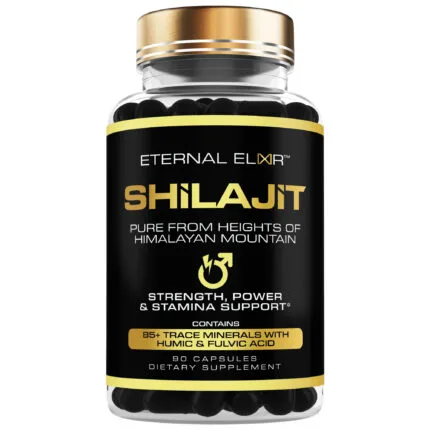
Eternal Elixir Shilajit 1000mg: shilajit extract (asphaltum), 20:1, standardised to 20% fulvic acid. 1,000 mg per serve of two capsules, 45 serves per bottle of 90 capsules. Other ingredients are a hypromellose (cellulose) capsule, magnesium stearate (vegetable source) and silica. Take two capsules a day on an empty stomach with water.
At $44.99, it’s $1.00 a serve. Orders ship from Sydney within 24 hours with a 30-day money-back guarantee, Afterpay and free shipping over $100. Two bottles take 10% off, three take 15% and five take 20%.
- Suits you if you want a capsule with the extract ratio and fulvic acid content on the label, and no measuring.
- Doesn’t suit you if you prefer the ritual of resin in a warm drink, or you want the lowest price per serve regardless of what the label discloses.
Many people take shilajit with tongkat ali. Our Tongkat Ali 200:1 gives 2,000 mg per three-capsule serve, 90 capsules for $39.99, and our tongkat ali comparison covers the alternatives. For a morning energy routine, some pair it with Korean Red Ginseng. You can browse the full range too.
The bottom line on shilajit dosage
The research supports 500 mg a day of a purified shilajit extract, taken daily for at least 8 weeks, with 14 weeks the longest tested. Our capsules hold 500 mg each, and the label serve is two capsules a day on an empty stomach. Whatever product you choose, check that the label states how much shilajit you’re getting, and buy from a seller that tests each batch.
Frequently asked questions
How much shilajit should I take per day?
The human trials used 500 mg a day of purified shilajit, usually as 250 mg twice a day, and the one trial that compared doses found 500 mg did better than 250 mg. Our label serve is two 500 mg capsules (1,000 mg) a day on an empty stomach. The two resin labels we checked give a 250 mg serve.
Can I take shilajit every day?
Yes. Every trial dosed daily, for 8 to 14 weeks. Longer-term use hasn’t been tested in a controlled trial, so some people take a break every few months to reassess.
Add Shilajit 1000mg to cart · $44.99
How much shilajit per day for men?
The trial that measured testosterone in men aged 45 to 55 used 250 mg twice a day for 90 days, and the strength trial in younger men found 500 mg a day worked better than 250 mg. So 500 mg a day for at least 8 weeks is the amount with evidence behind it.
How much shilajit per day for women?
The only trial in women used 125 mg or 250 mg twice a day for 14 weeks, and the higher dose, 500 mg a day in total, improved skin blood flow. Don’t take shilajit if you’re pregnant or breastfeeding.
Can I take shilajit on an empty stomach?
Yes. Our label says to take two capsules a day on an empty stomach with water. Other products give different directions, so follow the label on the product you buy. No trial has compared taking shilajit with food against without.
What happens if I take too much shilajit?
No trial has tested more than 500 mg a day, so there’s no evidence that more helps. Don’t go above your label serve. The bigger risk with poor-quality shilajit is contamination, which is a sourcing problem, so buy from a seller that tests each batch.
How long until shilajit starts working?
The trials measured results after 8 to 14 weeks. Give it at least 8 weeks at a steady daily dose before you judge it.
Can I take shilajit with coffee?
Lifecykel’s directions say its resin can be dissolved in warm water, coffee or tea. No trial has tested whether coffee changes how shilajit is absorbed. With our capsules, the label says to take them on an empty stomach with water.
Is shilajit safe long-term?
Human safety data covers up to 14 weeks of daily use, with no adverse effects reported in the trials above. A 2014 review found safety well documented in animal and human studies but noted that few well-controlled human trials exist. Beyond 14 weeks there’s no trial data, so check in with your doctor if you plan to take it for many months, especially if you take prescription medicines.
Sources
- Pandit S, Biswas S, Jana U, et al. Clinical evaluation of purified Shilajit on testosterone levels in healthy volunteers. Andrologia. 2016;48(5):570-575. PubMed 26395129
- Keller JL, Housh TJ, Hill EC, et al. The effects of Shilajit supplementation on fatigue-induced decreases in muscular strength and serum hydroxyproline levels. J Int Soc Sports Nutr. 2019;16(1):3. PubMed 30728074
- Das A, Datta S, Rhea B, et al. The human skeletal muscle transcriptome in response to oral Shilajit supplementation. J Med Food. 2016;19(7):701-709. PubMed 27414521
- Das A, El Masry MS, Gnyawali SC, et al. Skin transcriptome of middle-aged women supplemented with natural herbo-mineral Shilajit shows induction of microvascular and extracellular matrix mechanisms. J Am Coll Nutr. 2019;38(6):526-536. PubMed 31161927
- Stohs SJ. Safety and efficacy of shilajit (mumie, moomiyo). Phytother Res. 2014;28(4):475-479. PubMed 23733436
- Saper RB, Phillips RS, Sehgal A, et al. Lead, mercury, and arsenic in US- and Indian-manufactured Ayurvedic medicines sold via the Internet. JAMA. 2008;300(8):915-923. PubMed 18728265
- Product labels and listings checked September 2026: Eternal Elixir Shilajit 1000mg (supplement facts panel), Evolution Botanicals Himalayan Shilajit Resin, Lifecykel Shilajit Pure Resin and Wanderlust Shilajit 120 Tablets at Chemist Warehouse.