Last updated: September 26, 2026 · Originally published: March 21, 2026 · By Eternal Elixir Editorial
NMN looks safe for long-term use as far as the human trials go, but “long term” in those trials means months, not years. Across the randomised trials published since 2019, doses from 250 mg to 2,000 mg a day, taken for 14 days to 24 weeks, did not raise the rate of side effects above placebo, and liver enzymes stayed steady. The longest controlled trial ran 24 weeks at 250 mg a day, in 14 older men. Nobody has yet run a multi-year NMN trial in people, so anything past six months rests on judgement rather than measurement.
This guide sets out what each human trial found on NMN long-term safety, what hasn’t been tested, what the liver data show, how long Australian labels suggest you take it, and how our 500 mg capsule compares with the doses the trials used.
Key takeaways
- A 2026 review pooled 15 randomised NMN trials. Against placebo, NMN did not increase side effects and did not significantly raise the liver enzymes ALT or AST.
- The longest trial ran 24 weeks, at 250 mg a day, in 14 men. There is no controlled human data past that.
- Every trial in this guide that ran 10 weeks or longer used 250 mg a day. Our capsule is 500 mg, twice that.
- Bioglan and Melrose NMN labels at Chemist Warehouse say to use it for 12 weeks or less.
- Skip NMN if you are pregnant or breastfeeding, and talk to your doctor first if you take regular medicines or are being treated for cancer.
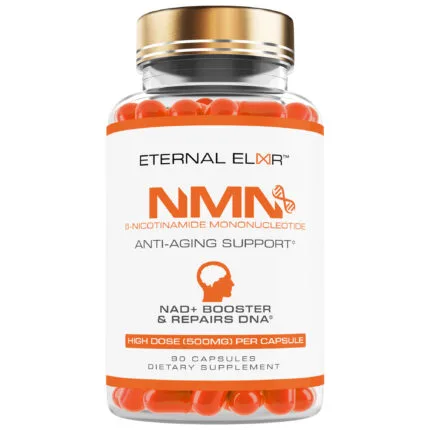
Eternal Elixir makes NMN 500mg, and it is our pick for adults who have read the evidence and want a plain, single-ingredient NMN: one 500 mg capsule a day, 90 capsules to a bottle, with nothing added besides rice flour and the capsule shell. That is double the 250 mg used in the longest trials, a point we come back to below.
Table of contents
- 1. Is NMN Safe to Take Long Term?
- 2. Human NMN Safety Trials at a Glance
- 3. What Five Years of Human Research Shows
- 4. What Hasn’t Been Shown Yet
- 5. Is NMN Toxic to the Liver?
- 6. NMN Side Effects Reported in Trials
- 7. How Long Can You Take NMN?
- 8. How Much NMN Per Day for Long-Term Use?
- 9. NMN 500mg in Australia: Labels and Prices Compared
- 10. Who Should Skip NMN or Talk to a Doctor First
- 11. Is NMN Worth Taking?
- 12. Our NMN 500mg
- 13. NMN Long-Term Safety: Frequently Asked Questions
- 13.1. Is NMN safe to take long term?
- 13.2. How long should NMN be taken?
- 13.3. Is NMN toxic to the liver?
- 13.4. Does NMN make your face look younger?
- 13.5. Is it safe to take NMN every day?
- 13.6. Is NMN powder or capsules better for long-term use?
- 13.7. Can I buy NMN at Chemist Warehouse?
- 13.8. Can I take NMN with other supplements or medicines?
- 14. More on NMN and Longevity
- 15. Sources
Is NMN Safe to Take Long Term?
For the periods that have been studied, yes, in healthy adults. Human NMN trials started in 2019, and by mid-2026 a systematic review could pool 15 randomised trials (Yang et al., 2026). Ten of them fed into the safety analysis. Doses ranged from 250 mg to 2,000 mg a day, and the trials lasted between 14 days and 24 weeks. Compared with placebo, NMN did not increase overall side effects, serious side effects, dropouts caused by side effects, or side effects in any body system. It did not significantly raise ALT or AST either.
The same review is careful about what that means. Its authors describe the tolerability as short-term and say larger, longer trials are needed to confirm long-term safety. That is the honest position. About six months is the ceiling of the controlled evidence, and most trials stopped at 12 weeks.
Human NMN Safety Trials at a Glance
These are the human trials behind the answer above. Doses are NMN per day.
| Trial | Who took part | Daily dose | How long | What it found |
|---|---|---|---|---|
| Irie et al., 2020 | 10 healthy men | Single doses of 100, 250 and 500 mg | One dose each, watched for five hours | No significant symptoms. A few blood values moved, all within normal ranges. |
| Yoshino et al., 2021 | 25 overweight postmenopausal women with raised blood sugar | 250 mg | 10 weeks | Muscle insulin sensitivity rose. Safety was not the main question. |
| Liao et al., 2021 | 48 recreational runners | 300, 600 or 1,200 mg | 6 weeks | No participant reported an adverse event. Exercise ECGs showed no obvious abnormalities. |
| Okabe et al., 2022 | 30 healthy adults | 250 mg | 12 weeks | No abnormal physical or lab results and no obvious side effects. |
| Igarashi et al., 2022 | 42 healthy men aged 65 and over | 250 mg | 12 weeks | Well tolerated, with no serious adverse events. |
| Kim et al., 2022 | 108 adults aged 65 and over | 250 mg, morning or afternoon | 12 weeks | No side effects reported from NMN. |
| Fukamizu et al., 2022 | 31 healthy adults aged 20 to 65 | 1,250 mg | 4 weeks | Blood, urine and body measures stayed within normal variation. No severe adverse events. |
| Yi et al., 2023 | 80 healthy adults aged 40 to 65 | 300, 600 or 900 mg | 60 days | No safety issues in adverse events, lab tests or clinical checks. |
| Katayoshi et al., 2023 | 36 healthy middle-aged adults | 250 mg (125 mg twice a day) | 12 weeks | Well tolerated, with no adverse events. |
| Pencina et al., 2023 (tablet dose study) | 32 overweight adults aged 55 to 80 | 1,000 mg once or twice a day | 14 days | Side effects about as frequent as on placebo. |
| Pencina et al., 2023 (physiology study) | 30 overweight adults aged 45 and over | 2,000 mg (1,000 mg twice a day) | 28 days | Side effects similar between groups. |
| Akasaka et al., 2023 | 14 men aged 65 and over with a long-term metabolic condition | 250 mg | 24 weeks | Tolerated without severe adverse events. Grip and walking speed did not improve. |
What Five Years of Human Research Shows
The first human study
The first published human data came from Keio University in Tokyo (Irie et al., 2020). Ten healthy men took single doses of 100, 250 and 500 mg, and the researchers watched them for five hours after each one. There were no significant symptoms and no changes in heart rate, blood pressure, oxygen saturation or body temperature. Bilirubin rose a little, and creatinine, chloride and glucose fell a little, all within normal ranges and regardless of dose. Blood levels of two methylated breakdown products of nicotinamide climbed with the dose, a detail that matters for the TMG question further down.
The 12-week trials at 250 mg a day
Most of the evidence sits here. Okabe and colleagues gave 250 mg a day or placebo to 30 healthy adults for 12 weeks. They found no abnormal physical or laboratory results and no obvious side effects, while NAD+ in whole blood went up (Okabe et al., 2022). Igarashi’s team used the same dose for 12 weeks in 42 healthy men aged 65 and over. NMN was well tolerated, nobody had a serious adverse event, and blood NAD+ and its metabolites rose (Igarashi et al., 2022).
Kim’s trial of 108 adults aged 65 and over, again 250 mg for 12 weeks, recorded no side effects from NMN (Kim et al., 2022). Katayoshi’s trial in 36 healthy middle-aged adults split the dose into 125 mg twice a day and reported no adverse events over 12 weeks (Katayoshi et al., 2023).
Higher doses, shorter trials
Trials at higher doses have been shorter. Among 48 recreational runners taking 300, 600 or 1,200 mg a day for six weeks, no one reported an adverse event, and ECGs during exercise testing showed no obvious abnormalities (Liao et al., 2021). Yi and colleagues gave 80 healthy adults aged 40 to 65 placebo or 300, 600 or 900 mg a day for 60 days. All 80 finished, and the authors found no safety issues in adverse events, laboratory results or clinical checks (Yi et al., 2023).
A dedicated safety trial tested 1,250 mg once a day for four weeks in 31 healthy adults aged 20 to 65. Blood counts, blood chemistry, urine and body composition stayed within normal variation, and there were no severe adverse events (Fukamizu et al., 2022). The highest doses come from two US trials of a pharmaceutical-grade NMN tablet. One gave 1,000 mg once or twice a day for 14 days to 32 overweight adults aged 55 to 80 (Pencina et al., 2023). The other gave 2,000 mg a day for 28 days to 30 overweight adults aged 45 and over (Pencina et al., 2023). In both, side effects were about as common on NMN as on placebo.
The longest trial: 24 weeks
The longest controlled trial we found ran for 24 weeks. Fourteen men aged 65 and over, with an average age of 81, a long-term metabolic condition and weak grip or slow walking, took 250 mg a day or placebo. NMN was tolerated without any severe adverse events, but it did not improve grip strength or walking speed (Akasaka et al., 2023). With only 14 people, a trial like this can pick up common problems. It cannot rule out rare ones.
What Hasn’t Been Shown Yet
- Years of use. No controlled human trial has run longer than 24 weeks. The 2026 review’s authors say longer trials are needed before long-term safety can be confirmed.
- Rare side effects. The biggest trial here had 108 people. A problem that affects one person in a thousand would not show up in trials this size.
- Pregnancy and breastfeeding. We found no trial that studied NMN in pregnancy or breastfeeding.
- Mouse results. The best-known long-term study gave NMN to mice for 12 months and found no obvious toxicity, along with less age-related weight gain (Mills et al., 2016). Those are mouse results. They tell us little about people taking NMN for years.
- Who ran the trials. Four of the Japanese trials (Okabe, Igarashi, Kim and Fukamizu) had co-authors employed by Mitsubishi Corporation Life Sciences, an NMN supplier. That doesn’t make the results wrong, but replication by groups with no link to a supplier would carry more weight.
- Face and skin. None of the trials in this guide measured skin or facial appearance, so there is no human evidence here that NMN makes your face look younger.
Is NMN Toxic to the Liver?
No liver harm has shown up in the human trials so far. The 2026 review found no significant rise in ALT or AST, the two liver enzymes doctors usually check first, across the trials that measured them. In the four-week trial at 1,250 mg a day, the blood chemistry panel, which included ALT, AST and gamma-GT, showed no changes beyond normal variation. Okabe’s 12-week trial found no abnormal laboratory results, and after single doses Irie saw creatinine, a kidney marker, dip slightly while staying in the normal range.
These trials mostly enrolled healthy people, so they can’t tell you how NMN behaves alongside an existing liver or kidney condition. If you have one, talk to your doctor before you start.
NMN Side Effects Reported in Trials
Side effects in the trials were uncommon, and no more frequent on NMN than on placebo. Several trials reported none at all. Liao’s runners reported no adverse events over six weeks. Kim’s 108 older adults reported no side effects from NMN over 12 weeks. Katayoshi’s middle-aged volunteers had no adverse events over the same period. In the two US trials at 1,000 to 2,000 mg a day, side effects turned up at a similar rate in the NMN and placebo groups.
Your own experience can still differ from a trial average. If something new starts after you begin, stop taking it and talk to your pharmacist or GP.
How Long Can You Take NMN?
Trial data run to 24 weeks at 250 mg a day, and to 60 days at 300 to 900 mg a day. Past that, no one has measured it in a controlled trial. So there is no evidence-based maximum, and no evidence that taking it indefinitely is safe either.
Several NMN products on Chemist Warehouse shelves put a limit on the label. Bioglan NMN 500 says it is “not recommended to use for more than 12 weeks”. Melrose FutureLab NMN 500mg lists a maximum of 500 mg of NMN a day and use for “12 weeks or less”. Our NMN product page gives one capsule a day and no time limit, but the evidence behind every brand is the same set of trials.
A reasonable plan for longer use is to finish a 90-day bottle, then see your GP for routine bloods, including liver and kidney function, before deciding whether to carry on. We found no evidence that cycling NMN on and off is safer than steady daily use, and none that steady use is safer than cycling.
How Much NMN Per Day for Long-Term Use?
The trials used between 250 and 2,000 mg a day, but dose and length of use travel together. Every trial in this guide that ran 10 weeks or longer used 250 mg a day. The trials at 500 mg and above lasted 60 days at most.
Our capsule is 500 mg, taken once a day. Put plainly:
- It is double the 250 mg a day used in the 10-week, 12-week and 24-week trials.
- It sits inside the 300 to 900 mg a day range that Yi tested for 60 days.
- It is below the 1,250 mg and 2,000 mg doses, which were tested for four weeks or less.
- It matches the 500 mg daily maximum printed on the Chemist Warehouse labels above.
If you want to stay at the dose with the longest safety record, that is 250 mg a day, half of one of our capsules. For timing and how to take it, see our NMN dosage guide for Australia and our note on taking NMN in the morning or at night.
NMN 500mg in Australia: Labels and Prices Compared
Eternal Elixir makes the first product in this table, so read it knowing we sell one of the three. Prices as of Sep 2026. Chemist Warehouse prices change often.
| Product | Capsules | NMN per capsule | Label directions and limits | Price | Cost per day | Buy |
|---|---|---|---|---|---|---|
| Eternal Elixir NMN 500mg | 90 | 500 mg | 1 capsule daily, no time limit stated | A$59.99 | A$0.67 | View NMN 500mg |
| Bioglan NMN 500 | 30 | 500 mg | 1 capsule daily. Not recommended for more than 12 weeks. | A$42.49 (RRP A$84.99) | A$1.42 | Chemist Warehouse |
| Melrose FutureLab NMN 500mg | 30 | 500 mg NMN plus 250 mg DMG | Maximum 500 mg NMN a day. 12 weeks or less. | A$52.47 (RRP A$74.95) | A$1.75 at one a day | Chemist Warehouse |
Who suits which: Bioglan is the cheapest way to try NMN for a month at Chemist Warehouse’s current sale price. Melrose adds 250 mg of DMG (dimethylglycine) to each capsule, if you want that in the same product. Ours costs less per day than either at today’s prices, and a bottle lasts 90 days, which lines up with the three-month point where a GP check makes sense. None of them should be taken during pregnancy or breastfeeding.
Add NMN 500mg to cart · $59.99
For the wider Chemist Warehouse range, see our guide to NMN at Chemist Warehouse. For a broader ranking, read our best NMN supplements in Australia comparison, and if you were weighing AgeMate, our AgeMate alternatives comparison covers formulation, dose and price.
Who Should Skip NMN or Talk to a Doctor First
- Pregnant or breastfeeding women: skip it. There is no trial data, and the Chemist Warehouse labels above say not to use it.
- Children and teenagers: don’t give it to them. Bioglan’s label says “Adults only”.
- People being treated for cancer: talk to your oncologist first. None of the trials in this guide enrolled people in cancer care, so there is no safety data for that group.
- People with a liver or kidney condition: talk to your doctor. The trials mostly studied healthy adults.
- Anyone on regular prescription medicines: ask your pharmacist or GP. We found no formal drug-interaction studies for NMN.
Is NMN Worth Taking?
What NMN does reliably is raise NAD+ in the blood. That showed up in the 12-week trials by Okabe and Igarashi, in Yi’s dose trial and in both US tablet trials. Whether it changes anything you would notice is less clear:
- Yi’s trial found longer six-minute walking distances than placebo at all three doses.
- Igarashi found small gains in gait speed and grip that the authors say need confirming in larger studies.
- Akasaka’s 24-week trial found no change in grip strength or walking speed.
- The 2026 review found no significant effect on body weight, fasting glucose, HbA1c, blood lipids or systolic blood pressure, and a slight fall in diastolic pressure.
So NMN is a way to raise NAD+ with a good short-term safety record. It has not been shown to slow ageing in people. If that trade-off suits you, a bottle is a fair trial run. To compare it with the other main NAD+ precursor, read NMN vs NR, see how long NMN takes to work, or browse our guide to NAD+ supplements in Australia.
Our NMN 500mg
Eternal Elixir NMN 500mg is a single-ingredient NMN supplement: 500 mg of NMN per capsule, with rice flour and a cellulose capsule. The label direction is one capsule a day, preferably in the morning, so a 90-capsule bottle lasts 90 days. At A$59.99 that works out to A$0.67 a day. It ships from Sydney within 24 hours, shipping is free on orders over A$100, and it carries a 30-day money-back guarantee.
Some people pair NMN with TMG, because the body clears spare nicotinamide by adding methyl groups to it, and Irie’s study saw those methylated breakdown products rise with the dose. No trial has tested whether adding TMG changes NMN’s safety. Our NMN and TMG guide sets out the reasoning and its limits.
NMN Long-Term Safety: Frequently Asked Questions
Is NMN safe to take long term?
In healthy adults, trials lasting up to 24 weeks at 250 mg a day found no increase in side effects over placebo, and pooled data from shorter trials at up to 2,000 mg a day found the same. No human trial has run for years, so beyond six months the evidence is thin.
How long should NMN be taken?
The controlled trials ran from 14 days to 24 weeks. Some Australian NMN labels, including Bioglan and Melrose, say 12 weeks or less. If you want to continue past three months, see your GP and get routine blood tests first.
Add NMN 500mg to cart · $59.99
Is NMN toxic to the liver?
Not in the trials so far. A 2026 review of randomised trials found no significant rise in the liver enzymes ALT or AST on NMN, and a four-week trial at 1,250 mg a day found no changes beyond normal variation in blood chemistry. If you have a liver condition, talk to your doctor before starting.
Does NMN make your face look younger?
There’s no human evidence for that. None of the trials in this guide measured skin or facial appearance, so be wary of any product that promises a visible change.
Is it safe to take NMN every day?
Daily use is what the trials tested: one dose a day, every day, for up to 24 weeks. Our capsule is 500 mg a day, twice the dose used in the longest trials and within the 300 to 900 mg range tested for 60 days.
Is NMN powder or capsules better for long-term use?
No trial has compared the safety of NMN powder with capsules. The practical difference is dose accuracy: a capsule holds a fixed amount, while a scoop depends on how you fill it. Our NMN powder vs capsules comparison covers cost and convenience.
Can I buy NMN at Chemist Warehouse?
Yes. Chemist Warehouse sells several NMN products, including Bioglan NMN 500 and Melrose FutureLab NMN 500mg, both in 30-capsule packs with a 12-week limit on the label. Our NMN Chemist Warehouse guide compares the range with buying direct.
Can I take NMN with other supplements or medicines?
We found no formal interaction studies for NMN, so if you take prescription medicines, ask your pharmacist first. Many people combine NMN with resveratrol or pterostilbene, and our pterostilbene vs resveratrol comparison covers that choice. If you are thinking about methylene blue as well, read our methylene blue and NMN guide first, and do not take methylene blue with serotonergic medicines such as SSRIs.
More on NMN and Longevity
- How to build a longevity stack with NMN, resveratrol, spermidine and TUDCA
- Ca-AKG 500mg capsules, if you are comparing other longevity supplements
- The full Eternal Elixir range
Sources
- Yang W, Huang J, Tang Z, Chen C, Sun Y. Safety and metabolism-related outcomes of oral nicotinamide mononucleotide supplementation in adults: a systematic review and meta-analysis. Nutrients. 2026;18(14):2251. PubMed 42514320
- Irie J, Inagaki E, Fujita M, et al. Effect of oral administration of nicotinamide mononucleotide on clinical parameters and nicotinamide metabolite levels in healthy Japanese men. Endocr J. 2020;67(2):153-160. PubMed 31685720
- Yoshino M, Yoshino J, Kayser BD, et al. Nicotinamide mononucleotide increases muscle insulin sensitivity in prediabetic women. Science. 2021;372(6547):1224-1229. PubMed 33888596. Enrolment and dose: ClinicalTrials.gov NCT03151239
- Liao B, Zhao Y, Wang D, et al. Nicotinamide mononucleotide supplementation enhances aerobic capacity in amateur runners: a randomized, double-blind study. J Int Soc Sports Nutr. 2021;18(1):54. PubMed 34238308
- Okabe K, Yaku K, Uchida Y, et al. Oral administration of nicotinamide mononucleotide is safe and efficiently increases blood nicotinamide adenine dinucleotide levels in healthy subjects. Front Nutr. 2022;9:868640. PubMed 35479740
- Igarashi M, Nakagawa-Nagahama Y, Miura M, et al. Chronic nicotinamide mononucleotide supplementation elevates blood nicotinamide adenine dinucleotide levels and alters muscle function in healthy older men. NPJ Aging. 2022;8(1):5. PubMed 35927255
- Kim M, Seol J, Sato T, et al. Effect of 12-week intake of nicotinamide mononucleotide on sleep quality, fatigue, and physical performance in older Japanese adults: a randomized, double-blind placebo-controlled study. Nutrients. 2022;14(4):755. PubMed 35215405
- Fukamizu Y, Uchida Y, Shigekawa A, et al. Safety evaluation of β-nicotinamide mononucleotide oral administration in healthy adult men and women. Sci Rep. 2022;12(1):14442. PubMed 36002548
- Yi L, Maier AB, Tao R, et al. The efficacy and safety of β-nicotinamide mononucleotide (NMN) supplementation in healthy middle-aged adults: a randomized, multicenter, double-blind, placebo-controlled, parallel-group, dose-dependent clinical trial. GeroScience. 2023;45(1):29-43. PubMed 36482258
- Katayoshi T, Uehata S, Nakashima N, et al. Nicotinamide adenine dinucleotide metabolism and arterial stiffness after long-term nicotinamide mononucleotide supplementation: a randomized, double-blind, placebo-controlled trial. Sci Rep. 2023;13(1):2786. PubMed 36797393
- Pencina KM, Lavu S, Dos Santos M, et al. MIB-626, an oral formulation of a microcrystalline unique polymorph of β-nicotinamide mononucleotide, increases circulating nicotinamide adenine dinucleotide and its metabolome in middle-aged and older adults. J Gerontol A Biol Sci Med Sci. 2023;78(1):90-96. PubMed 35182418
- Pencina KM, Valderrabano R, Wipper B, et al. Nicotinamide adenine dinucleotide augmentation in overweight or obese middle-aged and older adults: a physiologic study. J Clin Endocrinol Metab. 2023;108(8):1968-1980. PubMed 36740954
- Akasaka H, Nakagami H, Sugimoto K, et al. Effects of nicotinamide mononucleotide on older patients with diabetes and impaired physical performance: a prospective, placebo-controlled, double-blind study. Geriatr Gerontol Int. 2023;23(1):38-43. PubMed 36443648
- Mills KF, Yoshida S, Stein LR, et al. Long-term administration of nicotinamide mononucleotide mitigates age-associated physiological decline in mice. Cell Metab. 2016;24(6):795-806. PubMed 28068222
- Chemist Warehouse product listings, checked September 2026: Bioglan NMN 500mg 30 Capsules and Melrose FutureLab NMN 500mg 30 Capsules.