Last updated: September 27, 2026 · Originally published: April 8, 2026 · By Eternal Elixir Editorial
For men, the best human evidence on shilajit comes from two small trials of one purified extract. In men aged 45 to 55, 250 mg twice a day for 90 days raised total testosterone, free testosterone and DHEAS against placebo, by about 20%, 19% and 31%. In 63 active young men, 500 mg a day for 8 weeks helped the stronger half of the group hold on to strength after a hard workout. A 28-day pilot of a different shilajit resin at 500 mg a day found no change in testosterone. So shilajit may support healthy testosterone levels and training in men, but the evidence is thin, tied to specific extracts, and nowhere near what supplement labels imply.
This guide sets out what those trials measured, in whom, at what dose and for how long, where a 1,000 mg supplement serve sits against them, what side effects have been recorded, and how the shilajit products sold in Australia compare on dose and fulvic acid.
Key takeaways
- One placebo-controlled trial in men aged 45 to 55 found higher testosterone after 90 days of purified shilajit. A 28-day pilot in men aged 21 to 55 found no change.
- In one 8-week trial, 500 mg a day helped stronger young men keep more strength after a fatiguing workout. 250 mg a day did not.
- Recorded side effects were mild: none in the 8-week trial, and 7 of 25 men with mild, short-lived problems such as acne or an upset stomach in the pilot.
- The biggest risk is the product itself. Shilajit is a raw mineral resin, so buy one that states its purification and testing.
- Shilajit is not a stimulant and not a substitute for any prescription medicine. Results in the trials were measured over weeks, not hours.
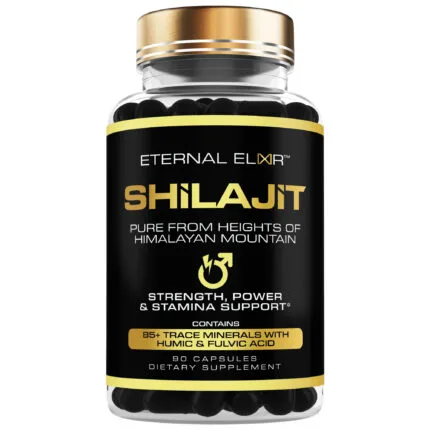
Eternal Elixir makes Shilajit 1000mg, and it is our pick for men who want shilajit in a measured capsule: 1,000 mg of 20:1 shilajit extract with 20% fulvic acid in each two-capsule serve, 90 capsules to a bottle. By weight, that is twice the 500 mg a day used in the trials. Our extract is not the one those trials used, which was standardised to at least 50% fulvic acid, so by fulvic acid our serve (about 200 mg) sits a little below the trials’ 500 mg dose (at least 250 mg). The trial results belong to that extract, and we won’t claim them for ours.
Table of contents
- 1. Shilajit for Men at a Glance
- 2. What Does Shilajit Do to a Man?
- 3. What the Research Says About Shilajit and Testosterone
- 4. Shilajit for Energy and Physical Performance
- 5. Shilajit Side Effects and Who Should Avoid It
- 6. How to Choose Shilajit in Australia (as of Sep 2026)
- 7. Eternal Elixir Shilajit 1000mg: What Is in the Bottle
- 8. Frequently asked questions about shilajit for men
- 8.1. What does shilajit do for men?
- 8.2. What happens if you take shilajit every day?
- 8.3. Is shilajit better than Viagra?
- 8.4. What are the side effects of shilajit?
- 8.5. How long does shilajit take to work for men?
- 8.6. How much shilajit should a man take a day?
- 8.7. What is the best shilajit for men in Australia?
- 9. Sources
Shilajit for Men at a Glance
| Outcome | What the study found | Who, dose, how long | Limits |
|---|---|---|---|
| Testosterone | Total and free testosterone and DHEAS rose against placebo, by about 20%, 19% and 31%. LH and FSH stayed steady. | Men aged 45 to 55, 250 mg twice a day, 90 days (Pandit et al., 2016) | One trial of one purified extract |
| Testosterone | No change: 394 ng/dL at the start, 383 ng/dL after 28 days. | 25 men aged 21 to 55, 500 mg a day of shilajit resin, 28 days (Yadav et al., 2026) | No placebo group, short |
| Strength after a fatiguing workout | In the stronger half of the group, strength fell 8.9% on 500 mg a day, against 17.0% on 250 mg and 16.0% on placebo. | 63 active men averaging 21 years, 21 per group, 8 weeks (Keller et al., 2019) | Only in the stronger half; no effect at 250 mg |
| Leg press strength | Up 12.94% within the group. | The same 28-day pilot of 25 men | No placebo group, so training and practice could explain it |
| Side effects | None reported in the 8-week trial. 7 of 25 men (28%) had mild, short-lived events in the pilot. Liver, kidney and blood tests stayed stable. | Keller et al., 2019. Yadav et al., 2026 | Small groups, short follow-up |
What Does Shilajit Do to a Man?
Shilajit is a dark resin that seeps from rock in the Himalayan, Altai and other mountain ranges. Its main components are fulvic acids, along with compounds called dibenzo-alpha-pyrones and more than 40 minerals (Keller et al., 2019). It has a long history in Ayurvedic practice, but only a handful of controlled human trials.
In men, those trials point to two possible effects, each from one study: support for healthy testosterone levels in middle age, and better strength retention after hard exercise in trained young men. Neither result has been confirmed by a second placebo-controlled trial that we could find. Shilajit is not a stimulant, so it won’t feel like a coffee, and the trials measured their results after 4 to 13 weeks of daily use.
What hasn’t been shown: we found no placebo-controlled trial of shilajit on libido, mood or day-to-day energy in healthy men, no trial longer than 90 days in men, and no trial of the 20:1 extract in our capsules.
What the Research Says About Shilajit and Testosterone
The trial most often quoted gave healthy men aged 45 to 55 either 250 mg of purified shilajit twice a day or a placebo for 90 days. Total testosterone, free testosterone and DHEAS rose significantly on shilajit compared with placebo, and the hormones that signal the testes to make testosterone (LH and FSH) stayed steady (Pandit et al., 2016). A later paper summarised the rises as 20.45%, 19.14% and 31.35% (Keller et al., 2019).
Two cautions. First, this is one trial of one branded extract, PrimaVie, standardised to at least 50% fulvic acid. Second, a newer 28-day pilot in 25 healthy men aged 21 to 55, using a different shilajit resin at 250 mg twice a day, found testosterone essentially unchanged, at 394 ng/dL before and 383 ng/dL after (Yadav et al., 2026). The pilot was shorter, had no placebo group and included younger men, so the two results don’t cancel out. They do show that the testosterone finding is not settled.
How shilajit compares with tongkat ali, the other herb men most often buy for this, is covered in our tongkat ali vs shilajit comparison. For the lifestyle side (sleep, training, body fat and alcohol), which matters more than any supplement, see our natural testosterone plan for men over 35.
Where a 1,000 mg serve sits
Both trials used 500 mg a day. Our serve is 1,000 mg of a 20:1 extract with 20% fulvic acid, which is double the trial dose by weight. The trial extract was at least 50% fulvic acid, so 500 mg of it held at least 250 mg of fulvic acid. Our 1,000 mg serve holds about 200 mg. Those are different products, and nobody has tested whether the trial results carry over from one to the other.
Shilajit for Energy and Physical Performance
In the 8-week trial, 63 recreationally active men, averaging 21 years old, took 250 mg, 500 mg or a placebo each day. Before and after, they did two sets of 50 maximal leg extensions and had their strength tested. In the half of the group who started stronger, strength fell 8.9% after the workout on 500 mg, compared with 17.0% on 250 mg and 16.0% on placebo. The 500 mg group also had lower levels of hydroxyproline, a blood marker of collagen breakdown. There were no reported adverse events (Keller et al., 2019).
The 28-day pilot recorded a 12.94% rise in leg press strength and better scores on a fatigue questionnaire. Without a placebo group, though, those changes can’t be separated from training, practice on the tests or expectation (Yadav et al., 2026).
So the performance evidence is one controlled result, in one subgroup, at one dose. It is a reason for interest, not a promise. Men who train hard and want to try shilajit should give it at least 8 weeks, the length of the controlled trial, and judge it on their own training log.
Shilajit and tongkat ali are often bought together. We found no trial of the two combined, so treat the pairing as two separate supplements, each with its own evidence. Our Tongkat Ali 200:1 Extract 2000mg is three capsules a day on an empty stomach, 30 serves per bottle. The research on it is in our tongkat ali benefits guide.
Shilajit Side Effects and Who Should Avoid It
In the trials, side effects were few and mild. The 8-week trial reported none. In the 28-day pilot, 7 of 25 men (28%) reported mild problems that cleared up on their own. The events were acne (two men) and one case each of rash, itching, upper stomach pain, indigestion, cough and fever. Most were judged unlikely to be caused by the shilajit, and liver, kidney and blood tests stayed stable (Yadav et al., 2026).
The larger risk is contamination. Shilajit is a raw material from rock, and Ayurvedic products in general have a record of heavy metal problems. When researchers bought 193 Ayurvedic medicines online, 20.7% contained detectable lead, mercury or arsenic (Saper et al., 2008). That study covered Ayurvedic medicines broadly, not shilajit alone, but it is why purification and batch testing matter. Our guide to spotting pure shilajit in Australia covers what to check.
Shilajit is for adults. Don’t take it while pregnant or breastfeeding, and talk to your GP first if you have a medical condition or take prescription medicines. Our shilajit side effects guide goes through the evidence in more detail.
How to Choose Shilajit in Australia (as of Sep 2026)
For men comparing products, the details that matter are how much shilajit is in each serve, whether the fulvic acid content is stated, and whether the seller says how it is purified and tested. We took each price, pack and serve from the seller’s own page in September 2026. For the full field, see our comparison of the best shilajit supplements in Australia.
| Product | Price (AUD, as of Sep 2026) | Pack | Shilajit per serve | Fulvic acid stated | Serves | Cost per serve | Buy |
|---|---|---|---|---|---|---|---|
| Eternal Elixir Shilajit 1000mg (our pick) | $44.99 | 90 capsules | 1,000 mg of 20:1 extract (2 capsules) | 20% | 45 | $1.00 | View product |
| Evolution Botanicals Himalayan Shilajit Resin | $79.95 | 30 g resin jar | 250 mg of resin | 50%+ (by gravimetry) | 120 | $0.67 | Evolution Botanicals |
| Lifecykel Shilajit Pure Resin (Chemist Warehouse, online only) | $92.00 | 15 g resin | 0.25 g of resin | Not stated | About 60 | $1.53 | Chemist Warehouse |
| Wanderlust Shilajit (Chemist Warehouse) | $19.49 | 120 tablets | Not stated (a 2-tablet serve weighs 1 g, with inulin listed first) | Not stated | 60 | $0.32 | Chemist Warehouse |
| ATP Science Tongkat Ali + Shilajit Powder | $74.95 | 150 g powder | 500 mg of 15:1 extract, plus 400 mg of tongkat ali (5 g scoop) | Not stated | 30 | $2.50 | ATP Science |
Who each one suits, and who it doesn’t
- Eternal Elixir Shilajit 1000mg (our pick). Suits men who want a fixed, stated amount of extract in capsules, with the fulvic acid content on the label and nothing to weigh or taste. It doesn’t suit someone who wants the trial extract or the highest stated fulvic acid, and it costs more per serve than the Evolution Botanicals resin.
- Evolution Botanicals Himalayan Shilajit Resin. Suits resin users who want the highest stated fulvic acid here, two certificates of analysis on the product page and a lower cost per serve. You measure it with a spoon, and resin has a strong taste.
- Lifecykel Shilajit Pure Resin. Suits someone who wants to order a resin through Chemist Warehouse. The listing states third-party testing for heavy metals, microbes and pesticides, but no fulvic acid figure, and it has the highest cost per serve of the resins.
- Wanderlust Shilajit. Suits price-first shoppers, with the lowest cost per serve here. The listing states neither the amount of shilajit nor the fulvic acid content, and inulin is the first ingredient.
- ATP Science Tongkat Ali + Shilajit Powder. Suits men who want both herbs in one flavoured drink. It has the highest cost per serve in the table and doesn’t state its fulvic acid content.
If you’d rather buy from a pharmacy, our guide to shilajit at Chemist Warehouse covers what is listed there.
Eternal Elixir Shilajit 1000mg: What Is in the Bottle
Each bottle of Eternal Elixir Shilajit 1000mg holds 90 capsules. Two capsules make one serve of 1,000 mg of 20:1 shilajit extract with 20% fulvic acid, in a plant-based hypromellose capsule, so a bottle lasts 45 days at $44.99, or $1.00 a day. The label directs two capsules a day on an empty stomach, with water. Two bottles save 10%, three save 15% ($114.72) and five save 20%. Orders over $100 ship free, and orders leave Sydney within 24 hours. Our product page states that every batch is third-party lab tested for purity and potency, that the shilajit is purified and checked for heavy metals and contaminants, and that you can ask for the current batch certificate of analysis.
If you want shilajit as part of a broader morning routine, our Daily Energy & Vitality Stack ($109.99) already includes a bottle of Shilajit 1000mg with Tongkat Ali 200:1 Extract 2000mg and Korean Panax Ginseng 1600mg, so buy one or the other, not both. For timing and how long to take it, see our shilajit dosage guide.
Who it suits: adult men who want to try shilajit in a measured daily capsule for at least 8 weeks and judge it for themselves. Who it doesn’t suit: anyone expecting a quick lift or the results of the trial extract, and anyone with a medical condition or on prescription medicines who hasn’t checked with their GP.
Add Shilajit 1000mg to cart · $44.99
Frequently asked questions about shilajit for men
What does shilajit do for men?
In one placebo-controlled trial, men aged 45 to 55 who took 250 mg of a purified extract twice a day for 90 days had higher total and free testosterone than men on placebo. In another, 500 mg a day for 8 weeks helped stronger young men keep more strength after a hard workout. A 28-day pilot of a different resin found no change in testosterone. So shilajit may support healthy testosterone and training in men, but each finding rests on one small study.
What happens if you take shilajit every day?
Every trial above gave shilajit daily, for 28 days to 90 days. Side effects were few and mild: none in the 8-week trial, and 7 of 25 men with short-lived problems such as acne or an upset stomach in the 28-day pilot, with liver, kidney and blood tests stable. No trial in men has run longer than 90 days, so longer daily use hasn’t been studied.
Is shilajit better than Viagra?
The two can’t be compared. Viagra is a prescription medicine, and shilajit is a dietary supplement. We found no trial comparing them and no controlled trial of shilajit on sexual function in healthy men. If you have concerns about sexual health, see your GP, and check with them before combining any supplement with a prescription medicine.
What are the side effects of shilajit?
In the 28-day pilot, the recorded problems were acne in two men and one case each of rash, itching, upper stomach pain, indigestion, cough and fever, all mild and all resolved. The bigger risk is a poorly purified product, because raw shilajit comes from rock. Shilajit is for adults only, and it isn’t for use in pregnancy or breastfeeding. Talk to your GP first if you have a medical condition or take prescription medicines.
How long does shilajit take to work for men?
The trials measured results after 28 days, 8 weeks and 90 days, and none measured anything within days. Shilajit is not a stimulant, so there is no immediate effect to feel. Give it at least 8 weeks, the length of the controlled strength trial, before you judge it.
How much shilajit should a man take a day?
Both trials used 500 mg a day of their own extracts. Our label serve is two capsules, 1,000 mg of 20:1 extract with 20% fulvic acid, once a day on an empty stomach with water. Take the serve on your product’s label rather than a dose from a study of a different extract, and don’t exceed it.
What is the best shilajit for men in Australia?
Our pick is Eternal Elixir Shilajit 1000mg. It gives a fixed 1,000 mg of 20:1 extract per two-capsule serve with the fulvic acid content on the label, 90 capsules a bottle and dispatch from Sydney within 24 hours. Eternal Elixir makes it, so weigh that when you read our pick. Evolution Botanicals’ resin states the highest fulvic acid figure in our table and costs less per serve, if you don’t mind measuring resin.
Add Shilajit 1000mg to cart · $44.99
Sources
- Pandit S, Biswas S, Jana U, De RK, Mukhopadhyay SC, Biswas TK. Clinical evaluation of purified Shilajit on testosterone levels in healthy volunteers. Andrologia. 2016;48(5):570-575. PubMed 26395129
- Keller JL, Housh TJ, Hill EC, Smith CM, Schmidt RJ, Johnson GO. The effects of Shilajit supplementation on fatigue-induced decreases in muscular strength and serum hydroxyproline levels. J Int Soc Sports Nutr. 2019;16(1):3. PubMed 30728074
- Yadav D, Mishra S, Shah KM, Reddy ST, Gupta R, Pandey P. Safety and efficacy of TruBlk Shilajit resin supplementation on physical performance and blood biomarkers in healthy adults: a 28-day open-label pilot study. Cureus. 2026. PMC12848467
- Saper RB, Phillips RS, Sehgal A, et al. Lead, mercury, and arsenic in US- and Indian-manufactured Ayurvedic medicines sold via the Internet. JAMA. 2008;300(8):915-923. PubMed 18728265