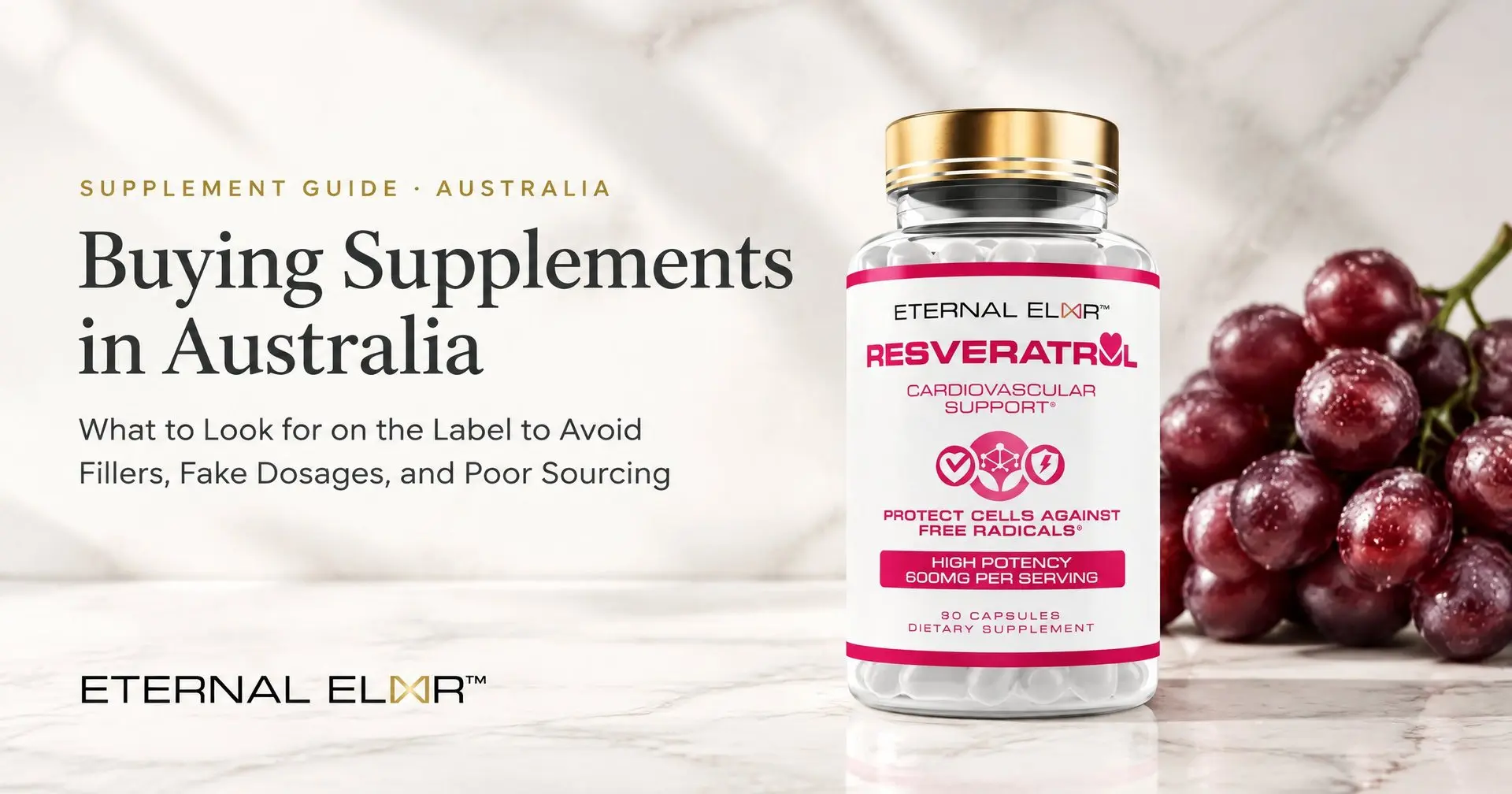
Last updated: September 28, 2026 · Originally published: March 21, 2026 · By Eternal Elixir Editorial
Quick Answer
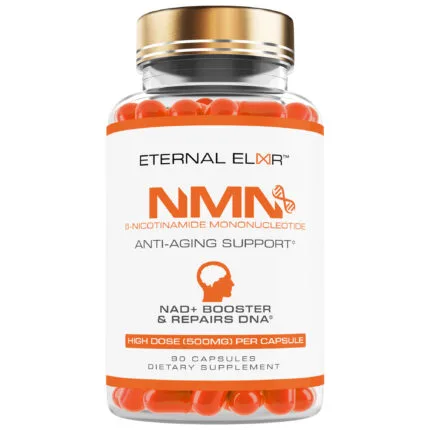
When buying supplements in Australia, judge the back of the bottle, not the front. Check the amount of each active ingredient per serve and how many capsules make a serve. For herbs, look for a standardised percentage as well as an extract ratio. Avoid proprietary blends that hide amounts, check the form of the ingredient, and work out the cost per serve. Then ask the brand for testing documents. Our pick for a label you can check in seconds is Eternal Elixir NMN 500mg: 500mg in every capsule, one capsule a serve, 90 capsules, $0.67 a day.
Eternal Elixir makes the products recommended on this page, so read this as our pick with the reasoning shown.
Buying supplements in Australia means choosing between pharmacy shelves, supermarket aisles, brand websites and overseas stores, often for the same ingredient at very different prices. The front of the bottle is marketing. The supplement facts panel on the back tells you what you are paying for. This guide walks through what to check on the label, with real Australian examples, so you can spot fillers, inflated dosages and vague sourcing before you buy.
Table of contents
- 1. Why the Front of the Bottle Isn’t Enough
- 2. Check the Amount per Serve, Not per Capsule
- 3. Extract Ratios vs Standardised Extracts
- 4. Proprietary Blends: The Amounts You Can’t See
- 5. Check the Form of the Ingredient
- 6. Read the Inactive Ingredients
- 7. Work Out the Cost per Serve
- 8. Ask for Testing Documents
- 9. Where to Buy Supplements in Australia
- 10. Our Labels, Checked the Same Way
- 11. Label Red Flags
- 12. Buying Supplements in Australia: Common Questions
- 12.1. What is the best supplement company in Australia?
- 12.2. Where is the best place to buy supplements in Australia?
- 12.3. How do I find a supplement’s certificate of analysis?
- 12.4. Are more expensive supplements always better?
- 12.5. What does “standardised extract” mean?
- 12.6. What is a proprietary blend?
- 12.7. Is it safe to buy supplements from overseas websites?
- 13. The Bottom Line
- 14. Sources
Why the Front of the Bottle Isn’t Enough
The large number on the front of a supplement can mean several different things. It might be the amount in one capsule, the amount in a serve of two or three capsules, or the weight of raw plant that an extract was made from. Two bottles that both say “500mg” can deliver very different amounts of the active ingredient each day. The only way to compare them is to read the facts panel, the directions and the ingredient list together.
Check the Amount per Serve, Not per Capsule
Start with the serving size. If a serve is two capsules, the amount on the front is often the total for both. Our own Trans-Resveratrol 1200mg is an example. The 1200mg is a two-capsule serve of 600mg capsules, so the 90-capsule bottle holds 45 serves at $1.33 a serve. That is stated on the label, but you need to read the directions to see it.
Then check how long the bottle lasts. Divide the capsule count by the capsules in a serve to get the number of days. A bottle that looks cheap can run out in a fortnight if it needs several capsules a day.
Extract Ratios vs Standardised Extracts
Herbal products usually state one or both of two numbers, and they tell you different things.
- An extract ratio, such as 25:1 or 200:1, describes how much dried plant went into the extract. A 25:1 extract means 25 parts of dried root made one part of extract. It says nothing about how much of the active compound ended up in the capsule.
- A standardised percentage, such as 1% eurycomanone for tongkat ali, tells you the minimum share of the marker compound in the extract. That is the number that lets you compare products.
Evolution Botanicals’ Tongkat Ali label is a clear example because it states both. Each capsule holds 500mg of a 25:1 root extract standardised to 1% eurycomanone. That works out to 5mg of eurycomanone per capsule, made from the equivalent of 12,500mg of dried root. A label that only gives the ratio, or only gives a big “equivalent to” figure, leaves you guessing. Our guides to tongkat ali in Australia and tongkat ali dosage go through how to read these numbers for that herb, and our tongkat ali comparison lines up the products on sale.
Proprietary Blends: The Amounts You Can’t See
A proprietary blend lists a total weight followed by a list of ingredients, without saying how much of each is in it. The label might show a 500mg blend of four ingredients, and the one on the front of the pack could make up almost none of that weight. You have no way to compare the dose with the amounts used in research.
The fix is simple. Prefer products that list every active ingredient with its own amount per serve. If a blend is the only option for what you want, ask the brand for the individual amounts before you buy.
Check the Form of the Ingredient
The same nutrient can come in forms that supply very different amounts of the part you want.
- Minerals: labels may list the weight of the whole compound or the weight of the mineral itself. Switch Nutrition’s Mag3 label shows the difference plainly. A serve of 2,000mg of magnesium L-threonate provides 144mg of magnesium. Compare products on the elemental amount. Our magnesium supplement comparison explains the common forms.
- Resveratrol: check that the label says trans-resveratrol, the form most studied, and gives the amount of it per capsule. Our comparison of pterostilbene vs resveratrol covers a related form question.
- Curcumin: curcumin on its own is poorly absorbed. In a small 1998 study in healthy volunteers, taking 20mg of piperine (from black pepper) with 2g of curcumin raised curcumin’s bioavailability by 2000% (Shoba et al., Planta Medica). Labels should say whether an absorption aid or a specific formulated form is used.
Read the Inactive Ingredients
Every capsule and tablet contains some inactive ingredients. They hold tablets together, help powders flow in manufacturing, or form the capsule shell. Common examples are cellulose (HPMC) capsule shells, gelatine shells, rice flour, silicon dioxide and magnesium stearate. A short list of recognisable ingredients is easier to judge than a long one.
Check this list for anything you avoid. Gelatine shells are not vegetarian. Some products contain soy, lactose or sulfites, and gummies often carry sugar or sweeteners. Colours and flavours are there for looks and taste, not for the active ingredient.
Work Out the Cost per Serve
The bottle price is the least useful price on the shelf. Divide the price by the number of serves at the dose you will take. Here is how two NMN products with the same 500mg per capsule compare:
| Product (as of Sep 2026) | Price (AUD) | Capsules | NMN per capsule | Directions | Cost per day |
|---|---|---|---|---|---|
| Eternal Elixir NMN 500mg | $59.99 | 90 | 500mg | 1 capsule daily | $0.67 |
| Melrose FutureLab NMN Capsules 500mg | $74.95 one-off, $61.45 on auto-deliver | 30 | 500mg, plus dimethylglycine | 1 capsule daily | $2.50 one-off, $2.04 on auto-deliver |
Both labels are easy to read: one capsule a day, with the NMN amount stated per capsule. The difference is the bottle size and the price per capsule. Our NMN comparison runs the same sums across more brands.
Add NMN 500mg to cart · $59.99Ask for Testing Documents
A certificate of analysis (COA) is a lab report for a batch. A useful one names the product and batch number and reports the measured amount of the active ingredient, plus tests for heavy metals such as lead, arsenic, mercury and cadmium, and for microbes. Check the date and that the batch matches your bottle.
Be careful with what a document covers. A certificate for a raw ingredient from the supplier is not the same as a test on the finished capsules. If a brand doesn’t publish reports, email and ask for the one that matches your batch. A clear, quick answer is a good sign. If you compete in a tested sport, look for products batch-tested for substances banned in sport.
Where to Buy Supplements in Australia
Each channel has trade-offs:
- Pharmacies such as Chemist Warehouse and Priceline carry big brands and let you ask a pharmacist about interactions with your medicines. Pharmacy ranges lean towards multivitamins and blends, and specialist single ingredients can be hard to find in store.
- Brand websites usually show the full label, directions and larger bottle sizes, and you can contact the maker directly about testing.
- Online retailers and marketplaces such as iHerb and Amazon offer range and price. Many products ship from overseas, so allow for delivery time and heat in transit, and check that the listing states the amount per serve.
Wherever you buy, the label checks above apply. If you take prescription medicines, ask your pharmacist or doctor before adding a supplement.
Our Labels, Checked the Same Way
We built our range around labels that pass these checks. Most of our capsules contain a single active ingredient with the amount per capsule on the pack, and many come in 90-capsule bottles. Three examples:
- NMN 500mg: 500mg per capsule, one capsule a day, preferably in the morning. 90 serves for $59.99, or $0.67 a day.
- Trans-Resveratrol 1200mg: 600mg of trans-resveratrol per capsule, two capsules a day, with or without food. 45 serves for $59.99, or $1.33 a serve.
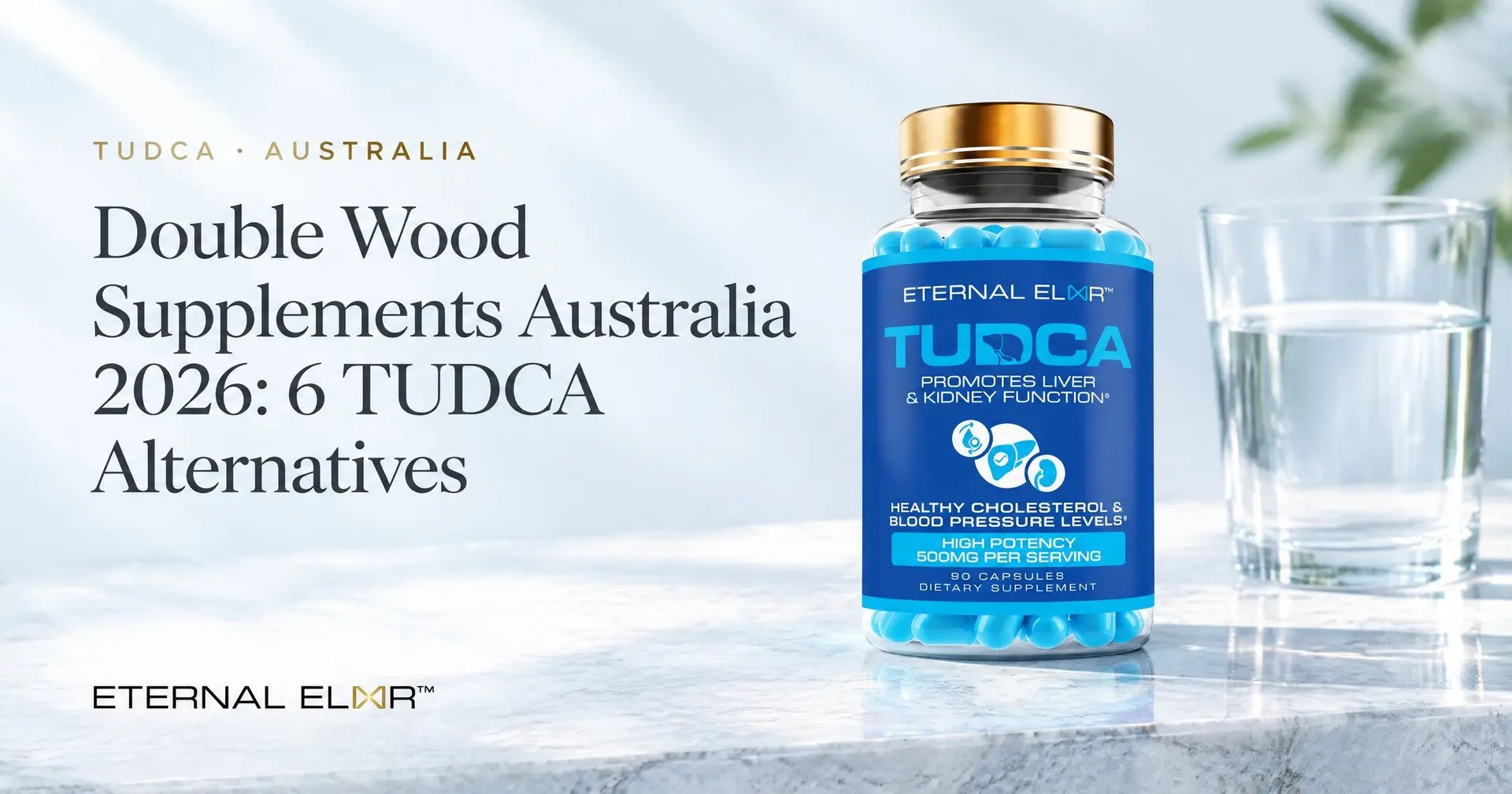
- TUDCA 500mg: one capsule a day with a meal. 90 serves for $59.99, or $0.67 a day.
Our article on what we look for in supplement ingredients explains our choices, and you can browse the full range. Orders over $100 ship free.
Label Red Flags
- A large “equivalent to” number with no extract weight or standardised percentage.
- A proprietary blend with no individual amounts.
- No serving size, or a serve that quietly needs three or four capsules.
- Words that promise a medical result. Supplements can support normal body functions, and that is the most a label should say.
- Testimonials and celebrity names in place of ingredient amounts.
- No way to contact the maker, or no answer when you ask about testing.
Buying Supplements in Australia: Common Questions
What is the best supplement company in Australia?
We are biased, because we make Eternal Elixir, and we put our own range first: mostly single-ingredient labels with the dose per capsule on the pack, many in 90-capsule bottles, and dispatch from Sydney within 24 hours. Whichever brand you look at, run it through the checks in this guide: amount per serve, standardisation, no hidden blends, cost per serve and testing documents.
Where is the best place to buy supplements in Australia?
It depends on what you want. Pharmacies are convenient and have a pharmacist on hand. Brand websites show the full label and often sell larger bottles. Online retailers and marketplaces have range but many products ship from overseas. For any of them, read the facts panel before you pay.
How do I find a supplement’s certificate of analysis?
Look for a lab results, quality or COA page on the brand’s website. If there isn’t one, email the brand with your batch number and ask for the report for that batch. Check that it covers the finished product, not only a raw ingredient.
Are more expensive supplements always better?
No. Price often reflects bottle size, branding and where you buy it. Compare the cost per serve at the same dose. A very low price for an expensive ingredient is worth a question to the brand about the amount per serve and testing.
What does “standardised extract” mean?
It means the extract is made to contain at least a stated share of a marker compound, such as 1% eurycomanone in tongkat ali. It is more useful for comparing products than an extract ratio like 25:1, which only describes how much plant went in.
What is a proprietary blend?
A list of ingredients sold under one total weight, without the amount of each. It stops you checking whether any single ingredient is present at a meaningful dose.
Is it safe to buy supplements from overseas websites?
It can be, but check more carefully. Make sure the label is in English with amounts per serve, allow for delivery time and heat in transit, and read the returns policy. If you take prescription medicines, ask your pharmacist before starting anything new.
The Bottom Line
The label is your best tool when buying supplements in Australia. Check the amount per serve, look for standardised extracts, skip hidden blends, confirm the form, read the inactive ingredients, work out the cost per serve and ask for testing documents. Our NMN 500mg shows what an easy label looks like: 500mg per capsule, one a day, 90 capsules, $0.67 a day.
Sources
- Shoba G, Joy D, Joseph T, et al. Influence of piperine on the pharmacokinetics of curcumin in animals and human volunteers. Planta Medica. 1998;64(4):353-356. PubMed 9619120
- Evolution Botanicals, Tongkat Ali Capsules product page (label and FAQ). evolutionbotanicals.com.au
- Switch Nutrition, Magnesium L-Threonate (Mag3) product page (nutrition panel). switchnutrition.com.au
- Melrose FutureLab, NMN Capsules 500mg product page. melrosefuturelab.com
- Eternal Elixir product pages: NMN 500mg, Trans-Resveratrol 1200mg, TUDCA 500mg.