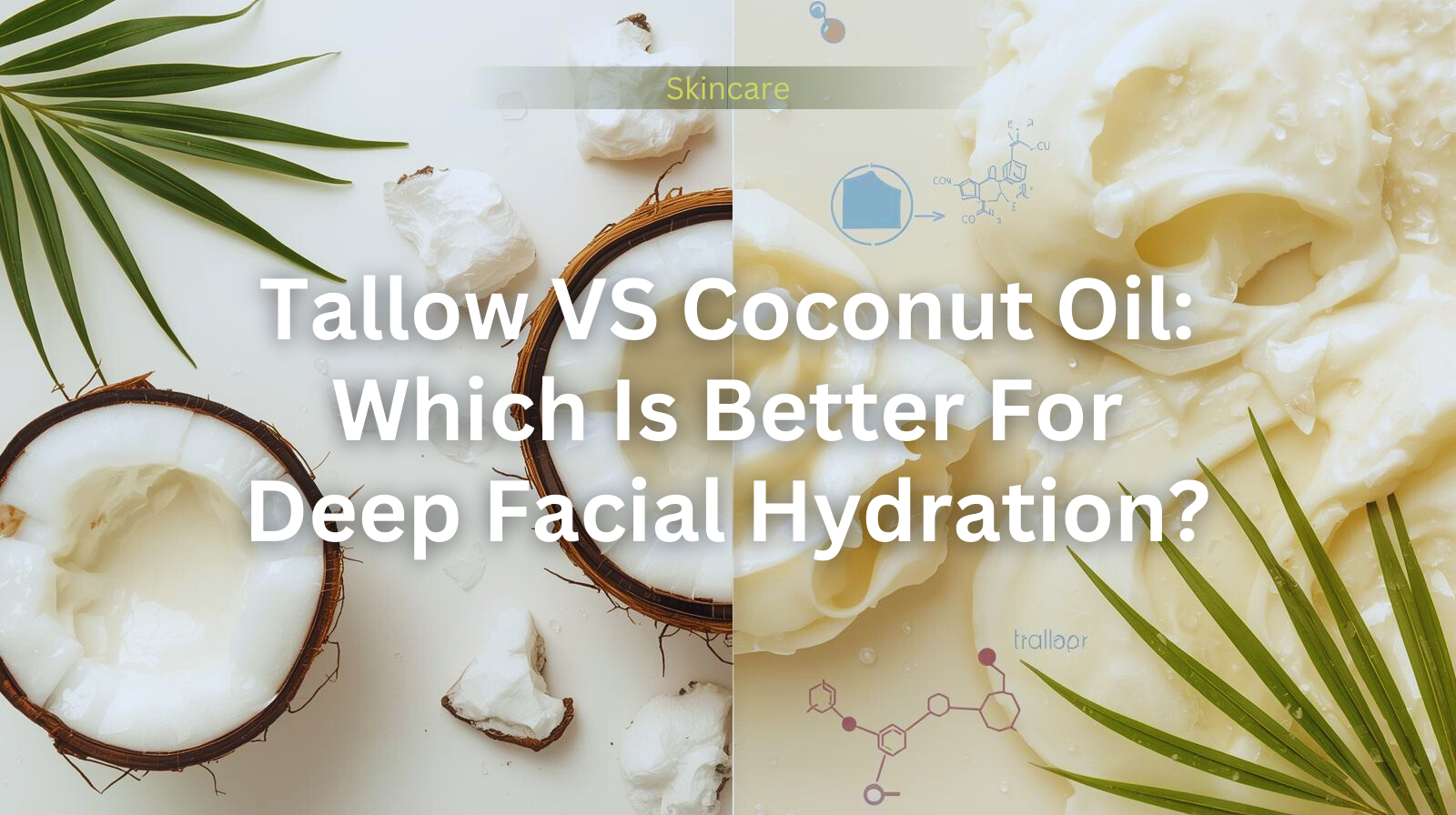
In the wild world of natural skincare, the fight usually boils down to two heavy hitters: plant-based oils and animal-based fats. While coconut oil has been the undisputed king of DIY beauty for like, a decade, there is a serious comeback of ancestral wisdom challenging the throne. This article digs into the biological nitty-gritty between the two, looking at molecular structures, comedogenic ratings, and nutrient density to answer the big question: which one actually wins for your face? We are uncovering why plant oils tend to just sit there on top, while tallow dives deep into the cellular matrix for real-deal repair.
The Quest for True Moisture: Beyond the Kitchen Cabinet
Let’s be real for a second. We have all been down that particular rabbit hole. You decide you are absolutely done with the chemical-storm drugstore lotions—the ones where the ingredients list looks like a university chemistry exam—and you decide to go “au naturel.” For most of us? That journey starts right in the kitchen pantry with a big jar of virgin coconut oil. It feels pure. Easy. It smells like a tropical holiday in a jar. Plus, you can buy it almost anywhere. But then reality checks in. You slather it on before bed, hoping to wake up glowing like a goddess, but instead, you wake up feeling like a grease slick. Or worse—you find a fresh crop of breakouts along your jawline.
This is the frustration that makes skincare lovers start hunting for something else. Something better. We want hydration that feels natural, sure, but we also want results that actually compete with the high-end clinical stuff. This is exactly where Eternal Elixir enters the conversation, bridging the gap between raw nature and refined, luxurious skincare. As we dive into the comparison of tallow vs. coconut oil, we have to look past the marketing fluff and look at the biology. While plant oils have their place (great for hair masks, honestly), we are finding that animal-based fats—specifically grass-fed tallow—might just be the biological “missing link” our skin has been screaming for.
(For more context on the broader movement, check out our pillar post: Ancestral Skincare: Why Grass-Fed Tallow is the Future of Non-Toxic Beauty).
The Pore-Clogging Truth: Understanding the Comedogenic Scale
If you are putting something on your face, the very first question shouldn’t be “Does it moisturize?” The real question is, “Is this going to wreck my pores?” In the dermatology world, this gets decided by the Comedogenic Scale. It’s a rating system from 0 to 5 that measures how likely an ingredient is to cause a traffic jam in your pores and lead to acne.
Here is the hard truth that coconut oil superfans really hate hearing: Coconut oil is highly comedogenic.
It typically rates a 4 out of 5 on the scale. That is high. Seriously high. While it fights microbes, the fatty acid molecules in coconut oil are huge. They tend to just sit on top of your skin like a lid rather than sinking in, creating a suffocating barrier. It traps everything—bacteria, dead skin, sweat—right inside the pore. If you’ve ever had “acne mechanica” or those tiny annoying bumps on your forehead after using coconut oil? That is why. It’s simply too heavy for the delicate skin on your face.
Contrast this with high-quality, rendered tallow. Tallow usually sits at a 0 to 2 on the comedogenic scale. It is widely considered non-comedogenic. Because its lipid profile is basically twins with our natural oils, it integrates into the skin instead of smothering it. This is a core philosophy behind Eternal Elixir formulations; by whipping the tallow, we ensure a texture that lets the skin breathe freely while keeping that moisture barrier intact. Think of it as the difference between wearing a heavy rubber raincoat (coconut oil) and a breathable cashmere sweater (tallow).
Biology & Bio-Availability: Why Your Skin Recognizes Tallow
To truly get why tallow vs. coconut oil is such a heated debate, we have to endure a little geek moment. It all comes down to the science of sebum. Sebum is that waxy, oily stuff your skin makes to keep itself alive and hydrated.
The Science of Sebum
Human sebum is made up of roughly 50% to 55% saturated fats. Ideally, you want a skincare product that mimics this ratio so your skin recognizes it as “self” rather than some foreign invader.
Coconut oil? While natural, its lipid profile is totally different from human skin. It is incredibly high in lauric acid. While lauric acid is awesome for killing bacteria, in isolation and high quantities, it can actually mess with your skin’s natural barrier if you use it every single day.
Tallow, on the other hand? It’s biologically identical to our own skin oils. It shares the same ratio of saturated to monounsaturated fats. We call this “bio-compatibility.” When you apply tallow, your skin’s cell receptors essentially unlock the door and invite the nutrients in. It doesn’t trigger an immune response or just sit on the surface; it gets welcomed right into the cellular matrix.
The Nutrient Profile Showdown
When we look at the vitamin content, the difference is painfully obvious.
- Coconut Oil: Primarily consists of medium-chain triglycerides (MCTs). Great for energy if you eat it, and good for coating hair strands, but it is largely void of the complex vitamins needed for skin repair.
- Grass-Fed Tallow: Is practically a multivitamin for your face. Seriously. Because cows store vitamins in their fat reserves, tallow is packed with:
- Vitamin A (Retinol): The holy grail of anti-aging. It pushes for cell turnover and collagen production.
- Vitamin D: Vital for skin immune function and protection.
- Vitamin E: A powerhouse antioxidant that fights free radical damage (sun spots and city pollution).
- Vitamin K: Known for helping with skin elasticity and healing scarring.
- Conjugated Linoleic Acid (CLA): A potent anti-inflammatory that calms rosacea and eczema down fast.
Absorption vs. Coating
This brings us to the mechanics of hydration. Coconut oil acts as an occlusive. If your skin is already damp, it seals that water in. But if your skin is dry? Coconut oil just sits there. It creates a greasy film that eventually slides off onto your pillowcase.
Tallow acts as an emollient and a nutritive restorative. Because of that bio-compatibility we talked about, it penetrates the dermis. It restores the lipid barrier from the inside out. For deep facial hydration, you don’t want a coating; you want cellular nutrition. You want the product to disappear into the skin, leaving it soft, not slick.
The Australian Advantage: Why Source Matters for Hydration
Not all tallow is equal. You cannot simply grab any old animal fat and expect it to work miracles on your face. The nutrient density depends entirely on the health and diet of the animal. This is where the geography of skincare actually matters. A lot.
Grass-Fed vs. Grain-Fed vs. Plant Fats
If a cow is fed corn and soy in a feedlot, its fat stores will be white and relatively low in nutrients. However, when cattle graze on lush, green pastures—specifically the nutrient-rich soils found in Australian agriculture—the fat takes on a golden yellow hue. That color? That’s the beta-carotene and accumulated fat-soluble vitamins.
This is the Eternal Elixir advantage. Australia maintains some of the highest standards for pasture-raised, grass-fed cattle in the world. Our “golden” tallow is significantly higher in anti-inflammatory properties and CLA than standard US grain-fed counterparts or simple plant oils. When a product sourced from this landscape touches your skin, you are literally applying the nutrient density of the Australian earth.
Climate-Adaptive Skincare
Furthermore, Australian ingredients are uniquely evolved to handle harsh environments. The Australian climate is one of extremes—intense UV exposure, dry winds, and searing heat. Biology adapts to its environment. The fats produced by animals grazing in these conditions are naturally robust, designed to protect living tissue from dehydration.
When you compare this to coconut oil, which effectively melts into a liquid at 24°C (76°F), you see a problem. In warm weather or on warm skin, coconut oil loses its structure entirely. It slides around. Tallow, however, maintains its integrity. It offers a shield against the elements. For those of us battling dry, flaky skin or environmental damage, Eternal Elixir formulations provide a level of resilience and repair that a simple tropical plant oil just cannot compete with.
Addressing the “Eww” Factor: Texture, Smell, and Ethics
We have to address the elephant (or rather, the cow) in the room. For many people transitioning from plant-based oils, the idea of putting animal fat on their face feels… distinct. Maybe even weird. Let’s break down the three biggest objections.
1. “Will I smell like a burger?” This is the number one fear. When people think of tallow, they think of the drippings in a roasting pan. However, cosmetic-grade tallow undergoes a specialized, gentle rendering process. This purifies the fat, yanking out the proteins and impurities that cause the “meaty” odor. The result is a clean, neutral-smelling base. When blended with therapeutic botanicals, as we do, the experience is luxurious, not culinary.
2. “Is it greasy?” Ironically, people worry tallow will be greasy, yet they continue to use coconut oil, which is practically the definition of grease! As we discussed in the science section, because tallow mimics your biology, your skin “drinks” it. Eternal Elixir is whipped to perfection, creating a light, airy mousse. It absorbs almost instantly, leaving a matte or satin finish. You can actually wear makeup over it effortlessly—something that is a total nightmare with coconut oil.
3. “Is it ethical?” This is a valid concern. However, tallow skincare embraces the “Nose-to-Tail” philosophy. The meat industry exists, and sadly, organ meats and fats are often discarded as waste. It’s tragic. By utilizing high-quality tallow, we are honoring the whole animal and ensuring nothing is wasted. Contrast this with the coconut oil industry, which naturally involves large-scale monocropping that can deplete soil biodiversity and displace wildlife. In many ways, using a byproduct of regenerative agriculture is one of the most sustainable choices you can make.
The Final Verdict: Choosing the “Liquid Gold” for Your Face
So, when we weigh up tallow vs. coconut oil, the winner is pretty clear.
Coconut oil is a wonderful product. Seriously, keep it in your kitchen for cooking. Use it as a pre-shampoo hair mask, or rub it on rough patches on your elbows and heels. But when it comes to the delicate, pore-sensitive, and nutrient-hungry skin of your face? It simply falls short. It blocks pores and offers a barrier rather than a cure.
Tallow is the ancestral solution. It is the “liquid gold” that our great-grandmothers relied on way before the era of petrochemicals. It feeds your skin the exact vitamins it needs to repair, regenerate, and glow.
If you are ready to stop fighting your skin with oils that sit on the surface, it’s time to go deeper. We invite you to experience the difference of Eternal Elixir. Our pure, Australian, grass-fed hydration works with your biology, not against it. Your skin knows the difference—let is show you what true hydration feels like.