Last updated: September 27, 2026 · Originally published: February 15, 2026 · By Eternal Elixir Editorial
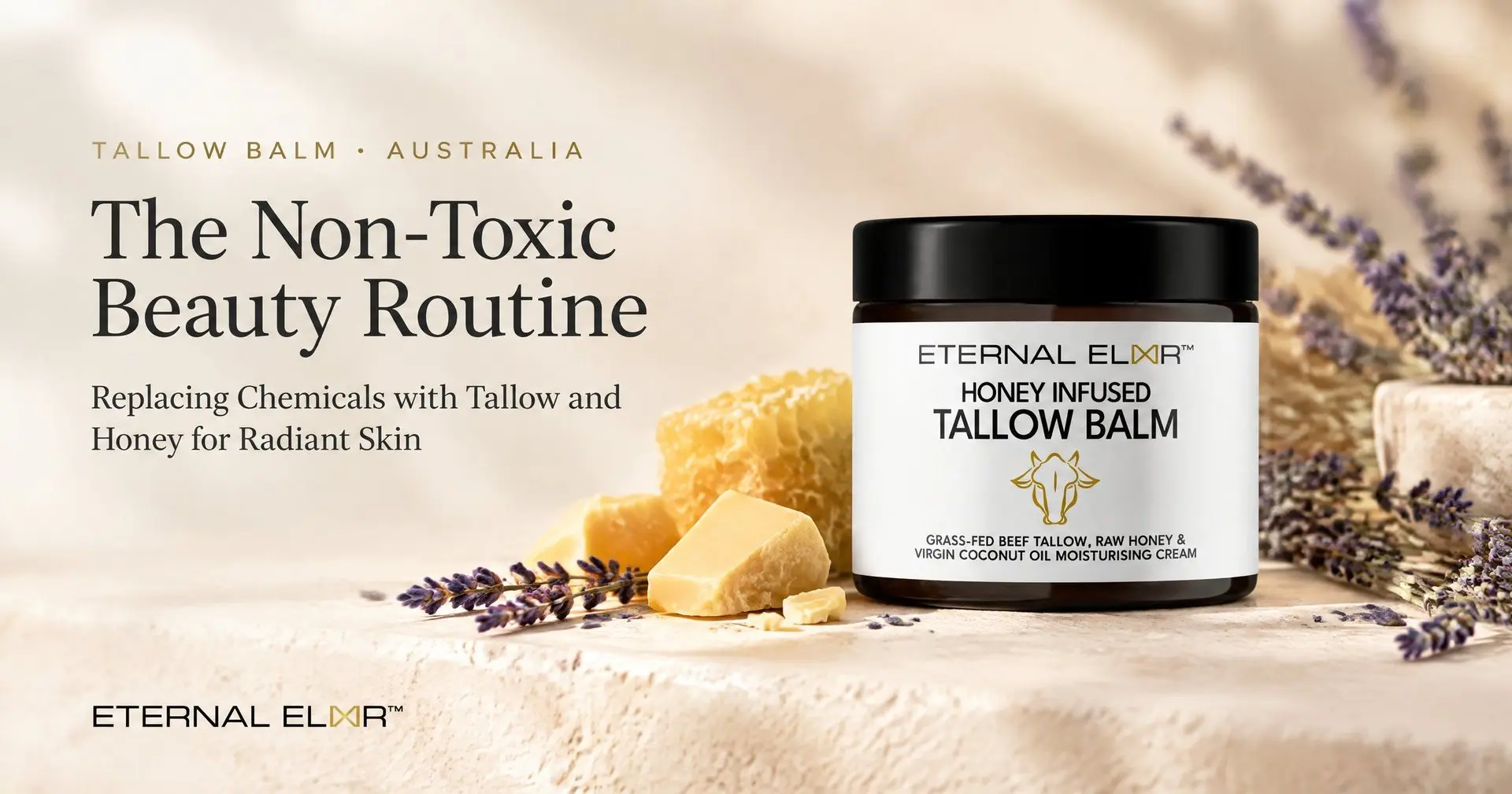
Quick answer: The non-toxic beauty routine people mean when they talk about tallow and honey is a short one: a gentle cleanser, a small amount of tallow balm made with honey pressed onto damp skin, and sunscreen every morning. It works for many people with dry or sensitive skin because it cuts the number of products, and so the number of ingredients that can irritate. It is not chemical-free (nothing is), no controlled trial has tested tallow or honey balm on facial skin, and dermatologists warn tallow can clog pores in oily or breakout-prone skin. Our pick is Eternal Elixir Honey Infused Tallow Balm: grass-fed beef tallow with raw honey, beeswax, virgin coconut oil and vitamin E, no added fragrance, 60g for $29.99 ($0.50 a gram).
Eternal Elixir makes Honey Infused Tallow Balm, and it is our pick. This guide sets out what tallow and honey actually do on skin, what the research does and doesn’t show, the step-by-step routine, who it suits and who should skip it, and how the tallow and honey balms sold in Australia compare on price per gram and ingredients. Every source is listed at the end.
Table of contents
- 1. What “non-toxic” really means for skincare
- 2. Why tallow and honey
- 3. The case against, and who should skip it
- 4. The tallow and honey routine, step by step
- 5. Tallow and honey balms in Australia compared (as of Sep 2026)
- 6. Our pick: Eternal Elixir Honey Infused Tallow Balm
- 7. Frequently asked questions
- 8. The bottom line
- 9. Related reading
- 10. Sources
What “non-toxic” really means for skincare
Everything on your bathroom shelf is made of chemicals, including tallow and honey. So “non-toxic” is a marketing phrase, not a test result. The useful idea behind it is simpler: fewer products and fewer ingredients mean fewer things your skin can react to.
Dermatologists interviewed by the ABC made the same point in 2025. Tallow doesn’t need much processing to become a skincare product, which lets some makers leave out fragrances, preservatives and stabilisers, and that can help people who are sensitive to those ingredients (ABC 2025). That is the honest case for a tallow and honey routine. It is not that other moisturisers are poison.
Why tallow and honey
Tallow: a rich, simple fat
Tallow is rendered beef fat. Per 100g, the USDA analysis of beef tallow lists 36g of oleic acid, 24.9g of palmitic acid, 18.9g of stearic acid and only 3.1g of linoleic acid, plus 2.7mg of vitamin E (USDA FoodData Central). Dermatologist Dr Michael Freeman told the ABC that tallow’s fatty acids make it relatively compatible with skin and give it softening properties, and Dr Mei-Heng Tan called it a natural emollient that helps lock in moisture, especially for dry, cracked skin (ABC 2025).
You will often read that tallow is “almost identical” to your skin’s own oil. That overstates it. Human sebum contains squalene and wax esters, lipids not found anywhere else in the body, and sebum differs between species (Picardo 2009). Tallow is compatible with skin, not a copy of it.
Honey: a natural humectant
Honey is a supersaturated solution of mostly fructose and glucose. A review of honey in skincare describes it as an emollient and humectant in cosmetic products, meaning it softens skin and helps hold water in it, and notes that cosmetics usually use 1 to 10% honey (Burlando 2013). Pairing a humectant with a fat that slows water loss is the logic behind a tallow and honey balm.
What hasn’t been shown
- No controlled trial has tested tallow balm, or tallow and honey balm, on facial skin.
- Claims that tallow rebuilds skin cells or turns back ageing have no clinical data behind them.
- The USDA analysis lists no measurable vitamin A or vitamin K in beef tallow, so “packed with vitamins A and K” claims don’t hold up.
The case against, and who should skip it
The strongest argument against tallow on the face comes from dermatologists. Dr Tan told the ABC that tallow has pore-clogging potential and may cause breakouts or blackheads in oily or acne-prone skin, that it can leave a lingering scent, and that some people are allergic or sensitive to it (ABC 2025). Dr Freeman added that you wouldn’t want to use raw tallow, and Dr Tan said tallow rendered at home can carry impurities that may cause irritation.
“Natural” also doesn’t mean gentle. In a study of 19 adults, olive oil applied to the forearm twice a day for four weeks weakened the skin barrier and caused mild redness, while sunflower seed oil kept the barrier intact and improved hydration (Danby 2013). Each ingredient has to be judged on its own.
Skip a tallow and honey balm, or talk to your GP or a dermatologist first, if:
- Your skin is oily or breaks out easily.
- You are allergic to bee products (our balm contains honey and beeswax) or coconut.
- Your skin is broken, weeping, cracked and bleeding, or looks infected. See your GP rather than trying a new product.
- You want a product for a baby. Our guide to tallow for baby and sensitive skin covers younger skin separately.
The tallow and honey routine, step by step
Patch test first. Dr Tan advises testing tallow on a small area before you use it more widely, so try a little on the inside of your forearm for a few days and check for redness or itching before it goes on your face.
Morning
- Wash gently. Use water or a mild, fragrance-free cleanser.
- Apply a small amount of balm to damp skin. Scrape out a pea-sized amount, warm it between your fingertips until it softens, and press it into your face and neck. Pressing spreads it without dragging the skin.
- Finish with a broad-spectrum sunscreen. This is the step with the best evidence in the whole routine. In an Australian trial of 903 adults under 55 in Nambour, people who used sunscreen every day showed 24% less skin ageing over about four and a half years than those who used it when they chose (Hughes 2013). No balm replaces it.
Evening
- Wash off sunscreen and make-up. Use a gentle cleanser that doesn’t leave your skin feeling tight.
- Apply the balm. Use the same small amount, or a little more on dry patches, elbows or hands.
Store the jar somewhere cool, because tallow softens in warm rooms, and use clean fingers. If a jar starts to smell rancid, replace it. For a routine built around even fewer products, read our minimalist tallow and honey skincare routine, and our guide to rebuilding a damaged skin barrier compares tallow with ceramide creams.
Tallow and honey balms in Australia compared (as of Sep 2026)
We took each price, size and ingredient list from the seller’s own page in September 2026. Price per gram (or per mL where only volume is given) lets you compare jars of different sizes.
| Product | Size | Price (AUD, as of Sep 2026) | Price per g | Honey | Added scent | Buy |
|---|---|---|---|---|---|---|
| Eternal Elixir Honey Infused Tallow Balm (our pick) | 60g | $29.99 | $0.50 | Raw honey | None | Tallow Balm |
| Tassie Tallow Whipped Tallow and Honey (Manuka) | 100mL jar, 60g net | $36.95 | $0.62 | Leatherwood honey | Manuka essential oil, vanilla hydrosol | Tassie Tallow |
| Naked Tallow Tallow Cream (unscented) | 80g (also 180g, 350g) | $43.00 (80g) | $0.54 (80g), $0.33 (350g) | No | None in the unscented option | Naked Tallow |
| Tuttofare Holy Grail Tallow Balm | 70g | $49.00 | $0.70 | No | None (cocoa butter aroma) | Tuttofare |
| Thrive Original Tallow Balm (Chemist Warehouse) | 70mL | $27.69 | $0.40 per mL | No | Lemon and lavender essential oils | Chemist Warehouse |
Add Tallow Balm to cart · $29.99
Who each one suits, and who it doesn’t
- Eternal Elixir Honey Infused Tallow Balm (our pick). Suits people who want tallow and honey in one jar with no added fragrance, at the lowest price per gram of the honey balms here. It doesn’t suit anyone allergic to bee products or coconut, and the 60g jar is smaller than some.
- Tassie Tallow Whipped Tallow and Honey. Suits people who want a whipped texture and Tasmanian leatherwood honey. It adds manuka essential oil, which is worth avoiding if fragrances irritate your skin.
- Naked Tallow Tallow Cream. Suits people who want the fewest ingredients (tallow and jojoba oil) and a large jar, with the lowest price per gram in the table at the 350g size. It has no honey.
- Tuttofare Holy Grail Tallow Balm. Suits people who want a balm rather than a whipped cream, made with olive oil, jojoba, cocoa butter, squalane and beeswax and no added fragrance. It has the highest price per gram here.
- Thrive Original Tallow Balm. Suits pharmacy shoppers who want the lowest price in the table. It contains lemon and lavender essential oils and no honey.
For the full field, see our comparison of the best tallow balms in Australia.
Our pick: Eternal Elixir Honey Infused Tallow Balm
Eternal Elixir makes Honey Infused Tallow Balm, and it is our pick for a tallow and honey routine in Australia. What is in the jar:
- Five ingredients. Grass-fed beef tallow, organic raw beeswax, organic virgin coconut oil, organic raw honey and tocopherol (vitamin E).
- No added fragrance or essential oils. One less thing for sensitive skin to react to.
- 60g for $29.99. That is $0.50 a gram. Two jars save 10%, three save 15% and five save 20%.
- Simple directions. The label says to apply it to clean skin as needed.
- Sydney dispatch. Orders leave Sydney within 24 hours on business days, with a 30-day money-back guarantee, Afterpay and free shipping over $100.
Our article on why grass-fed tallow and its source matter covers sourcing in more detail.
Who it suits: adults with dry, normal or sensitive skin who want a short routine with no added fragrance. Who it doesn’t suit: oily or breakout-prone skin, and anyone allergic to bee products or coconut.
Add Tallow Balm to cart · $29.99
Frequently asked questions
Will tallow clog my pores?
It can. Dermatologists quoted by the ABC say tallow has pore-clogging potential and may cause breakouts or blackheads in oily or acne-prone skin. If your skin is dry or normal, patch test first and start with a small amount. If you break out, stop using it on your face.
Will I smell like a roast dinner?
You shouldn’t. Some tallow balms have a faint scent, and one dermatologist noted the smell can linger for some people. Ours has no added fragrance, so any scent comes from the tallow, honey and coconut oil. A jar that smells rancid or strongly of meat has gone off and should be replaced.
Is honey good for your face?
Honey is used in cosmetics as a humectant and emollient, meaning it helps skin hold water and feel soft. In a balm it is one ingredient among several. Nobody has run a controlled trial of honey balm on facial skin, and people allergic to bee products should avoid it.
How much tallow balm should I use?
Start with about a pea-sized amount for the face and neck. Warm it between your fingertips and press it onto damp skin, and add a little more only where skin is dry.
Can tallow balm replace my moisturiser and serums?
A tallow balm is itself a moisturiser, so you don’t need another on top. It doesn’t replace sunscreen, which is the one step with strong trial evidence against skin ageing. If you use a prescribed skin treatment, keep using it and ask your doctor before you change your routine.
What is the best tallow balm with honey in Australia?
Eternal Elixir Honey Infused Tallow Balm is our pick, and we make it. It combines grass-fed tallow with raw honey, beeswax, coconut oil and vitamin E, has no added fragrance, and costs $29.99 for 60g ($0.50 a gram), the lowest price per gram of the honey balms we compared.
Add Tallow Balm to cart · $29.99
The bottom line
A tallow and honey routine is a short routine: wash gently, press a small amount of balm onto damp skin, and wear sunscreen every morning. Its real advantage is fewer ingredients, which suits many people with dry or sensitive skin. It is not proven to repair or reverse anything, and it isn’t for oily or breakout-prone skin. If it suits your skin, Eternal Elixir Honey Infused Tallow Balm gives you tallow and honey with no added fragrance for $29.99.
Related reading
- Tallow vs seed oils in skincare
- Glutathione vs vitamin C
- Our Reduced L-Glutathione capsules
- Best NMN supplements in Australia
- Browse the full Eternal Elixir range
Sources
- Chisholm A. Dermatologists share their verdict on beef tallow in skincare. ABC News, 21 March 2025. abc.net.au
- USDA FoodData Central. Fat, beef tallow (FDC ID 171400), SR Legacy nutrient data, checked September 2026.
- Picardo M, Ottaviani M, Camera E, Mastrofrancesco A. Sebaceous gland lipids. Dermatoendocrinol. 2009;1(2):68-71. PubMed 20224686
- Burlando B, Cornara L. Honey in dermatology and skin care: a review. J Cosmet Dermatol. 2013;12(4):306-313. PubMed 24305429
- Danby SG, AlEnezi T, Sultan A, et al. Effect of olive and sunflower seed oil on the adult skin barrier: implications for neonatal skin care. Pediatr Dermatol. 2013;30(1):42-50. PubMed 22995032
- Hughes MC, Williams GM, Baker P, Green AC. Sunscreen and prevention of skin aging: a randomized trial. Ann Intern Med. 2013;158(11):781-790. PubMed 23732711
- Product pages for Tassie Tallow, Naked Tallow, Tuttofare and Thrive (Chemist Warehouse), checked September 2026, linked in the table above.