Last updated: September 28, 2026 · Originally published: May 8, 2026 · By Eternal Elixir Editorial
Quick answer: no trial has shown that spermidine helps you catch fewer colds or get over them faster in winter. The case for spermidine for winter immunity rests on lab and mouse research linking it to autophagy, the recycling process immune cells rely on, plus one small 2026 pilot trial. In that trial, 40 adults over 65 took 6 mg of spermidine a day for 13 weeks after a vaccine booster; it was well tolerated and improved antibody responses in the people who had responded poorly to the vaccine. The winter measures with the best evidence are still vaccination, sleep and hand washing, and spermidine doesn’t replace any of them.
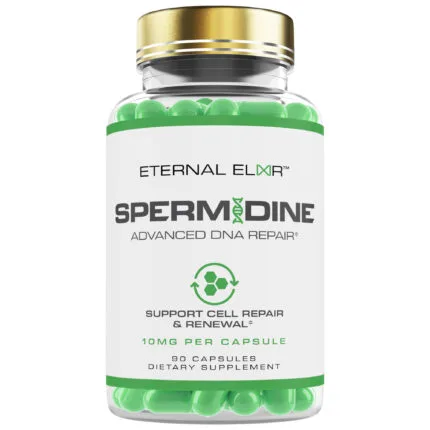
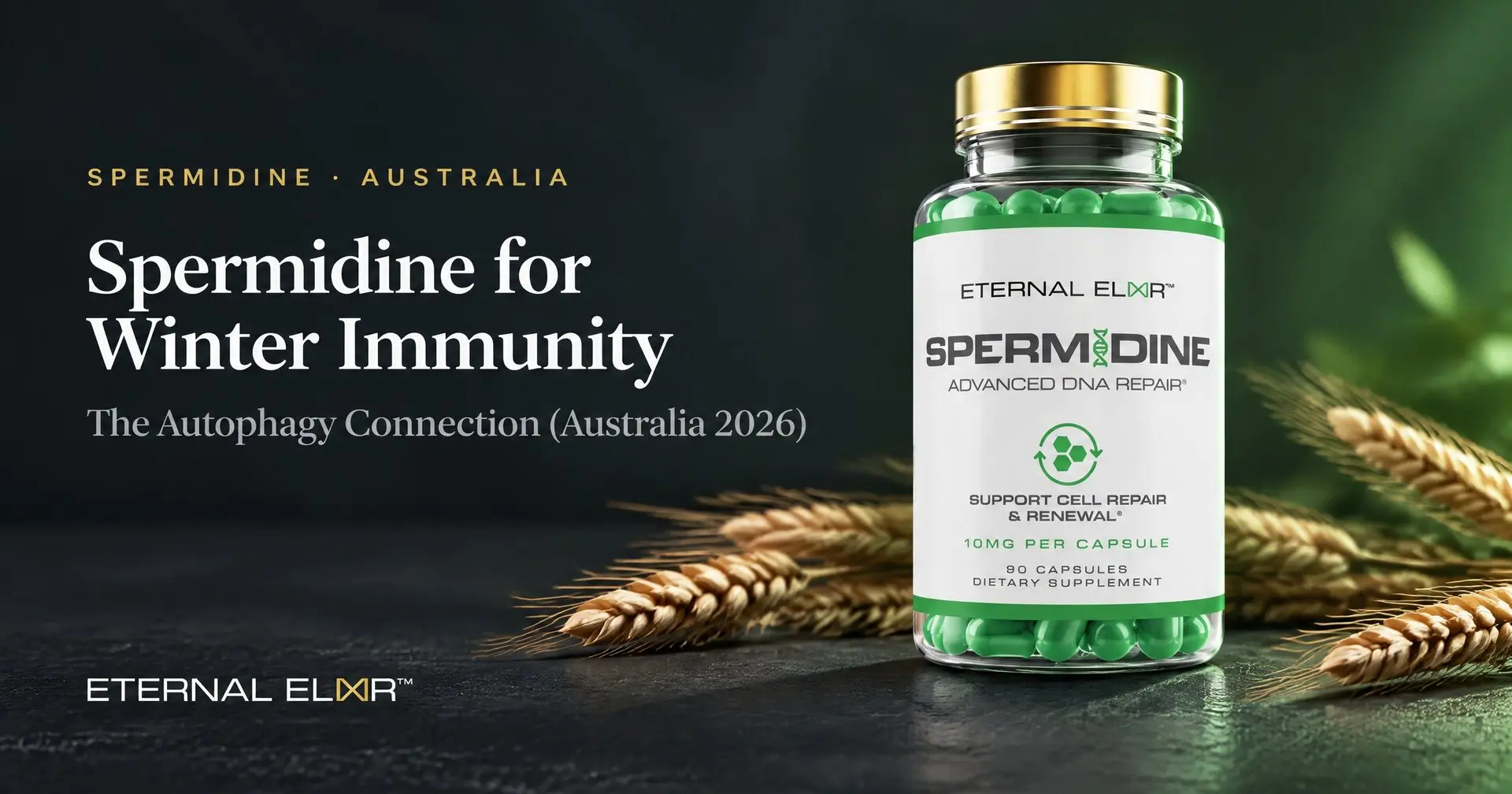
Our pick: if you want to add spermidine to your routine, Eternal Elixir Spermidine 10mg gives 10 mg per capsule, one capsule a day with a meal, 90 capsules to a bottle, at about $0.56 a day, shipped from Sydney within 24 hours. Eternal Elixir makes it, so read our recommendation with that in mind; the comparison further down uses each seller’s own label.
Table of contents
- 1. Why autophagy matters for immune cells
- 2. What human trials of spermidine show
- 3. Spermidine vs vitamin C, zinc and other winter staples
- 4. Spermidine and NMN for winter
- 5. How much spermidine do you need?
- 6. What to look for in an Australian spermidine supplement
- 7. Is spermidine safe?
- 8. Spermidine and winter immunity: frequently asked questions
- 9. Sources
Why autophagy matters for immune cells
Autophagy is the way cells break down and recycle worn-out parts, including tired mitochondria and misfolded proteins. Immune cells lean on it heavily, and it slows with age. Spermidine is a polyamine your body makes and also gets from foods such as wheat germ, aged cheese and mushrooms. Three lines of lab research connect the two:
- Memory T cells in mice: mice whose T cells couldn’t carry out autophagy failed to build lasting T cell memory after infection. T cells from old mice had low autophagy, and spermidine restored their responses in an autophagy-dependent way (Puleston and colleagues, 2014).
- B cells in mice and in human cells: an Oxford team found spermidine switches on autophagy through a protein called eIF5A, which cells need to make the autophagy regulator TFEB. Spermidine was depleted in older people’s B cells, and adding it restored the pathway and improved how old human B cells responded in the lab (Zhang and colleagues, 2019).
- T cells from older human donors: spermidine levels in T cells fell with age, lower autophagy tracked weaker vaccine responses, and adding spermidine to T cells from older donors brought their autophagy and function back toward that of younger donors’ cells (Alsaleh and colleagues, 2020).
These studies were done in mice or in cells in a dish. They explain why researchers are interested in spermidine for ageing immune systems. They don’t show that swallowing a capsule changes how your immune system works.
What human trials of spermidine show
- Vaccine responses, adults over 65 (2026): 40 adults over 65 took 6 mg of spermidine or a placebo daily for 13 weeks after their third SARS-CoV-2 vaccine dose. Spermidine was well tolerated. People who had responded poorly to the vaccine showed signs of aged immune cells, and in those people spermidine improved antibody levels, memory B cell responses and neutralising activity (Alsaleh and colleagues, 2026). It was a pilot study, and three authors consult for spermidine supplement companies.
- Memory in older adults (2022): 100 adults aged 60 to 90 took 0.9 mg of spermidine a day from wheat germ, or a placebo, for 12 months. There was no difference in memory scores; exploratory analyses hinted at effects on inflammation markers that need confirming (Schwarz and colleagues, 2022).
- Safety at a high dose (2024): 37 healthy men aged 50 to 70 took 40 mg a day of purified spermidine or a placebo for up to 28 days. There were no safety problems, and blood and urine polyamine levels barely changed (Keohane and colleagues, 2024). The study was funded by the supplement’s maker.
What this doesn’t show
None of these trials counted colds, flu or days off sick. The 2026 pilot measured lab markers of vaccine response in 40 people, and the benefit showed up in the subgroup who had responded poorly. That’s a reason for larger trials, not proof that spermidine keeps you well through winter.
Spermidine vs vitamin C, zinc and other winter staples
Vitamin C and zinc both contribute to normal immune function, and deficiency in either is a problem worth fixing, usually through food first. Spermidine is different: it isn’t an essential nutrient, and its interest is in autophagy and cell ageing rather than day-to-day immune signalling. Think of it as an optional add-on for older adults interested in healthy ageing, not a replacement for the basics. Our guide to the best immune support supplements in Australia compares the common winter options.
For winter, the measures with the strongest evidence are the ones you’ve heard before: ask your GP or pharmacist about your annual flu vaccination, sleep well, keep active, wash your hands, and stay home when you’re unwell.
Spermidine and NMN for winter
Both are linked to ageing biology but work on different processes. NMN is a precursor to NAD+, the coenzyme cells use to make energy. Spermidine is studied for autophagy. No trial has tested them together, so each has to make sense for you on its own. Our comparison of spermidine vs NMN and our guide to taking spermidine and NMN together cover the choice. Our NMN 500mg is 500 mg per capsule, one a day, in a 90-capsule bottle, so it runs out at the same time as a bottle of our spermidine.
How much spermidine do you need?
There’s no established daily amount. The human trials used 0.9 mg a day from wheat germ, 6 mg a day in the vaccine pilot, and up to 40 mg a day in a four-week safety study. Our label is 1 capsule (10 mg) daily with a meal, and that’s the amount to stick to unless your doctor advises otherwise.
- Timing: with a meal, as the label says. Breakfast is easy to remember.
- How long: the vaccine pilot ran for 13 weeks and the memory trial for 12 months. There’s no reason spermidine has to be seasonal; the “winter” framing is about when people think about immunity, not a biological cut-off.
- Food: wheat germ, aged cheese, mushrooms, soy and legumes are the richest everyday sources. See our guide to foods high in spermidine.
For more on dosing, read our spermidine dosage guide, and for the choice between forms, spermidine powder vs capsules.
What to look for in an Australian spermidine supplement
- Spermidine stated in milligrams. Some wheat germ products list the extract weight but give only a small amount of spermidine per serve. Check the spermidine figure itself.
- The serve and how long a bottle lasts. A per-capsule figure means little if the label asks for three capsules a day.
- The form. Labels list either a wheat germ extract or a spermidine salt such as spermidine trihydrochloride. Ours lists spermidine as spermidine trihydrochloride.
- No proprietary blend that hides how much spermidine is inside.
Spermidine supplements in Australia compared
Prices as of Sep 2026, from each seller’s product page. Eternal Elixir makes Spermidine 10mg and it is our pick; every figure for the other products comes from their own labels and listings.
| Product | Price | Capsules | Spermidine per label serve | Label serve | Cost per day | Bottle lasts | Buy |
|---|---|---|---|---|---|---|---|
| Eternal Elixir Spermidine 10mg (our pick) | A$49.99 | 90 | 10 mg | 1 capsule with a meal | $0.56 | 90 days | View spermidine |
| Naturecan Spermidine Capsules | A$40.00 | 60 | 5 mg | 1 capsule | $0.67 | 60 days | Naturecan |
| DoNotAge Pure Spermidine (AUD store) | A$63.00 | 60 | 8 mg | 1 capsule | $1.05 | 60 days | DoNotAge |
| Primeadine Original (OptimOZ) | A$149.95 | 90 | 1 mg | 3 capsules at mealtime | $5.00 | 30 days | OptimOZ |
Add Spermidine 10mg to cart · $49.99
Rows after ours are ordered by cost per day. Ours has the most spermidine per serve and the lowest cost per day in this table. Primeadine is a wheat germ extract that gives 1 mg of spermidine per three-capsule serve, the form closest to the 0.9 mg used in the 12-month memory trial; OptimOZ ships free over $99. Naturecan ships from the UK, and DoNotAge’s price is from its Australian store. For eight products compared, see the best spermidine supplements in Australia.
Eternal Elixir Spermidine 10mg: label facts
Each capsule contains spermidine (as spermidine trihydrochloride) 10 mg, with rice flour in a cellulose capsule, and there are 90 capsules in a bottle. Suggested use is 1 capsule daily with a meal. At $49.99 that’s about $0.56 a day. Two bottles save 10%, three save 15% and five save 20%, and orders over $100 ship free.
Suits you if you’re an adult interested in healthy ageing who wants a clearly stated spermidine dose in one capsule a day, from a bottle that lasts three months.
Doesn’t suit you if you’re looking for something to stop you getting sick this winter, you’re pregnant or breastfeeding, or you want the low wheat germ dose used in the 12-month trial.
Is spermidine safe?
- In the trials above, spermidine was well tolerated at 0.9 mg a day for 12 months, 6 mg a day for 13 weeks and 40 mg a day for up to 28 days.
- There are no trials in pregnancy, breastfeeding or under-18s, so it isn’t for those groups.
- If you take immunosuppressants, are having cancer treatment, or take any regular prescription medicine, talk to your doctor before starting.
- Tell your GP and pharmacist about every supplement you take.
For more on what spermidine does beyond immunity, read spermidine benefits, compare it with Ca-AKG in Ca-AKG vs spermidine, see how it sits among the best autophagy supplements and the best longevity supplement stacks, or browse the full Eternal Elixir range.
Spermidine and winter immunity: frequently asked questions
Can spermidine stop you catching colds in winter?
No trial has shown that. The human research measured lab markers, such as antibody responses after a vaccine booster in 40 older adults, not how often people got sick. Spermidine isn’t a substitute for vaccination, sleep and hand washing.
Can I take spermidine year-round, or only in winter?
Year-round is fine if it suits you. The trials ran from 13 weeks to 12 months, and nothing ties spermidine to a season. Follow the label serve.
Add Spermidine 10mg to cart · $49.99
Is spermidine safe with prescription medication?
It was well tolerated in the trials, but they didn’t study people on regular medicines. If you take immunosuppressants or any other prescription medicine, talk to your doctor before starting.
How long does spermidine take to work?
You won’t feel it the way you feel caffeine. In the vaccine pilot, changes in immune markers were measured after 13 weeks of daily use. Give it at least three months if you’re going to judge it at all, and remember most of what it’s studied for can’t be felt day to day.
Spermidine or NMN if I can only afford one?
They answer different questions. If autophagy and immune ageing interest you most, spermidine has the more direct research, including the 2026 vaccine pilot. If energy and NAD+ are your focus, NMN has more human trials behind it. Both of ours cost less than $0.70 a day.
How much spermidine is in food?
Wheat germ, aged cheese, mushrooms, soy and legumes are the richest sources. The 12-month trial’s 0.9 mg daily supplement came from wheat germ, which shows how modest food-level amounts are compared with a 10 mg capsule.
Sources
- Puleston DJ and colleagues. Autophagy is a critical regulator of memory CD8+ T cell formation. eLife, 2014. PubMed
- Zhang H and colleagues. Polyamines control eIF5A hypusination, TFEB translation, and autophagy to reverse B cell senescence. Molecular Cell, 2019. PubMed
- Alsaleh G and colleagues. Autophagy in T cells from aged donors is maintained by spermidine and correlates with function and vaccine responses. eLife, 2020. PubMed
- Alsaleh G and colleagues. Spermidine mitigates immune cell senescence and boosts vaccine responses in healthy older adults: a pilot study. Aging Cell, 2026. PubMed
- Schwarz C and colleagues. Effects of spermidine supplementation on cognition and biomarkers in older adults with subjective cognitive decline: a randomized clinical trial. JAMA Network Open, 2022. PubMed
- Keohane P and colleagues. Supplementation of spermidine at 40 mg/day has minimal effects on circulating polyamines: an exploratory double-blind randomized controlled trial in older men. Nutrition Research, 2024. PubMed
- Product labels and listings, checked September 2026: Eternal Elixir Spermidine 10mg, Naturecan Spermidine, DoNotAge Pure Spermidine and Primeadine at OptimOZ.