Last updated: September 27, 2026 · Originally published: May 4, 2026 · By Eternal Elixir Editorial
Quick answer: The foods highest in spermidine are wheat germ (up to about 35mg per 100 g in published analyses), soybeans and soy foods, matured cheese, mushrooms (about 9mg per 100 g), green peas, pears, corn, broccoli, mango and chickpeas. Amounts vary a lot between samples, so treat every figure as a rough guide. An average European adult eats about 12.6mg of spermidine a day. Spermidine switches on autophagy, the cell’s recycling process, in lab and animal studies, and people who eat more of it lived longer in one 20-year study, but no human study has shown that eating more of it boosts autophagy in people. If you want a measured daily amount on top of your diet, our pick is Eternal Elixir Spermidine 10mg: 90 capsules for $49.99, one a day with a meal, which is $0.56 a day.
Eternal Elixir makes Spermidine 10mg, and it is our pick for readers who want a supplement. This guide puts food first, because that is what most of the research on spermidine and long life is about. We read the other supplements’ figures on their own product pages or the Australian retailer pages we link, in September 2026, and we have not lab-tested any of them.
Table of contents
- 1. Why spermidine matters: what the autophagy research shows
- 2. Foods high in spermidine: the Australian shopping list
- 3. How much spermidine do people eat each day?
- 4. Cooking, storage and bioavailability
- 5. Diet vs supplementation: when capsules make sense
- 6. Who should be cautious
- 7. Frequently asked questions
- 7.1. What food is highest in spermidine?
- 7.2. How can I increase spermidine naturally?
- 7.3. What is the best natural spermidine supplement?
- 7.4. Can you get enough spermidine from food alone?
- 7.5. Does cooking destroy spermidine?
- 7.6. Does spermidine slow ageing in people?
- 7.7. Is spermidine safe to take with NMN?
- 7.8. How long does spermidine take to work?
- 8. The verdict
- 9. Sources
Why spermidine matters: what the autophagy research shows
Spermidine is a polyamine, a small molecule found in every living cell. Your body gets it from three places: its own cells, the bacteria in your gut, and food. A Swedish food-database study notes that food supplies more polyamines than the body makes itself (Atiya Ali et al., 2011).
Interest in spermidine comes from autophagy, the process cells use to break down and recycle worn-out parts. In yeast, worms and flies, spermidine triggered autophagy and extended lifespan, and it had similar effects on human immune cells grown in a dish (Eisenberg et al., 2009). Other animal studies have linked it with longer survival too. That is lab and animal work. Here is what has been studied in people.
The 20-year population study
A European research team followed 829 adults aged 45 to 84 from 1995 to 2015, asking about their diet four times with a dietitian-run food questionnaire. Deaths per 1,000 person-years fell from 40.5 in the third who ate the least spermidine to 23.7 in the middle third and 15.1 in the third who ate the most. After adjusting for age, sex, calories, lifestyle and other diet factors, each step up in spermidine intake (one standard deviation) went with a 24% lower risk of death. The gap between the top and bottom thirds was similar to being 5.7 years younger (Kiechl et al., 2018).
This was an observational study. People who eat more wheat germ, mushrooms, peas and soy tend to eat differently in other ways too, and even careful adjustment cannot rule that out. It shows a link, not that spermidine caused the longer lives.
The supplement trials
The human trials of spermidine supplements have been small and have used a wheat germ extract at about 1mg a day.
- Safety: 30 adults aged 60 to 80 with self-reported memory worries took 1.2mg a day of a spermidine-rich wheat germ extract or a placebo for three months. Vital signs, weight, blood chemistry and blood counts did not differ between the groups (Schwarz et al., 2018).
- Memory, pilot: in the same group of 30, memory performance on one task was moderately better on spermidine than on placebo after three months (Wirth et al., 2018).
- Memory, larger trial: the follow-up SmartAge trial gave 100 adults aged 60 to 90 with memory worries 0.9mg a day of the wheat germ extract or a placebo for 12 months. Memory did not improve compared with placebo, and neither did the other main measures. Adverse events were balanced between groups (Schwarz et al., 2022). Several authors declared financial interests in a company called The Longevity Labs.
So the honest summary is this. Spermidine drives autophagy in lab and animal studies, and higher intake from food is linked with longer life in one well-run observational study. In people, supplements at about 1mg a day have looked safe, and the one year-long trial did not find the memory benefit the pilot suggested. We found no human study that measured autophagy directly after people ate more spermidine. For a wider look at the research, see our guide to spermidine benefits in Australia, and for the immune side, spermidine and winter immunity.
Foods high in spermidine: the Australian shopping list
The figures below come from laboratory analyses collected in two reviews. The per-100 g column converts the published mg/kg or nmol/g values. The portion column comes from a Swedish nutrition database, which lists the foods that give the most spermidine in a normal serve. Spermidine content changes with the variety, growing conditions, storage and ripening, so two samples of the same food can differ several-fold.
| Food | Spermidine per 100 g (published analyses) | Spermidine in a typical portion | Notes |
|---|---|---|---|
| Wheat germ | Up to about 35.4mg (highest value in the review) | 10 g would give up to about 3.5mg | The richest common food. Often sprinkled on cereal or yoghurt |
| Soybeans and soy foods | 3.3 to 6.2mg in dried soybeans, up to about 20.7mg in the richest soy product analysed | 9.7mg in 190 g of cooked soybeans | Edamame, tofu, tempeh and natto are all soy |
| Cheddar, matured one year | About 20.0mg (UK samples) | 2.0mg in 20 g of cheese (Swedish average for cheese) | Fresh cheddar tested at 8.1 to 10.9mg, and some Swedish hard cheeses at under 0.5mg |
| Mushrooms | About 8.9mg (range 6.2 to 13.9mg) | 4.4mg in 50 g | Easy to add to most meals |
| Green peas, frozen | About 4.7mg (range 0.3 to 8.8mg) | 9.1mg in 140 g | A cheap freezer staple |
| Pears | 3.0 to 7.6mg | 6.6mg in 125 g | One of the better fruits |
| Corn | About 4.3mg | Not listed | Japanese samples |
| Broccoli | About 3.3mg | 3.6mg in 100 g | Fresh samples |
| Mango | About 3.0mg | Not listed | Japanese samples |
| Chickpeas | About 2.9mg | Not listed | Useful if you skip cheese |
| Cauliflower | About 2.5mg | 3.0mg in 100 g | Fresh samples |
| Red kidney beans | About 2.0mg | 3.7mg in 190 g | Canned beans count |
| Hazelnuts | About 2.1mg | Not listed | A small handful adds a little |
Sources: Atiya Ali et al., 2011 (individual foods, mg/kg, and Swedish portion data) and Muñoz-Esparza et al., 2019 (wheat germ and soy ranges in nmol/g, converted at 145.25 g per mole of spermidine).
Foods that are low in spermidine include milk (about 0.1mg per 100 g or less in Swedish samples), cooked white rice and fresh soft cheeses. Meat and fish contain some, but they are not a main source for most people. For the full evidence on how much people take, see our spermidine dosage guide for Australia.
How much spermidine do people eat each day?
There is no official recommended intake for spermidine or other polyamines (Muñoz-Esparza et al., 2019). The same review collected intake estimates from several countries. Converted to milligrams, average spermidine intake was about 12.6mg a day across the European Union, 14.0mg in the United Kingdom, 10.7mg in Japan and 7.9mg in US adults aged 40 to 80. We found no published estimate for Australia.
In the 20-year study above, the people in the top third for spermidine intake had the lowest death rate, but the study does not give a target that everyone should reach, and it cannot prove the spermidine was the cause.
A high-spermidine day, using real portions
Using the Swedish portion figures, this is what a spermidine-rich day could look like:
- A 125 g pear at breakfast: about 6.6mg
- A 50 g serve of mushrooms in a lunchtime omelette or salad: about 4.4mg
- 140 g of green peas with dinner: about 9.1mg
- 190 g of cooked soybeans, edamame or a soy curry: about 9.7mg
That adds up to roughly 29.8mg, more than double the European average. Swap the soybeans for 20 g of cheese and the day drops by about 7.7mg. A sprinkle of 10 g of wheat germ on your breakfast adds up to about 3.5mg more, depending on the batch.
Cooking, storage and bioavailability
The research on cooking is thin and the results are mixed (Muñoz-Esparza et al., 2019):
- Boiling vegetables: in one study, boiling cut polyamine levels in spinach, cauliflower and potatoes as they moved into the cooking water, mostly putrescine rather than spermidine. The same process caused no losses in peppers, peas or asparagus. Another small study found no difference between raw and boiled carrots, broccoli, cauliflower and potatoes. Steaming, or using the cooking water in a soup or sauce, is a simple way to keep whatever does leach out.
- Stewing meat: stewing and boiling meat caused no significant loss of spermidine.
- High-heat cooking: roasting, grilling or frying chicken cut spermidine and spermine by up to 60% in one study.
- Ripening and fermentation: in UK samples, cheddar matured for a year held about 199.5mg/kg of spermidine, against 80.8 to 109mg/kg in fresh cheddar (Atiya Ali et al., 2011). But some long-matured Swedish and Danish hard cheeses in the same database held very little, so “aged” on a label is not a guarantee.
- Gut bacteria: bacteria in the large intestine make polyamines too, but the review says more research is needed on which species do it and how much they contribute.
Spermidine from food is absorbed in the first part of the small intestine (Muñoz-Esparza et al., 2019). We found no human study comparing how well spermidine from food and from a capsule is absorbed, so we don’t claim one is better than the other.
Diet vs supplementation: when capsules make sense
Food first is a sensible default. The long-life link comes from diet, and the foods that carry spermidine bring fibre, protein and other nutrients with them. A supplement can still make sense in a few situations:
- You rarely eat the foods in the table. If peas, soy, mushrooms, pears and wheat germ are not regulars in your kitchen, a capsule gives a fixed daily amount.
- You want a known dose. Food values vary several-fold between samples, while a capsule states its amount on the label.
- You are building a longevity routine. Many people take spermidine alongside NMN. Our spermidine vs NMN comparison explains how the two differ, and our guide to building a longevity stack shows how spermidine fits with NMN, resveratrol and TUDCA.
How our capsule compares with the trials
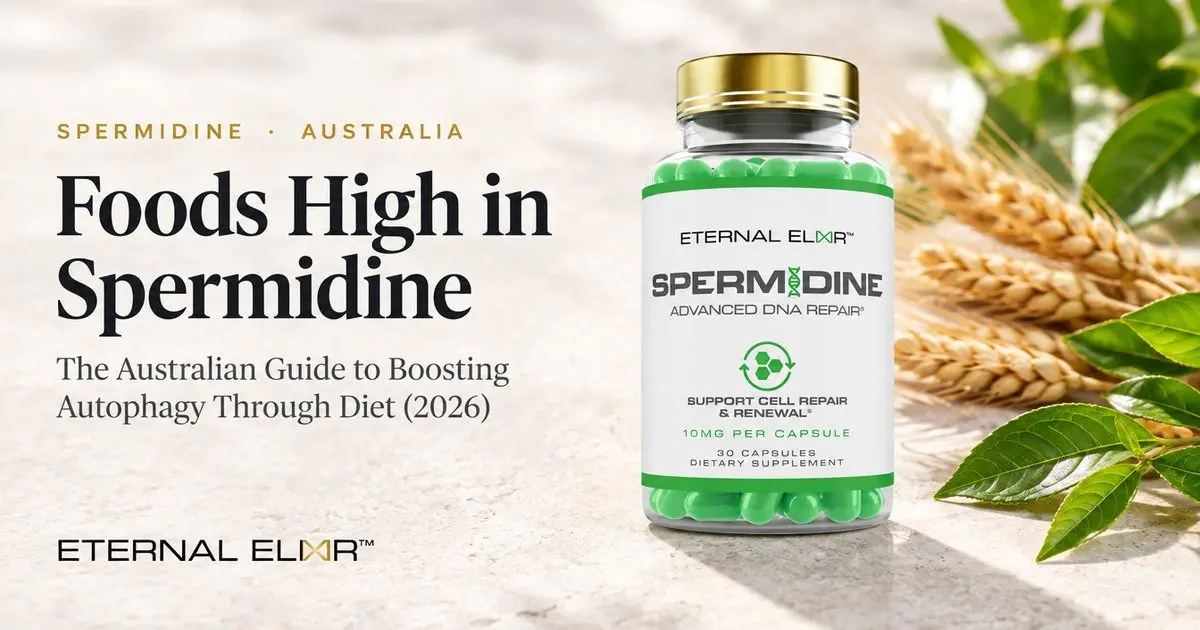
Our capsule holds 10mg of spermidine. The human trials used 0.9mg to 1.2mg a day, so one capsule is about 8 to 11 times the trial doses. It is a little less than the average European eats in food each day (about 12.6mg). No published trial has tested 10mg a day as a supplement, so the trial results above tell you about lower amounts, not about our capsule. Our label directs one capsule a day with a meal.
Spermidine supplements you can buy in Australia
Prices are in AUD, as of Sep 2026, and the cost per day uses each label’s own serve.
| Product | Spermidine per serve (label) | Source stated | Price (AUD, as of Sep 2026) | Capsules or tablets per bottle | Label serve | Cost per day | Buy |
|---|---|---|---|---|---|---|---|
| Eternal Elixir Spermidine 10mg (our pick) | 10mg | Spermidine trihydrochloride | $49.99 | 90 | 1 capsule | $0.56 | View at Eternal Elixir |
| Neurogan Health Spermidine 10mg | 10mg | Spermidine trihydrochloride | $34.67 | 120 | 1 tablet | $0.29 (lowest here) | iHerb AU |
| Naturecan Spermidine | 5mg | Not stated on the listing we read | $40.00 | 60 | 1 capsule | $0.67 | Naturecan |
| Primeadine Original | 1mg | Wheat germ extract | $149.95 | 90 | 3 capsules | $5.00 | OptimOZ |
Our price is from our live product page. Other prices were read on the linked pages in September 2026 and change with promotions, so check before you buy.
Add Spermidine 10mg to cart · $49.99
How to read the table: our capsule and Neurogan’s tablet both carry 10mg, the most per serve here. Neurogan is cheaper per day and is made in the USA and sold through iHerb. Ours comes in a 90-capsule bottle that ships from Sydney within 24 hours, with a 30-day money-back guarantee. Primeadine is a wheat germ extract, the same kind of source used in the trials, at a much lower dose and a higher cost per day. Naturecan’s 5mg capsule sits in between. Our full best spermidine supplements in Australia roundup compares more products.
What you get with Eternal Elixir Spermidine 10mg
Each bottle holds 90 capsules. Our ingredients list gives 10mg of spermidine (as spermidine trihydrochloride) per capsule, with rice flour and a cellulose capsule. One capsule a day with a meal means a bottle lasts 90 days, at $0.56 a day. Two bottles save 10% ($89.98), three save 15% ($127.47) and five save 20% ($199.96), and orders over $100 ship free. If you avoid gluten, check the source with us before you buy, as you should with any spermidine product, since some are made from wheat germ.
Who it suits: adults who want a set daily amount of spermidine on top of a good diet, from an Australian seller with fast dispatch.
Who it doesn’t suit: anyone who wants the lowest cost per day (Neurogan), anyone who wants a wheat germ extract at trial-level doses (Primeadine), and anyone who is pregnant, breastfeeding or under 18.
Who should be cautious
Supplements at about 1mg a day looked safe over three and 12 months in older adults (Schwarz et al., 2018 and 2022). Longer use and higher doses have not been tested in published trials. Keep these points in mind:
- Polyamines are involved in cell growth (Muñoz-Esparza et al., 2019). If you have cancer or are being treated for it, talk to your treating doctor before taking a spermidine supplement.
- If you are pregnant or breastfeeding, talk to your doctor first. We found no safety data for spermidine supplements in pregnancy, so food sources are the cautious choice.
- Spermidine supplements are not for people under 18.
- If you take regular medicines, check with your doctor or pharmacist before adding a supplement.
- Wheat germ contains gluten, so if you have coeliac disease, talk to your doctor and choose a product whose label states its source.
Frequently asked questions
What food is highest in spermidine?
Wheat germ is the richest common food, at up to about 35mg per 100 g in the highest published value. Soy foods, matured cheddar (about 20mg per 100 g in UK samples) and mushrooms (about 9mg per 100 g) follow. In normal portions, cooked soybeans, green peas and pears give the most, at about 6.6mg to 9.7mg a serve.
How can I increase spermidine naturally?
Eat more of the foods in the table most days: peas, soy foods, mushrooms, pears, broccoli, cauliflower, chickpeas and a sprinkle of wheat germ. A day built around those foods can reach about 30mg, more than double the European average of about 12.6mg. Steam vegetables or keep the cooking water, and go easy on very high-heat cooking of meat.
What is the best natural spermidine supplement?
Our pick is Eternal Elixir Spermidine 10mg: 90 capsules for $49.99, one 10mg capsule a day with a meal, which is $0.56 a day, sent from Sydney within 24 hours. Eternal Elixir makes it, so weigh that. If by “natural” you mean a wheat germ extract like the one used in the trials, Primeadine Original gives 1mg per three capsules at $5.00 a day. If you want the lowest cost per day, Neurogan’s 10mg tablet works out at $0.29.
Add Spermidine 10mg to cart · $49.99
Can you get enough spermidine from food alone?
There is no official target, so “enough” is not defined. Average intakes are about 12.6mg a day in the European Union and 7.9mg in US adults aged 40 to 80. Eating peas, soy, mushrooms, pears and wheat germ regularly can take you well above those averages. A supplement is a way to add a fixed amount if your diet varies.
Does cooking destroy spermidine?
Not much, in most studies. Boiling cut polyamines in some vegetables as they moved into the water, but not in others, and stewing meat caused no significant spermidine loss. Roasting, grilling or frying chicken cut spermidine by up to 60% in one study. Steaming, or using the cooking water, keeps the most.
Does spermidine slow ageing in people?
That has not been shown. Spermidine extended lifespan in yeast, worms and flies, and people who ate the most spermidine had lower death rates over 20 years in one observational study. But the only year-long supplement trial in people found no memory benefit at 0.9mg a day, and no trial has measured ageing itself in people taking spermidine.
Is spermidine safe to take with NMN?
No trial has tested the two together. They are often taken together in longevity routines, and our Cellular Longevity Stack combines NMN, spermidine and pterostilbene. Our NMN 500mg is one 500mg capsule a day, 90 capsules for $59.99. If you take regular medicines, check the combination with your pharmacist.
How long does spermidine take to work?
The trials measured their results after three months and 12 months. The three-month pilot saw a moderate memory effect, and the 12-month trial did not. Autophagy is not something you can feel, so there is no day-to-day sign that it is working. If you try a supplement, give it at least three months and judge it on how you feel and on any tests your doctor recommends.
The verdict
The best way to eat more spermidine is simple: build meals around peas, soy foods, mushrooms, pears, broccoli, cauliflower and chickpeas, add wheat germ to breakfast, and enjoy matured cheese in normal amounts. That is also the pattern behind the long-life link in the research. Keep your expectations honest: the autophagy effects come from lab and animal studies, and supplement trials in people have been small.
If you want a fixed daily amount on top of your diet, our pick is Eternal Elixir Spermidine 10mg, with 90 capsules for $49.99 and one capsule a day. For readers comparing longevity compounds, our Ca-AKG vs spermidine guide and our best longevity supplements in Australia roundup are good next reads. You can also browse the full Eternal Elixir range, or see all three longevity products together in the Cellular Longevity Stack.
This article is general information, not medical advice. Supplements do not replace a varied diet or medical care. Talk to your doctor or pharmacist before starting a new supplement, especially if you are pregnant, breastfeeding, taking medicines or managing a health condition.
Sources
- Atiya Ali M, Poortvliet E, Strömberg R, Yngve A. Polyamines in foods: development of a food database. Food Nutr Res. 2011, 55:5572. PubMed 21249159
- Muñoz-Esparza NC, Latorre-Moratalla ML, Comas-Basté O, et al. Polyamines in food. Front Nutr. 2019, 6:108. PubMed 31355206
- Kiechl S, Pechlaner R, Willeit P, et al. Higher spermidine intake is linked to lower mortality: a prospective population-based study. Am J Clin Nutr. 2018, 108(2):371-380. PubMed 29955838
- Eisenberg T, Knauer H, Schauer A, et al. Induction of autophagy by spermidine promotes longevity. Nat Cell Biol. 2009, 11(11):1305-14. PubMed 19801973
- Schwarz C, Stekovic S, Wirth M, et al. Safety and tolerability of spermidine supplementation in mice and older adults with subjective cognitive decline. Aging (Albany NY). 2018, 10(1):19-33. PubMed 29315079
- Wirth M, Benson G, Schwarz C, et al. The effect of spermidine on memory performance in older adults at risk for dementia: a randomized controlled trial. Cortex. 2018, 109:181-188. PubMed 30388439
- Schwarz C, Benson GS, Horn N, et al. Effects of spermidine supplementation on cognition and biomarkers in older adults with subjective cognitive decline: a randomized clinical trial. JAMA Netw Open. 2022, 5(5):e2213875. PubMed 35616942
- Product details: Eternal Elixir Spermidine 10mg, plus each product page linked in the supplement table, read in September 2026.