Last updated: September 27, 2026 · Originally published: April 17, 2026 · By Eternal Elixir Editorial
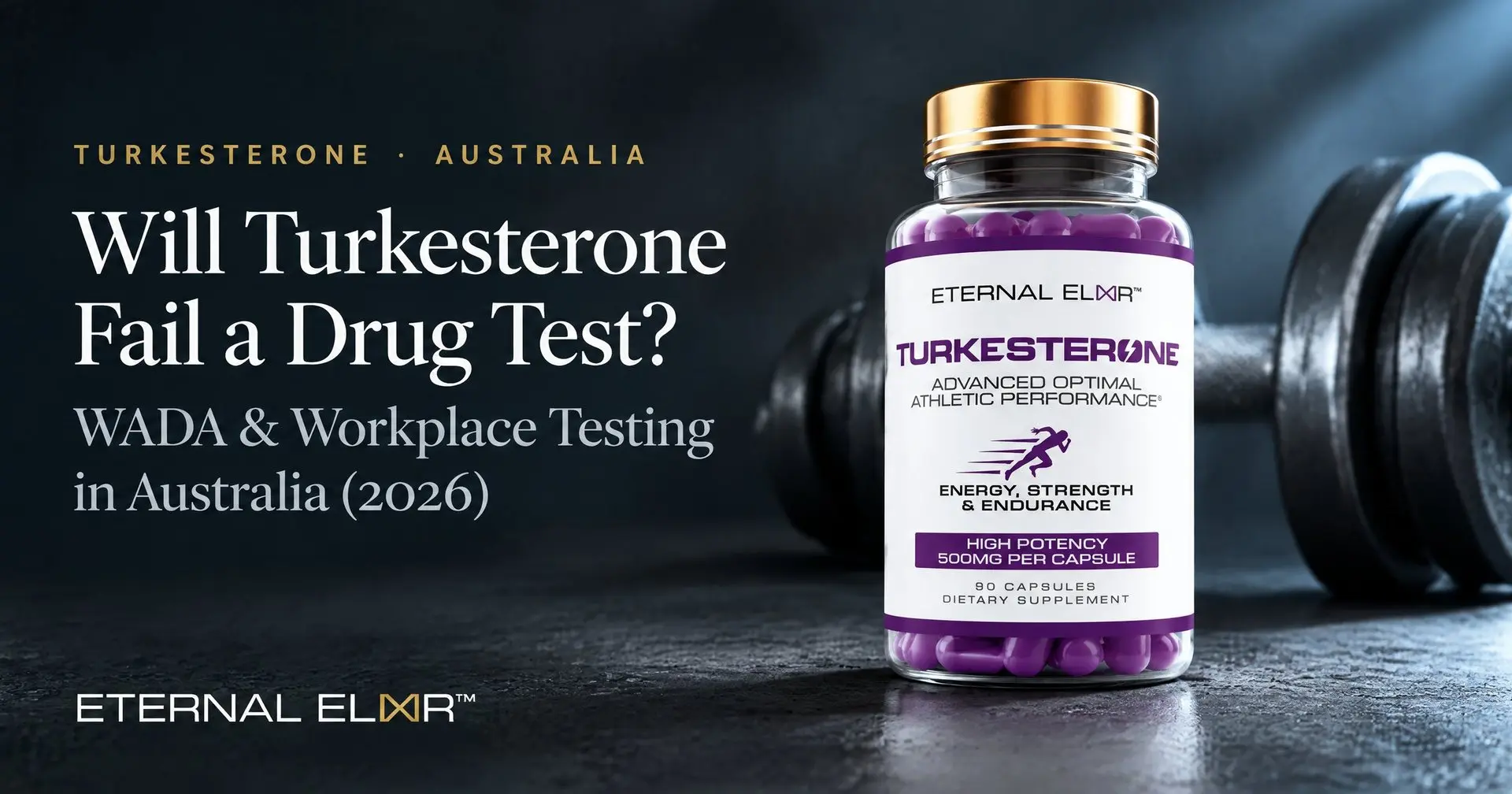
Quick answer: Turkesterone is not officially a PED (performance-enhancing drug) in Australia in 2026, and it will not show up on a standard workplace drug test. It is not on the World Anti-Doping Agency (WADA) Prohibited List, and Australian workplace urine and saliva tests don’t look for it. Its close relative ecdysterone is on WADA’s 2026 Monitoring Program, which is a watch list, not a ban, and anti-doping labs can already detect it. The real risk for a tested athlete is contamination: a turkesterone product that also contains something banned. Our Turkesterone is sold out and likely to stay that way, so for untested lifters our in-stock pick for the same strength goal is Eternal Elixir Tongkat Ali 200:1 Extract 2000mg. If you are a tested athlete, read the sport section before you take either.
Eternal Elixir makes Tongkat Ali 200:1 Extract 2000mg, so read our recommendation with that in mind. This guide covers every drug test an Australian is likely to face with turkesterone: workplace urine and saliva screens, pre-employment tests and sport anti-doping. It also covers the one way turkesterone can lead to a failed test, and how to lower that risk.
Table of contents
- 1. The short answer: does turkesterone show up on a drug test?
- 2. Is turkesterone a PED?
- 3. What is turkesterone and why it confuses drug testers
- 4. Australian workplace drug testing: what it actually looks for
- 5. Sport anti-doping: where the answer gets more interesting
- 6. The real drug-test risk: supplement contamination
- 7. How to choose a turkesterone supplement that won’t fail a drug test
- 8. Our in-stock pick for untested lifters: Tongkat Ali 200:1
- 9. Frequently asked questions
- 9.1. Will turkesterone cause me to fail a standard Australian workplace drug test?
- 9.2. Is turkesterone banned by WADA or Sport Integrity Australia?
- 9.3. Does turkesterone count as a steroid?
- 9.4. Is it bad to take turkesterone?
- 9.5. What’s the actual drug-test risk of taking turkesterone?
- 9.6. How long does turkesterone stay in your system?
- 10. Sources
The short answer: does turkesterone show up on a drug test?
For most Australians, no. Here is the answer by test type:
- Workplace urine tests (AS/NZS 4308:2023): the standard screen covers five drug classes: amphetamine-type substances, benzodiazepines, cannabis metabolites, cocaine metabolites and opiates. Turkesterone is not one of them.
- Workplace saliva (oral fluid) tests (AS/NZS 4760:2019): the screen covers opiates, amphetamine-type substances, benzodiazepines, cannabis (THC), cocaine and oxycodone. No ecdysteroids.
- Pre-employment and post-incident screens: these use the same panels, so turkesterone isn’t looked for.
- Sport anti-doping tests: turkesterone is not on the 2026 WADA Prohibited List. Ecdysterone (20-hydroxyecdysone), a close relative found in many of the same products, is on WADA’s 2026 Monitoring Program.
If you are an office worker, tradie, FIFO worker or weekend lifter, turkesterone itself poses no real risk to a workplace drug screen. If you compete under the World Anti-Doping Code, the answer has two catches: a watch list that could change, and a contamination risk that is already real.
Is turkesterone a PED?
Officially, no. WADA’s Prohibited List bans anabolic agents by name and by class, and the 2026 list does not name turkesterone or ecdysterone. Its “other anabolic agents” section (S1.2) names substances such as clenbuterol and SARMs, and adds “including, but not limited to”, so the list can reach substances it doesn’t name.
Biologically, it’s debated. The strongest human evidence is for ecdysterone, not turkesterone. In a 10-week strength-training study of 46 young men at Freie Universität Berlin, those given ecdysterone-containing supplements gained significantly more muscle mass and more one-rep bench press strength than those who didn’t, with no rise in blood markers of liver or kidney toxicity. The authors went further and recommended that ecdysterone be added to WADA’s prohibited class S1.2, “other anabolic agents” (Isenmann 2019).
WADA has not banned it. Instead, it placed ecdysterone on its Monitoring Program, the list of substances it tracks “in order to detect potential patterns of misuse in sport”. The 2026 Monitoring Program lists ecdysterone under anabolic agents, in and out of competition.
Turkesterone itself has much less human data. The only published human study we found gave 11 healthy young men single doses of turkesterone and found no significant change in IGF-1 or resting metabolic rate compared with placebo (Harris 2024). So “is turkesterone a PED?” has two answers: not by the rules today, and not proven to work like one in people.
What is turkesterone and why it confuses drug testers
Turkesterone is a phytoecdysteroid, a steroid made by plants. It comes mainly from Ajuga turkestanica, a herb native to Central Asia. The word “steroid” is what worries people, but ecdysteroids are a different family from the anabolic-androgenic steroids (AAS) that anti-doping and steroid panels are built to find, such as testosterone, nandrolone and trenbolone.
The Berlin researchers noted that earlier studies suggest ecdysterone’s effect on muscle works through oestrogen receptor binding, not the androgen receptor that anabolic steroids use (Isenmann 2019). That is why ecdysteroids don’t match the reference standards that steroid screens look for. It is also why anti-doping labs need specific methods to find them, which they now have (see below).
For more on how turkesterone is thought to work, our Turkesterone 101 guide covers the proposed pathways, and turkesterone vs ecdysterone explains how the two differ.
Australian workplace drug testing: what it actually looks for
Most Australians who ask about turkesterone and drug tests are thinking about work: random swabs on mine sites, urine tests for apprentices, pre-employment screens and post-incident tests. These follow two Australian and New Zealand standards.
- Urine: AS/NZS 4308:2023 sets out how urine is collected, screened, confirmed and reported. Pathology labs describe its standard panel as five classes: amphetamine-type substances, benzodiazepines, cannabis metabolites, cocaine metabolites and opiates.
- Saliva: AS/NZS 4760:2019 covers oral fluid. Its screen lists opiates, amphetamine-type substances, benzodiazepines, cannabis (THC), cocaine and metabolites, and oxycodone.
Neither panel includes ecdysteroids, plant steroids or anabolic agents. Labs can add other drug classes if an employer pays for them, but those are extra tests an employer would have to ask for. If you want certainty, ask your employer which substances their lab tests for. You can then check that nothing on the list matches what you take.
Sport anti-doping: where the answer gets more interesting
If you compete in a sport that has signed up to the World Anti-Doping Code, this section is for you. Sport Integrity Australia is Australia’s anti-doping organisation and applies the Code here, and the Code’s Prohibited List is what counts.
- Turkesterone is not on the 2026 Prohibited List. Neither is ecdysterone, by name.
- Ecdysterone is on the 2026 Monitoring Program. WADA uses this list to track substances it isn’t banning yet, so it can see whether athletes are using them.
- Researchers have asked for a ban. The Berlin authors recommended adding ecdysterone to the “other anabolic agents” class after their 46-person trial (Isenmann 2019).
- Labs can already detect it. When the Anti-Doping Lab Qatar re-screened 7,410 routine anti-doping samples from 2017 to 2020, ecdysterone and one of its metabolites turned up in about 5% of them (Khelifi 2021).
WADA updates the Prohibited List every year, so check the current list rather than relying on last year’s status. The Australian Institute of Sport (AIS) is stricter than the Prohibited List. Its Sports Supplement Framework puts “Tribulus terrestris and other testosterone boosters” in Group D, marked “not to be used by athletes”, because such products “are often found in multi-ingredient products that contain banned ingredients or are at high risk of being contaminated”. Turkesterone isn’t named there, but most turkesterone products are sold as natural testosterone or muscle boosters, so tested athletes should talk to their sport dietitian first.
The real drug-test risk: supplement contamination
Here is the risk that matters most for tested athletes: what is actually in the capsule.
In a 2025 randomised double-blind trial, 28 resistance-trained young men took either a commercial phytosteroid supplement labelled with 20-hydroxyecdysone and diosgenin or a placebo for 12 weeks. When the researchers measured the capsules, they held less than 1% of the claimed 20-hydroxyecdysone and 10.4% of the claimed diosgenin, and the product showed no hypertrophic effect on muscle cells in the lab. Both groups got stronger from training, with no difference between them (Dissemond 2025).
That study found too little of the listed ingredient. The other problem is finding something that isn’t on the label. HASTA (Human and Supplement Testing Australia) puts it plainly: “The consumption of contaminated supplements has led to drug prosecutions for some of the world’s most high profile athletes.” Sport Integrity Australia’s own advice is that “no supplement is 100% safe for an athlete to use.”
Contamination can happen in three ways:
- Shared manufacturing equipment, where residues from another product end up in yours.
- Adulterated raw materials, where a cheap extract is topped up with something stronger to meet a potency claim.
- Proprietary blends that hide what is in the capsule and how much.
How to choose a turkesterone supplement that won’t fail a drug test
No product can promise that, but you can lower the risk a lot:
- Look for batch testing against the WADA list. HASTA tests sport supplements for substances prohibited by WADA, and once a product is HASTA Certified, every batch must be tested. You can search its certified list by brand, product or batch number. HASTA notes that its testing covers banned substances only and doesn’t verify other label claims.
- Check the label states the turkesterone content. A good label gives the extract amount and the turkesterone percentage. Bulk Nutrients’ capsules, for example, list 500mg of Ajuga turkestanica extract giving 50mg of turkesterone (10%), one capsule a day.
- Read the warnings. That same label says the product is not suitable for children under 15 or pregnant women and “should only be used under medical or dietetic supervision”.
- Avoid proprietary blends that don’t give the turkesterone amount.
- Ask for a certificate of analysis for the batch you are buying, and walk away from a seller that can’t provide one.
For more on reading labels, see our guide to what to check on an Australian supplement label. For doses, see our turkesterone dosage guide, and for how long people expect to wait for results, how long turkesterone takes to work. If you are weighing turkesterone against other options, our turkesterone vs creatine comparison covers the evidence for each, and our turkesterone supplements comparison lists what is sold in Australia.
Our in-stock pick for untested lifters: Tongkat Ali 200:1
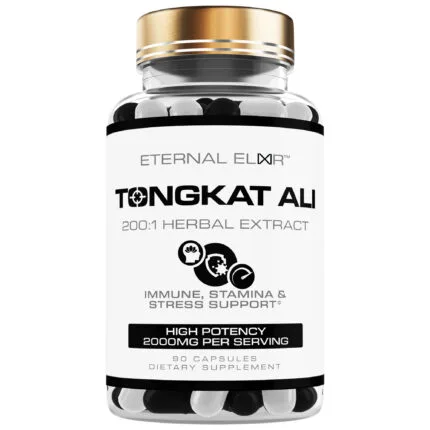
Our Turkesterone is sold out, and we don’t expect to restock it. For lifters who are not drug tested and want support for the same strength and testosterone goal, our pick is Eternal Elixir Tongkat Ali 200:1 Extract 2000mg. It has 90 capsules to a bottle, 2,000mg of 200:1 extract per three-capsule serve (30 serves), and costs $39.99, down from $59.99, which is $1.33 a serve. The label says to take three capsules a day on an empty stomach. Two bottles save 10%, three save 15% and five save 20%, and it ships from Sydney within 24 hours with a 30-day money-back guarantee.
Who it suits: recreational and untested lifters who want a herb with placebo-controlled trials in men behind it. We compare the two herbs in tongkat ali vs turkesterone.
Who it doesn’t suit: tested athletes. The AIS lists “other testosterone boosters” in its Group D, not to be used by athletes, and our Tongkat Ali isn’t on HASTA’s certified list. It also doesn’t suit anyone on prescription medicines who hasn’t checked with their doctor, because tongkat ali extract lowered the absorption of the heart medicine propranolol in one study.
Browse the rest of the range in our online shop.
Frequently asked questions
Will turkesterone cause me to fail a standard Australian workplace drug test?
No. Australian workplace urine tests under AS/NZS 4308:2023 screen for amphetamine-type substances, benzodiazepines, cannabis, cocaine and opiates, and saliva tests under AS/NZS 4760:2019 cover a similar list. Turkesterone is a plant ecdysteroid and is not on either panel, so pre-employment, random and post-incident screens won’t pick it up.
Add Tongkat Ali 200:1 to cart · $39.99
Is turkesterone banned by WADA or Sport Integrity Australia?
No. Turkesterone is not on the 2026 WADA Prohibited List, which Sport Integrity Australia applies in Australia. Its relative ecdysterone is on WADA’s 2026 Monitoring Program, a watch list of substances that are not banned. The list is updated every year, so tested athletes should check the current version. The AIS also advises athletes not to use testosterone boosters because of contamination risk.
Does turkesterone count as a steroid?
Chemically it is a plant steroid (a phytoecdysteroid), but it is not an anabolic-androgenic steroid like testosterone or nandrolone. Research on its relative ecdysterone suggests it acts through oestrogen receptor binding rather than the androgen receptor, and it isn’t what workplace or standard steroid panels look for.
Is it bad to take turkesterone?
Long-term safety data in people doesn’t exist. Short studies are reassuring: the 10-week ecdysterone trial found no rise in liver or kidney markers, and a Phase 1 study of purified 20-hydroxyecdysone at single doses of 100 to 1,400mg, and up to 450mg twice daily for 14 days in older adults, reported only mild to moderate adverse events. Products vary a lot in what they contain, so follow the label, and talk to your doctor if you take prescription medicines or have a medical condition.
What’s the actual drug-test risk of taking turkesterone?
For tested athletes, the risk is contamination, not turkesterone itself. A 2025 study found a commercial phytosteroid product held less than 1% of its claimed ecdysterone, and contaminated supplements have led to positive tests for high-profile athletes. If you are tested, use only HASTA Certified batches and talk to your sport dietitian.
How long does turkesterone stay in your system?
There is no published data for turkesterone itself. For its relative 20-hydroxyecdysone, the Phase 1 study found a mean half-life of 2.4 to 4.9 hours. Anti-doping labs use sensitive methods and look for metabolites too, so a short half-life is no reason to time your doses around a test.
Sources
- World Anti-Doping Agency. The 2026 Prohibited List (S1.2 Other anabolic agents) and The 2026 Monitoring Program. wada-ama.org
- Isenmann E, Ambrosio G, Joseph JF, et al. Ecdysteroids as non-conventional anabolic agent: performance enhancement by ecdysterone supplementation in humans. Arch Toxicol. 2019;93(7):1807-1816. PubMed 31123801
- Khelifi S, Saad K, Vonaparti A, et al. Ultra-fast retroactive processing by MetAlign of LC/HR full-scan Orbitrap mass spectrometry data in WADA Human Urine Sample Monitoring Program. Rapid Commun Mass Spectrom. 2021;35(17):e9141. PubMed 34106497
- Dissemond J, Havers T, Held S, et al. How reliable is the labeling of a commercial phytosteroid product? A 12-week randomized double-blind training study. J Int Soc Sports Nutr. 2025;22(1):2540408. PubMed 40781783
- Dioh W, Tourette C, Del Signore S, et al. A Phase 1 study for safety and pharmacokinetics of BIO101 (20-hydroxyecdysone) in healthy young and older adults. J Cachexia Sarcopenia Muscle. 2023;14(3):1259-1273. PubMed 37057316
- Harris DR, Chapman-Lopez T, Machek SB, et al. The effects of multiple acute turkesterone doses on indirect measures of hypertrophy and metabolic measures: a preliminary investigation. Muscles. 2024;3(4):364-375. PubMed 40757520
- Salman SA, Amrah S, Wahab MS, et al. Modification of propranolol’s bioavailability by Eurycoma longifolia water-based extract. J Clin Pharm Ther. 2010;35(6):691-696. PubMed 21054461
- Australian Institute of Sport. Sports Supplement Framework, Group D. ausport.gov.au
- Sport Integrity Australia. Anti-doping. sportintegrity.gov.au
- HASTA (Human and Supplement Testing Australia). hasta.org.au
- Workplace testing panels: Sonic Commercial Pathology, urine drug testing under AS/NZS 4308:2023 (soniccommercialpath.com.au), and Alcolizer Technology, AS/NZS 4760:2019 and AS/NZS 4308:2023 screening classes (alcolizer.com).
- Bulk Nutrients Turkesterone Capsules label, checked September 2026. bulknutrients.com.au