Last updated: September 27, 2026 · Originally published: April 16, 2026 · By Eternal Elixir Editorial
Quick answer: The research on shilajit benefits for women comes down to two small trials. In 60 postmenopausal women with low bone density, 250mg or 500mg of a standardised shilajit extract a day for 48 weeks slowed the bone loss seen with a placebo. In 45 women aged 30 to 65, 250mg twice a day for 14 weeks improved blood flow in the skin and switched on collagen-related genes, but skin hydration and elasticity did not change. No trial in women has measured energy, hormones, periods or iron levels. If you want to try shilajit, our pick is Eternal Elixir Shilajit 1000mg: a 20:1 extract with 20% fulvic acid, two capsules a day, $1.00 a serve. Don’t take it while pregnant or breastfeeding, and talk to your GP first if you take prescription medicines.
Eternal Elixir makes Shilajit 1000mg, and it is our pick. This guide covers what the trials in women measured, at what dose and for how long, what has never been tested, who should avoid shilajit, and how the shilajit products sold in Australia compare on dose, fulvic acid and cost per serve. Every study is listed in the sources at the end.
Table of contents
- 1. Shilajit benefits for women at a glance
- 2. What is shilajit?
- 3. What the research in women shows
- 4. What hasn’t been tested in women
- 5. Does shilajit affect hormones in women?
- 6. Shilajit side effects and who should avoid it
- 7. How to take shilajit
- 8. Shilajit in Australia compared (as of Sep 2026)
- 9. Our pick: Eternal Elixir Shilajit 1000mg
- 10. Frequently asked questions
- 10.1. Is shilajit good for females?
- 10.2. What happens if a woman takes shilajit every day?
- 10.3. What should be avoided when taking shilajit?
- 10.4. When should a woman take shilajit?
- 10.5. Does shilajit increase testosterone in women?
- 10.6. Is shilajit safe during pregnancy?
- 10.7. How long does shilajit take to work for women?
- 10.8. What is the best shilajit supplement for women in Australia?
- 11. The bottom line
- 12. Related reading
- 13. Sources
Shilajit benefits for women at a glance
- Bone density: one 48-week trial in 60 postmenopausal women found less bone loss at the spine and hip with 250mg or 500mg of shilajit extract a day than with a placebo.
- Skin: one 14-week trial in 45 women found better skin blood flow at 250mg twice a day, with no change in hydration, elasticity or barrier function.
- Collagen: a trial that measured a blood marker of collagen production found it rose after 8 weeks, but the participants were young men.
- Energy, hormones, periods and iron: not tested in women. Claims you see online about these come from tradition, animal work or studies in men.
- Quality matters most: shilajit is a mineral pitch from rock, so buy a purified product whose seller states how it is tested.
What is shilajit?
Shilajit is a brown to black mineral pitch that seeps from rocks in high mountain ranges, mainly the Himalayas, and has a long history in Ayurvedic medicine. Researchers describe three main groups of compounds in it: fulvic acid, humic acid and a family called dibenzo-alpha-pyrones (Das 2019). Supplements sell it as a soft resin you dissolve in water, as powder, or as a dried extract in capsules or tablets.
Products differ a lot. The extract in the skin trial was standardised to at least 60% fulvic acid, our capsules state 20% fulvic acid, and several products sold in Australia state no fulvic acid figure at all. So a result from one trial extract can’t be assumed to carry over to another product, ours included.
What the research in women shows
Bone density after menopause
The largest trial of shilajit in women comes from India (Pingali 2022). Sixty postmenopausal women aged 45 to 65 with low bone density were randomised, double-blind, to a placebo, 250mg or 500mg of a standardised water extract of shilajit each day for 48 weeks.
- Bone mineral density at the lower spine and the top of the thigh bone fell steadily in the placebo group.
- In both shilajit groups the fall was smaller, and the 500mg group did better than the 250mg group.
- Blood markers of bone turnover, oxidative stress and inflammation moved in a favourable direction with shilajit and not with placebo.
That is a meaningful result, with limits. It is one trial of 60 women, run by one group, using one extract. It did not measure fractures. It has not been repeated. If bone health is your concern, talk to your GP about calcium, vitamin D, exercise and a bone density scan first, and treat shilajit as an extra at most.
Skin blood flow and collagen genes
In a US trial, 45 healthy women aged 30 to 65 were randomised into three groups of 15: a placebo, or 125mg or 250mg of PrimaVie shilajit twice a day, for 14 weeks (Das 2019). The researchers took skin samples from the upper arm and measured skin blood flow and skin quality on the cheeks.
- At 250mg twice a day, skin blood flow improved compared with both baseline and placebo.
- Genes linked to blood vessel growth and to collagen and the skin’s supporting structure were more active after shilajit.
- Skin hydration, elasticity and barrier function (water loss through the skin) did not differ from placebo.
- No adverse effects were reported that were linked to the supplement.
The study was partly funded by the company that makes PrimaVie. It shows changes in gene activity and blood flow, not visible changes in wrinkles or firmness, and the skin measurements a buyer would notice did not move.
A collagen marker, measured in men
A 2024 trial gave 35 recreationally trained men 500mg or 1,000mg of shilajit a day, or a placebo, for 8 weeks (Neltner 2024). Blood levels of pro-c1α1, a marker of type 1 collagen production, rose in both shilajit groups and did not change with placebo. It is a useful signal, but no one has measured it in women, and a blood marker is not the same as firmer skin or stronger bones.
What hasn’t been tested in women
Many of the benefits sold to women have no trial behind them. We searched PubMed in September 2026 and found no human trial of shilajit in women that measured:
- Energy or tiredness. The performance studies were in men.
- Hormones, periods or menopausal symptoms. No trial has measured oestrogen, progesterone, testosterone or cycle symptoms in women taking shilajit.
- Iron levels. The idea that fulvic acid helps you absorb iron has not been tested in people taking shilajit.
- Stress or mood. “Adaptogen” is a traditional label, not a measured result in women.
If you feel tired all the time, see your GP before you buy a supplement. Tiredness has many causes, including low iron, that are worth checking properly. For other options aimed at women, our guide to the best supplements for women over 40 compares a wider range.
Does shilajit affect hormones in women?
Nobody has measured it. The hormone study people quote was in men: in healthy men aged 45 to 55, 250mg of purified shilajit twice a day for 90 days raised total testosterone, free testosterone and DHEAS compared with a placebo (Pandit 2016, as summarised by Keller 2019). Whether anything similar happens in women is unknown, so claims that shilajit “balances” female hormones go beyond the evidence.
If you have a hormone-sensitive condition, or you take hormonal contraception or menopausal hormone therapy, talk to your doctor before you start. Our guide to shilajit for men covers the testosterone research in detail, and if you are comparing herbs, our article on tongkat ali for women looks at that evidence the same way.
Shilajit side effects and who should avoid it
The two trials in women ran for 14 and 48 weeks. The skin trial reported no adverse effects linked to shilajit, and the bone trial abstract does not report any problems. That is reassuring but limited: 105 women across two studies.
The bigger risk is the product itself. Shilajit comes from rock, and Ayurvedic products in general have a record of heavy metal problems. When researchers bought 193 Ayurvedic medicines online and tested them, 20.7% contained detectable lead, mercury or arsenic (Saper 2008). That study covered Ayurvedic medicines broadly, not shilajit alone, but it is why you should only buy a purified product whose seller says how each batch is tested. Our guide to checking for pure shilajit in Australia explains what to look for.
Do not take shilajit if:
- You are pregnant or breastfeeding. There are no trials in pregnant or breastfeeding women.
- You are under 18.
- You take prescription medicines or have a medical condition and haven’t checked with your GP or pharmacist first.
Stop taking it and see a doctor if you notice anything that worries you. Our shilajit side effects guide goes through the evidence in more detail.
How to take shilajit
Follow the directions on the product you buy. The trials in women used 250mg to 500mg a day of standardised extracts: the bone trial gave one daily dose and the skin trial split it into two. Our label serve is different because the extract is different: two capsules a day, giving 1,000mg of 20:1 extract, with water on an empty stomach.
- Pick a time you will stick to. The morning before breakfast is an easy time, and it fits the empty-stomach direction on our label.
- Give it time. The trials measured changes at 14 weeks for skin and at 24 and 48 weeks for bone, so a few days tells you nothing.
- Don’t double up. If you already take a product that contains shilajit, don’t add a second one.
Our shilajit dosage guide covers timing and cycling in more depth.
Shilajit in Australia compared (as of Sep 2026)
We took each price, pack and serve from the seller’s own page in September 2026. Cost per serve uses the serve on the label. For the full field, see our comparison of the best shilajit supplements in Australia.
| Product | Price (AUD, as of Sep 2026) | Pack | Shilajit per serve | Fulvic acid stated | Serves | Cost per serve | Buy |
|---|---|---|---|---|---|---|---|
| Eternal Elixir Shilajit 1000mg (our pick) | $44.99 | 90 capsules | 1,000mg of 20:1 extract (2 capsules) | 20% | 45 | $1.00 | Shilajit 1000mg |
| Evolution Botanicals Himalayan Shilajit Resin | $79.95 | 30g resin jar | 250mg of resin | 50%+ (by gravimetry) | 120 | $0.67 | Evolution Botanicals |
| Lifecykel Shilajit Pure Resin (Chemist Warehouse, online only) | $92.00 | 15g resin | 0.25g of resin | Not stated | About 60 | $1.53 | Chemist Warehouse |
| Wanderlust Shilajit (Chemist Warehouse) | $19.49 | 120 tablets | Not stated (a 2-tablet serve weighs 1g, with inulin listed first) | Not stated | 60 | $0.32 | Chemist Warehouse |
| Himalayan Power Shilajit Gold resin (Evelyn Faye) | From $59.95 (15g) | 15g, 30g or 50g resin | Not stated | Not stated | Not stated | Not stated | Evelyn Faye |
Add Shilajit 1000mg to cart · $44.99
Who each one suits, and who it doesn’t
- Eternal Elixir Shilajit 1000mg (our pick). Suits women who want a fixed, stated amount of extract in capsules, with the fulvic acid content on the label and nothing to taste or measure. It isn’t the trial extract, and it costs more per serve than the Evolution Botanicals resin.
- Evolution Botanicals Himalayan Shilajit Resin. Suits resin users who want the highest stated fulvic acid here, two certificates of analysis on the product page and a lower cost per serve. You measure it with a spoon, and resin has a strong taste.
- Lifecykel Shilajit Pure Resin. Suits someone who wants to order resin through Chemist Warehouse. The listing states third-party testing for heavy metals, microbes and pesticides but gives no fulvic acid figure, and it has the highest cost per serve here. It is sold and delivered by Lifecykel, not stocked in store.
- Wanderlust Shilajit. Suits price-first shoppers, with the lowest price per serve in the table. The listing states neither the amount of shilajit nor the fulvic acid content, and inulin is the first ingredient.
- Himalayan Power Shilajit Gold. A resin sold through the Evelyn Faye online health store. Its page gives no serve size and no fulvic acid figure, so you can’t work out a cost per serve.
If you would rather buy from a pharmacy, our guide to shilajit at Chemist Warehouse covers what is listed there.
Our pick: Eternal Elixir Shilajit 1000mg
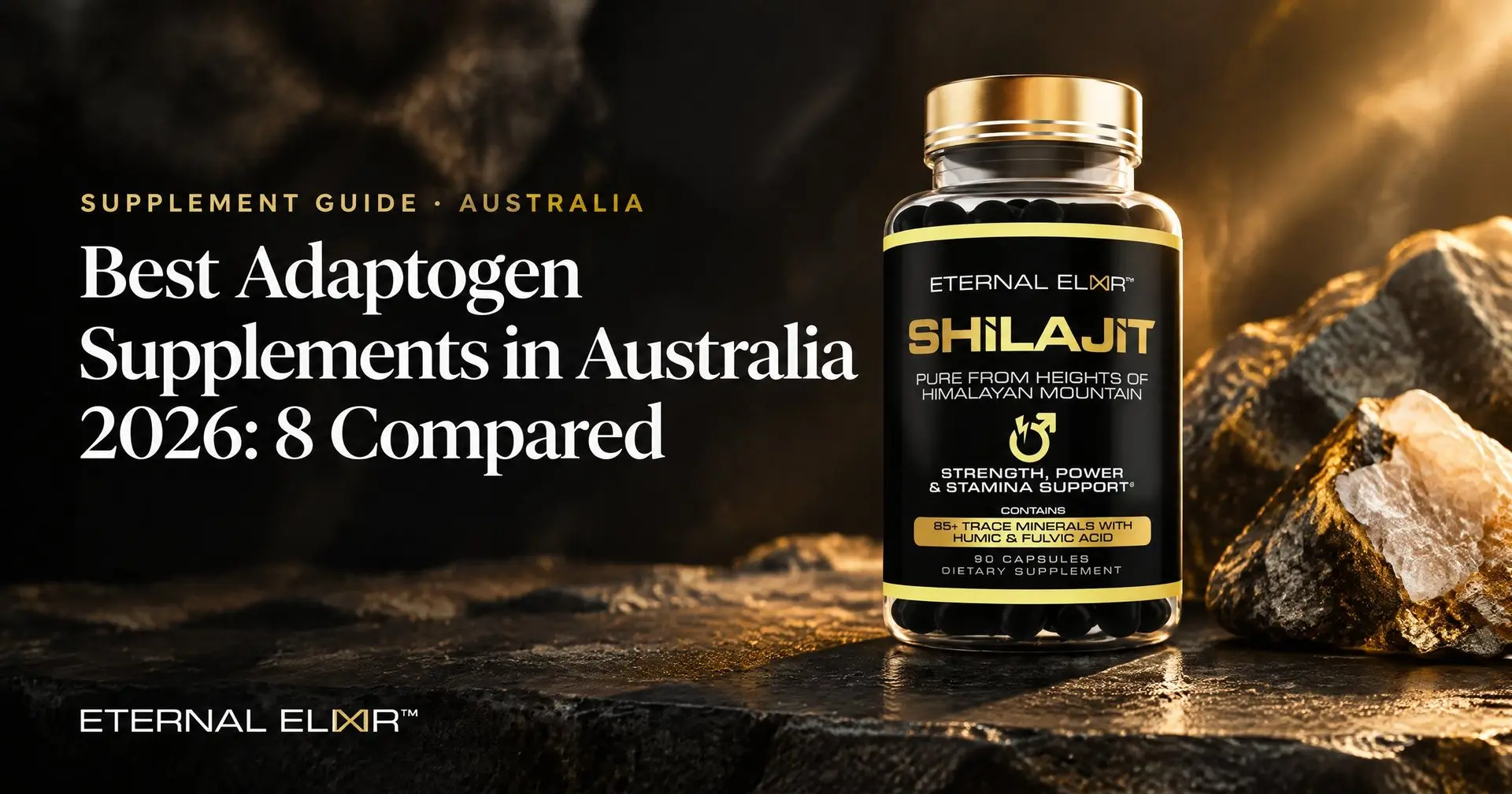
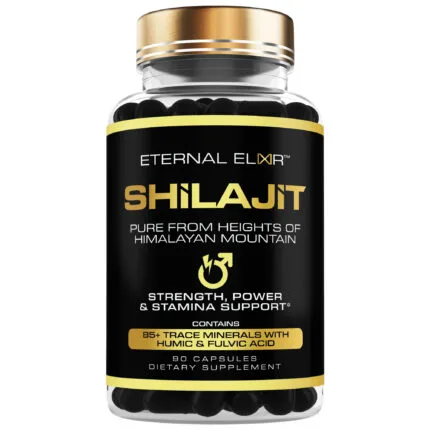
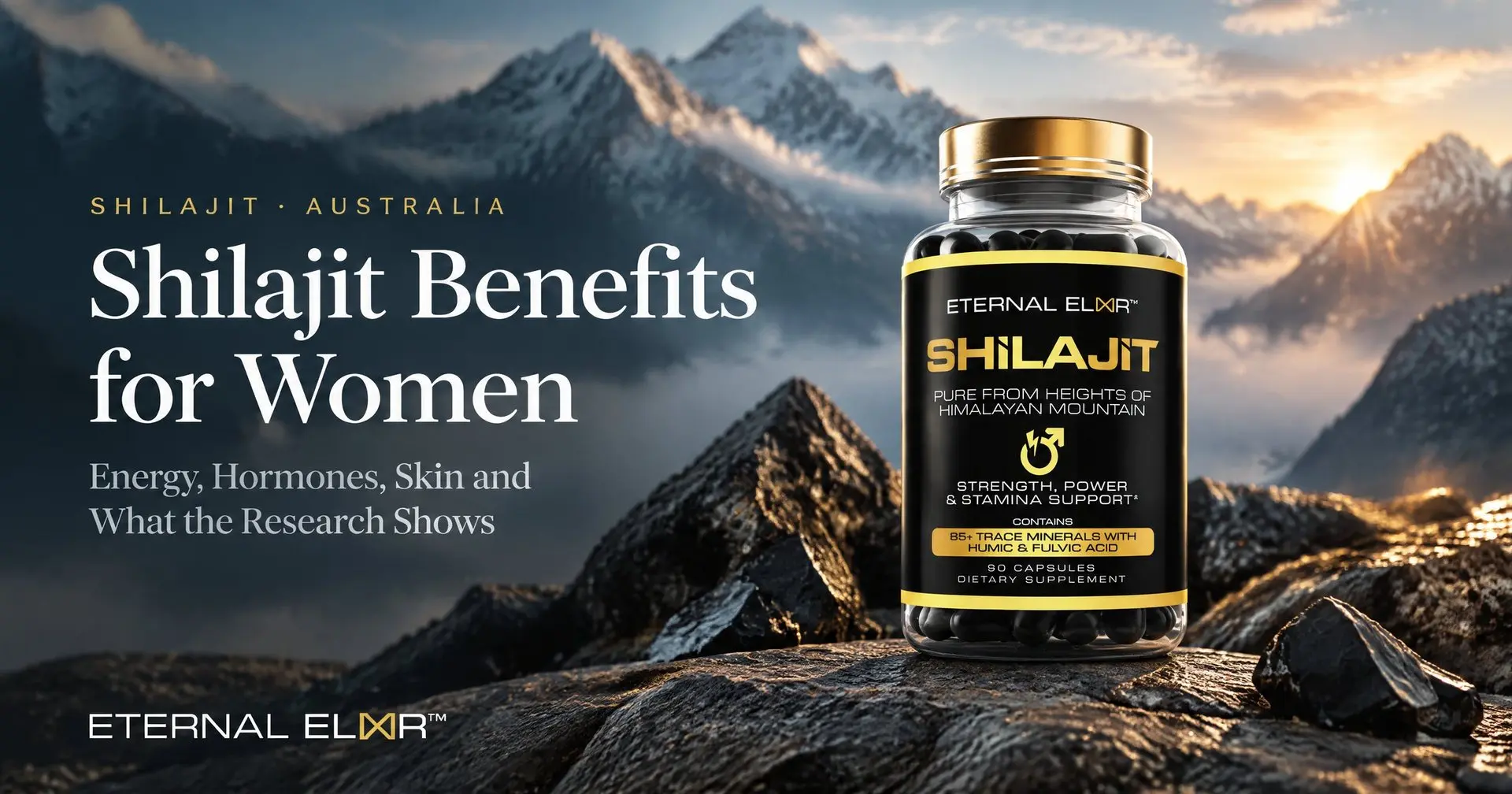
Eternal Elixir makes Shilajit 1000mg, and it is our pick for women who want to try shilajit in Australia. What is in the bottle:
- 90 capsules, 45 serves. Two capsules make one serve of 1,000mg of 20:1 shilajit extract with 20% fulvic acid.
- A short ingredient list. Shilajit extract, a plant-based hypromellose capsule, magnesium stearate and silica.
- $44.99 a bottle, $1.00 a serve. Two bottles save 10%, three save 15% and five save 20%.
- Batch testing. Our product page states that each batch is tested by third-party laboratories for identity, potency and contaminants including heavy metals, and you can ask us for the current batch certificate of analysis.
- Sydney dispatch. Orders leave Sydney within 24 hours on business days, with a 30-day money-back guarantee, Afterpay and free shipping over $100.
If you also want Tongkat Ali and ginseng, our Daily Energy & Vitality Stack ($109.99) already includes a bottle of Shilajit 1000mg, so buy one or the other, not both. For a wider daily routine, our guide to building a longevity stack with NMN, resveratrol, spermidine and TUDCA shows how other products fit together.
Who it suits: adult women who want to try shilajit in a measured daily capsule for at least three months and judge it for themselves. Who it doesn’t suit: anyone pregnant or breastfeeding, anyone expecting the results of the trial extracts, and anyone on prescription medicines who hasn’t checked with their GP.
Add Shilajit 1000mg to cart · $44.99
Frequently asked questions
Is shilajit good for females?
The evidence is limited but not empty. One 48-week trial found less bone loss in postmenopausal women taking 250mg or 500mg of a shilajit extract a day, and one 14-week trial found better skin blood flow in women taking 250mg twice a day. Energy, hormones and periods have not been tested in women. If you want to try it, our pick is Eternal Elixir Shilajit 1000mg.
Add Shilajit 1000mg to cart · $44.99
What happens if a woman takes shilajit every day?
In the trials, women took it every day for 14 and 48 weeks. The skin trial reported no adverse effects linked to shilajit, and the bone trial found less bone loss than placebo. Nobody has studied daily use for longer than that, so buy a purified, batch-tested product and review how you feel every few months.
What should be avoided when taking shilajit?
Avoid raw or untested shilajit, because rock-derived products can carry heavy metals. Don’t take it while pregnant or breastfeeding, don’t combine two shilajit products, and don’t go over the serve on the label. If you take prescription medicines, check with your GP or pharmacist before you start.
When should a woman take shilajit?
Take it at the same time each day, as the label directs. Our label says two capsules a day with water on an empty stomach, so the morning before breakfast is an easy habit. No trial has compared times of day.
Does shilajit increase testosterone in women?
No study has measured it in women. The testosterone result comes from healthy men aged 45 to 55 who took 250mg twice a day for 90 days. If you have a hormone-sensitive condition, talk to your doctor before you take shilajit.
Is shilajit safe during pregnancy?
There are no trials of shilajit in pregnant or breastfeeding women, so don’t take it during pregnancy or while breastfeeding. Ask your doctor before you start or restart it afterwards.
How long does shilajit take to work for women?
The skin changes were measured at 14 weeks, and the bone differences showed at 24 and 48 weeks. Give it at least three months before you judge it, and don’t expect a noticeable effect in the first few days.
What is the best shilajit supplement for women in Australia?
Eternal Elixir Shilajit 1000mg is our pick, and we make it. Each two-capsule serve gives 1,000mg of 20:1 extract with 20% fulvic acid, a bottle lasts 45 days at $1.00 a serve, and orders ship from Sydney within 24 hours. If you prefer a resin, the Evolution Botanicals jar states the highest fulvic acid in our table.
Add Shilajit 1000mg to cart · $44.99
The bottom line
The shilajit benefits for women that have been tested are narrow: less bone loss after menopause in one trial and better skin blood flow in another, both with specific extracts. Energy, hormones, periods and iron remain untested in women. If you want to try it, choose a purified product with a stated amount and testing, take it daily for at least three months, and skip it during pregnancy and breastfeeding. Our pick is Eternal Elixir Shilajit 1000mg at $1.00 a serve.
Related reading
- Tongkat ali in Australia: benefits, dosage and buying
- Tongkat ali vs shilajit
- Korean panax ginseng for energy, focus and stress
- Our Reduced L-Glutathione capsules
- Browse the full Eternal Elixir range
Sources
- Pingali U, Nutalapati C. Shilajit extract reduces oxidative stress, inflammation, and bone loss to dose-dependently preserve bone mineral density in postmenopausal women with osteopenia: a randomized, double-blind, placebo-controlled trial. Phytomedicine. 2022;105:154334. PubMed 35933897
- Das A, El Masry MS, Gnyawali SC, et al. Skin transcriptome of middle-aged women supplemented with natural herbo-mineral shilajit shows induction of microvascular and extracellular matrix mechanisms. J Am Coll Nutr. 2019;38(6):526-536. PMC7027386
- Neltner TJ, Sahoo PK, Smith RW, et al. Effects of 8 weeks of shilajit supplementation on serum pro-c1α1, a biomarker of type 1 collagen synthesis: a randomized control trial. J Diet Suppl. 2024;21(1):1-12. PubMed 36546868
- Pandit S, Biswas S, Jana U, et al. Clinical evaluation of purified shilajit on testosterone levels in healthy volunteers. Andrologia. 2016;48(5):570-575. PubMed 26395129
- Keller JL, Housh TJ, Hill EC, et al. The effects of shilajit supplementation on fatigue-induced decreases in muscular strength and serum hydroxyproline levels. J Int Soc Sports Nutr. 2019;16:3. PMC6364418
- Saper RB, Phillips RS, Sehgal A, et al. Lead, mercury, and arsenic in US- and Indian-manufactured Ayurvedic medicines sold via the Internet. JAMA. 2008;300(8):915-923. PubMed 18728265
- Product pages for Evolution Botanicals, Lifecykel and Wanderlust (Chemist Warehouse) and Himalayan Power (Evelyn Faye), checked September 2026, linked in the table above.