Last updated: September 27, 2026 · Originally published: April 12, 2026 · By Eternal Elixir Editorial
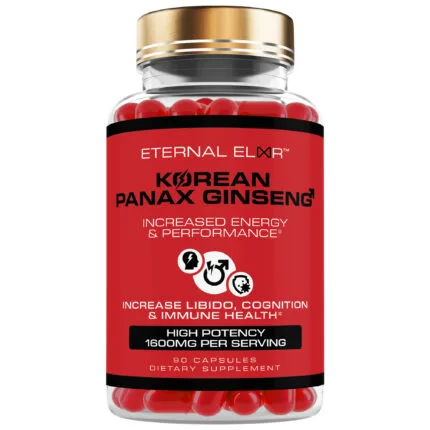
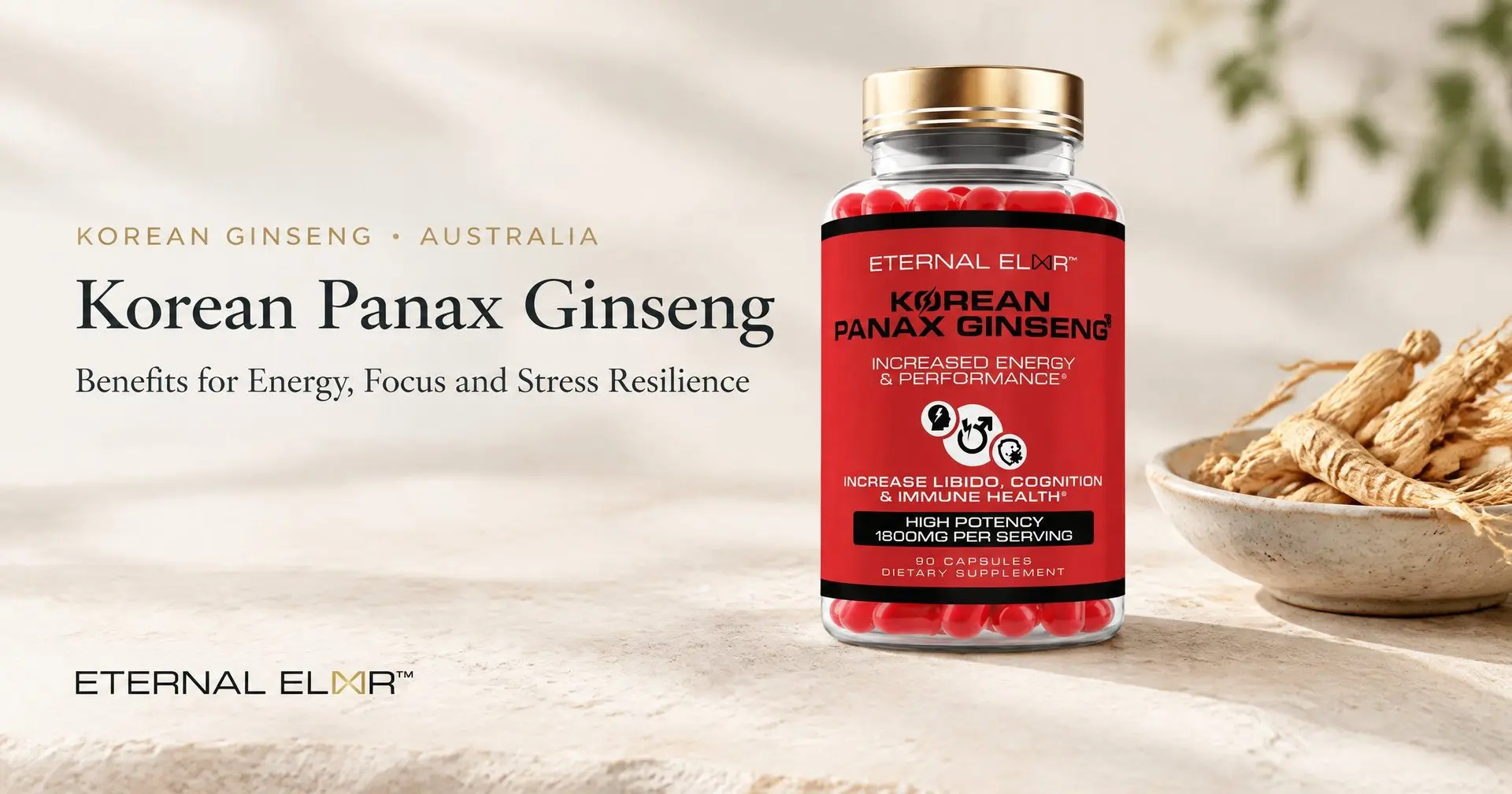
Quick answer: Korean panax ginseng (Panax ginseng) is the classic adaptogen herb, and the human trials point to three modest benefits: less mental fatigue, small improvements on some memory and arithmetic tasks, and lower perceived stress. The effects in trials were real but small, and the studies were mostly short. Our pick is Eternal Elixir Korean Panax Ginseng 1600mg: 1,600mg of Korean red ginseng root extract per two-capsule serve, standardised to 5% ginsenosides, 90 capsules for $44.99, or $1.00 a day. If you take blood thinners, blood-sugar or blood-pressure medicines, or antidepressants, or you are pregnant or breastfeeding, talk to your doctor first.
Eternal Elixir makes the Korean Panax Ginseng 1600mg in this guide, and it is our pick. The sections below cover what ginseng is, what the trials found for energy, focus and stress (and where they fall short), how our serve compares with trial doses, how it stacks up against ginseng sold in Australian pharmacies, and who should skip it.
Table of contents
- 1. Is Panax ginseng an adaptogen?
- 2. Korean ginseng for energy: what the research shows
- 3. Cognitive benefits: memory, focus and mental clarity
- 4. Stress resilience and cortisol
- 5. How our serve compares with the trial doses
- 6. Korean ginseng compared: what Australian shops sell
- 7. Why Eternal Elixir Korean Panax Ginseng is our pick
- 8. Side effects and who should avoid ginseng
- 9. Who Korean ginseng suits, and who it doesn’t
- 10. Frequently asked questions
- 10.1. What does taking Panax ginseng do?
- 10.2. Do adaptogens really work?
- 10.3. How long does Korean ginseng take to work?
- 10.4. Can you take Korean ginseng every day?
- 10.5. Does Korean ginseng interact with medications?
- 10.6. What is the best dosage of Korean panax ginseng?
- 10.7. What is the best Korean ginseng supplement in Australia?
- 11. The bottom line
- 12. Related reading
- 13. Sources
Is Panax ginseng an adaptogen?
Yes, by the usual definition. “Adaptogen” is a label for herbs said to help the body cope with physical and mental stress. It is not a medical category, and each herb has to be judged on its own trials. Panax ginseng is the adaptogen with the longest history of use in East Asia and one of the larger bodies of human research.
The name matters when you shop. Panax ginseng is Korean or Asian ginseng. American ginseng (Panax quinquefolius) is a different species, and Siberian ginseng (Eleutherococcus senticosus) is a different plant altogether. The trials in this article used Panax ginseng.
Korean red ginseng is Panax ginseng root that has been steamed and dried, which turns it red. White ginseng is dried without steaming. Our capsules use Korean red ginseng root extract.
What ginsenosides are
Ginseng’s active compounds are called ginsenosides. Extracts vary a lot in how much they contain, so a label that states a ginsenoside percentage tells you more than one that only gives milligrams of root. Ours is standardised to 5% ginsenosides, which works out at 80mg of ginsenosides in each 1,600mg serve.
Korean ginseng for energy: what the research shows
The fatigue evidence is encouraging but thin, and the best summary is a meta-analysis that says exactly that.
- Fatigue meta-analysis (Bach 2016). Pooling 12 randomised trials with 630 participants, ginseng reduced fatigue compared with placebo across the four trials that measured it. Across eight trials, it did not improve physical performance. The authors judged the evidence insufficient because the trials were few and small.
- Adults with long-term unexplained tiredness (Kim 2013). 90 adults (21 men and 69 women) took 1g or 2g a day of a Panax ginseng extract, or a placebo, for four weeks. Both doses improved the mental-fatigue score. The overall fatigue score did not beat placebo, and only the 2g dose improved a second fatigue scale.
- Systematic review (Arring 2018). Across 10 studies in people with fatigue, the reviewers found modest evidence of benefit and a low risk of side effects.
So ginseng looks more useful for mental tiredness than for physical performance. If you want better endurance in the gym, the trials don’t support it. If afternoons feel foggy and flat, it is a reasonable herb to try for a month. For other options, our guide to the best energy supplements in Australia compares the wider field.
Cognitive benefits: memory, focus and mental clarity
The best focus data come from a research group at Northumbria University in the UK that tested a standardised Panax ginseng extract in healthy young adults.
- Sustained mental work (Reay 2005). 30 healthy young adults took 200mg, 400mg or a placebo on separate days, then did repeated rounds of mental arithmetic and attention tasks. The 200mg dose improved serial-subtraction performance and reduced feelings of mental fatigue throughout the session. Both doses lowered blood glucose.
- Working memory and calm (Reay 2010). 30 volunteers, average age 23, took 200mg, 400mg or a placebo for eight days each. The 400mg dose improved calmness and mental arithmetic on the first and eighth days. The 200mg dose slowed a fall in mood but also slowed mental arithmetic. A week of use added nothing beyond the effects of a single dose.
These are single-dose and one-week results in young adults, measured over a few hours. They show ginseng can shift performance on specific tasks, not that it sharpens memory over months. The effects were also dose-specific, which is a reminder that more is not always better.
Stress resilience and cortisol
The newest trial is also the largest on stress. In Belgium, 149 moderately stressed adults took 200mg a day of red Panax ginseng root powder (containing 24mg of ginsenosides) or a placebo for three weeks. The ginseng group had larger drops in perceived stress and negative mood than the placebo group, and responded faster on a planning task (Dormal 2025). The funder helped design the study, though it had no role in the analysis.
A smaller American study looked at the body’s stress hormones. Ten women and nine men took a fermented Korean ginseng product at 960mg or 160mg a day, or a placebo, for 14 days each, then did an intense resistance workout. The higher dose lowered the cortisol response to the workout and reduced markers of muscle damage the next day (Flanagan 2018). That product was a specific fermented extract, so the result may not carry over to every ginseng.
Put together, the stress trials are small and short, but they point the same way: ginseng may take some of the edge off feeling stressed. For stress and mood from a different angle, see our guide to saffron for mood, sleep and stress.
How our serve compares with the trial doses
Ginseng trials used very different products, so compare with care:
- Focus trials: 200 to 400mg of a standardised extract.
- Stress trial: 200mg of root powder with 24mg of ginsenosides.
- Fatigue trial: 1g to 2g of extract a day.
Our serve is 1,600mg of Korean red ginseng root extract with 80mg of ginsenosides. That is well above the extract doses in the focus trials and more than three times the ginsenosides in the stress trial, and it sits inside the 1g to 2g range of the fatigue trial. No trial has tested our exact product. If you are sensitive to stimulants or ginseng keeps you awake, the label serve may be more than you need, so talk to your pharmacist about starting lower.
Korean ginseng compared: what Australian shops sell
Prices are from each seller’s product page, as of Sep 2026. Cost per day uses the label serve.
| Product | Serve | Ginseng per serve | Pack | Price (AUD, as of Sep 2026) | Cost per day | Buy |
|---|---|---|---|---|---|---|
| Eternal Elixir Korean Panax Ginseng 1600mg | 2 capsules | 1,600mg Korean red ginseng root extract, 5% ginsenosides (80mg) | 90 capsules, 45 serves | $44.99 | $1.00 | Korean Panax Ginseng 1600mg |
| CheongKwanJang Korean Red Ginseng Extract 120g (KGC Australia) | 3g (about 1 teaspoon) | 3,000mg Korean red ginseng root extract, ginsenosides not stated | 120g, 40 serves | $175.00 | $4.38 | redginseng.com.au |
| Caruso’s One a Day Ginseng 5500 (Chemist Warehouse) | 1 tablet | 250mg Korean ginseng root extract (62.5mg ginsenosides), plus Siberian and American ginseng extracts | 60 tablets | $19.97 | $0.33 | Chemist Warehouse |
| Nature’s Own Korean Ginseng 500mg (Chemist Warehouse) | 2 tablets | 200mg Panax ginseng extract (from 1,000mg dry root), ginsenosides not stated | 60 tablets, 30 serves | $14.74 | $0.49 | Chemist Warehouse |
Add Korean Panax Ginseng to cart · $44.99
How to read the table:
- Eternal Elixir gives the most extract per capsule serve and the highest stated ginsenoside content (80mg), in a 90-capsule bottle.
- CheongKwanJang is a traditional Korean red ginseng extract paste. Its serve is larger by weight, but it does not state ginsenosides and costs more than four times as much per day.
- Caruso’s has the lowest price per day. It blends Korean, Siberian and American ginseng, so it is not a pure Panax ginseng product.
- Nature’s Own is a low-cost Panax ginseng tablet with a much smaller extract dose.
For more brands, see our comparison of the best Korean red panax ginseng supplements in Australia and our look at Korean red ginseng at Chemist Warehouse.
Why Eternal Elixir Korean Panax Ginseng is our pick
Eternal Elixir makes this product, and it is our pick for Australians who want a straightforward Panax ginseng capsule. The reasons are on the label:
- Korean red ginseng root extract, not stem, leaf or a blend of species.
- Standardised to 5% ginsenosides, 80mg per serve, stated on the label.
- 800mg per capsule, two capsules each morning, 90 capsules to a bottle.
- Sydney dispatch within 24 hours, a 30-day money-back guarantee, Afterpay, and free shipping over $100. Two bottles save 10%, three save 15% and five save 20%.
Stacking ginseng
If you are also weighing up tongkat ali, it has its own human trials on stress hormones and testosterone. Our step-by-step guide to natural testosterone support for men over 35 explains where each fits, and Tongkat Ali 200:1 Extract is the product. For a wider daily routine, see our guide to building a complete longevity stack.
Our Daily Energy & Vitality Stack already contains Korean red ginseng, together with Tongkat Ali and shilajit, and our Brain, Mood & Sleep Stack pairs it with saffron and magnesium L-threonate. If you take either stack, don’t buy a separate bottle of ginseng. Ginseng should not be combined with methylene blue.
Side effects and who should avoid ginseng
Short-term use of Asian ginseng, up to six months in recommended amounts, appears safe for most people, according to the US National Center for Complementary and Integrative Health (NCCIH). Trouble sleeping is the most commonly reported side effect, so take it in the morning. Talk to your doctor or pharmacist before taking ginseng if:
- You take a blood thinner. Ginseng may interfere with blood clotting.
- You take medicine to lower blood sugar, since ginseng might lower it too.
- You take blood-pressure medicine, antidepressants or any other prescription medicine.
- You are pregnant or breastfeeding, or buying for a child. It is not recommended for these groups.
Who Korean ginseng suits, and who it doesn’t
It suits you if
- You feel mentally flat or foggy in the afternoons and want a non-caffeine option to try for a month.
- You are going through a stressful stretch and want a herb with some trial support for perceived stress.
- You want a single-species Panax ginseng with the ginsenoside content on the label.
It doesn’t suit you if
- You want better physical endurance. The meta-analysis found no effect on physical performance.
- You sleep poorly or are very sensitive to stimulants.
- You take blood thinners or blood-sugar medicine and haven’t checked with your doctor, or you are pregnant or breastfeeding.
Frequently asked questions
What does taking Panax ginseng do?
In human trials, Panax ginseng reduced mental fatigue, improved performance on some arithmetic and attention tasks for a few hours after a dose, and lowered perceived stress over three weeks. The effects were modest and the trials were mostly small and short. It did not improve physical performance in a meta-analysis of eight trials.
Do adaptogens really work?
It depends on the herb. “Adaptogen” is a marketing and traditional-medicine label, not proof. Panax ginseng has randomised, placebo-controlled trials showing small benefits for mental fatigue, focus tasks and perceived stress, which is more than many adaptogens can show. Judge each herb by its own trials and dose.
How long does Korean ginseng take to work?
The focus effects in trials appeared within a few hours of a single dose. The stress trial measured changes after three weeks and the fatigue trial after four. Give it at least four weeks of daily use before you decide whether it helps you.
Add Korean Panax Ginseng to cart · $44.99
Can you take Korean ginseng every day?
Yes, the trials used daily doses, and short-term daily use of up to six months appears safe for most people. There are fewer data on longer use, so some people take a break every few months. That is a personal choice rather than something the trials tested.
Does Korean ginseng interact with medications?
It can. Ginseng may interfere with blood clotting and might lower blood sugar, so talk to your doctor if you take a blood thinner or blood-sugar medicine. The same applies to any other prescription medicine, and ginseng is not recommended in pregnancy, while breastfeeding or for children.
What is the best dosage of Korean panax ginseng?
There is no single best dose, because products differ so much. Trials used 200 to 400mg of standardised extract for focus, 200mg of root powder with 24mg of ginsenosides for stress, and 1g to 2g of extract for fatigue. Our label serve is 1,600mg of extract with 80mg of ginsenosides, two capsules each morning.
What is the best Korean ginseng supplement in Australia?
Eternal Elixir Korean Panax Ginseng 1600mg is our pick, and we make it. It gives 1,600mg of Korean red ginseng root extract standardised to 5% ginsenosides per serve, 90 capsules for $44.99 ($1.00 a day), shipped from Sydney within 24 hours. Caruso’s One a Day Ginseng 5500 costs less per day, but it blends three types of ginseng.
Add Korean Panax Ginseng to cart · $44.99
The bottom line
Korean panax ginseng is a well-studied adaptogen with modest, real effects on mental fatigue, focus tasks and perceived stress, and no clear effect on physical performance. The trials were small and short, so expect a gentle lift rather than a transformation. If you want to try it, Eternal Elixir Korean Panax Ginseng 1600mg gives you 80mg of ginsenosides a day for $1.00, with two capsules each morning. Check with your doctor first if you take blood thinners, blood-sugar medicine or other prescription medicines.
Related reading
- Shilajit for men: energy, testosterone and performance
- Methylene blue capsules for energy, mood and focus
- Shop the full Eternal Elixir range
Sources
- Bach HV, Kim J, Myung SK, Cho YA. Efficacy of ginseng supplements on fatigue and physical performance: a meta-analysis. J Korean Med Sci. 2016;31(12):1879-1886. PubMed 27822924
- Kim HG, Cho JH, Yoo SR, et al. Antifatigue effects of Panax ginseng C.A. Meyer: a randomised, double-blind, placebo-controlled trial. PLoS One. 2013;8(4):e61271. PubMed 23613825
- Arring NM, Millstine D, Marks LA, Nail LM. Ginseng as a treatment for fatigue: a systematic review. J Altern Complement Med. 2018;24(7):624-633. PubMed 29624410
- Reay JL, Kennedy DO, Scholey AB. Single doses of Panax ginseng (G115) reduce blood glucose levels and improve cognitive performance during sustained mental activity. J Psychopharmacol. 2005;19(4):357-365. PubMed 15982990
- Reay JL, Scholey AB, Kennedy DO. Panax ginseng (G115) improves aspects of working memory performance and subjective ratings of calmness in healthy young adults. Hum Psychopharmacol. 2010;25(6):462-471. PubMed 20737519
- Dormal V, Jonniaux L, Buchet M, et al. Effect of hydroponically grown red Panax ginseng on perceived stress level, emotional processing, and cognitive functions in moderately stressed adults: a randomized, double-blind, placebo-controlled study. Nutrients. 2025;17(6):955. PubMed 40289951
- Flanagan SD, DuPont WH, Caldwell LK, et al. The effects of a Korean ginseng, GINST15, on hypo-pituitary-adrenal and oxidative activity induced by intense work stress. J Med Food. 2018;21(1):104-112. PubMed 28981384
- National Center for Complementary and Integrative Health. Asian ginseng: safety. nccih.nih.gov
- Product pages checked September 2026: Caruso’s One a Day Ginseng 5500, Nature’s Own Korean Ginseng 500mg, CheongKwanJang Korean Red Ginseng Extract 120g