Last updated: September 28, 2026 · Originally published: February 15, 2026 · By Eternal Elixir Editorial
Quick Answer
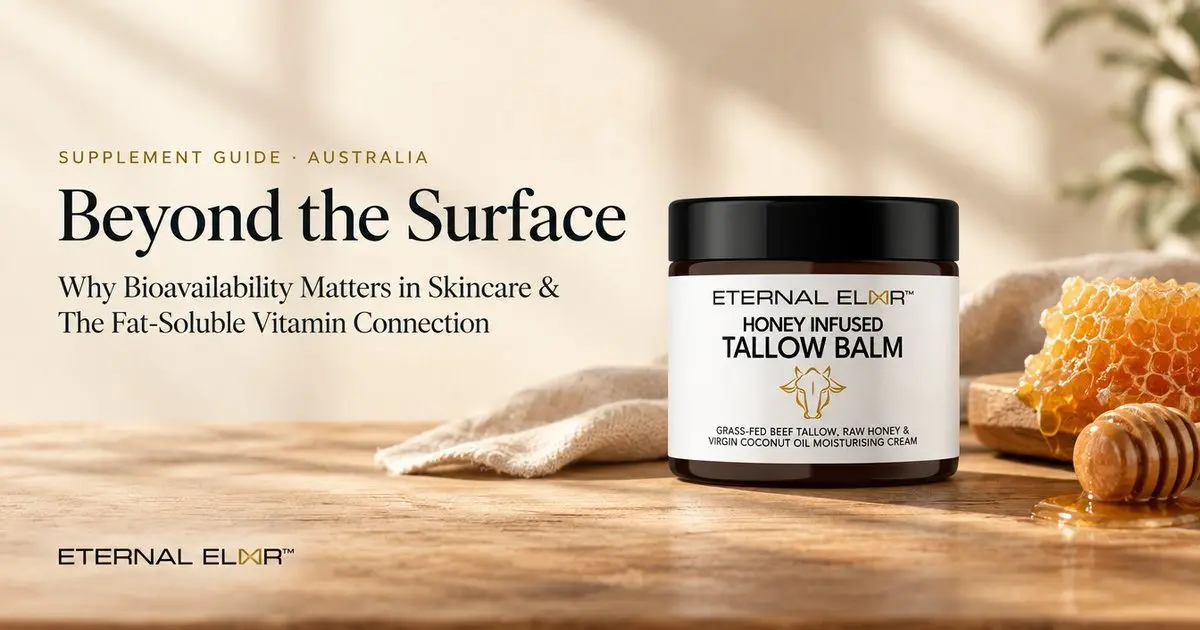
Bioavailability in skincare means how much of an ingredient gets past the skin’s outer layer to where it can act. Three things decide it: the size of the molecule, whether it dissolves in fat, and the base it is carried in. Vitamins A, D, E and K are all fat-soluble, so they travel best in an oil or balm rather than a watery gel. If you want a simple fat-based balm, our Grass-Fed Tallow Balm blends Australian pasture-raised tallow with beeswax, coconut oil, raw honey and vitamin E, and costs $29.99.
Eternal Elixir makes the Grass-Fed Tallow Balm, so read the product sections with that in mind. The science sections cite published research, listed at the end.
Most skincare marketing is about what goes into the jar. Looking beyond the surface means asking a different question: what actually gets into your skin once you apply it? That is what bioavailability describes, and it explains why two creams with the same “hero ingredient” can behave very differently.
This guide covers how the skin barrier is built, which molecules can pass through it, why fat-soluble vitamins need a fatty base, and where tallow fits in. It is also honest about the limits: a balm can soften and protect skin, but no balm feeds the living layers of skin the way food feeds the body.
Table of contents
- 1. What bioavailability means for your skin
- 2. The skin barrier: bricks, mortar and a fatty seal
- 3. What can get through: size and fat solubility
- 4. The fat-soluble vitamin connection
- 5. Where tallow fits, and where it doesn’t
- 6. Our Grass-Fed Tallow Balm
- 7. How to get the most from a tallow balm
- 8. Skin from the inside: diet and supplements
- 9. Frequently asked questions
- 10. Sources
What bioavailability means for your skin
For a supplement, bioavailability is the share of a dose that reaches your bloodstream. For a skincare product it means something similar: the share of an ingredient that crosses the outer layer of skin, the stratum corneum, and reaches the layer where it can do its job.
Much of what you apply never gets that far. Some of it evaporates, some rubs off on your pillow, and some sits in the outermost dead cell layer. That isn’t always a bad thing. A moisturiser that stays in the outer layer and slows water loss is doing exactly what it should. But if a product promises that an active ingredient will change something deeper down, bioavailability is the question that decides whether it can.
The skin barrier: bricks, mortar and a fatty seal
Dermatologists often describe the stratum corneum as a brick wall. The bricks are flattened, dead skin cells called corneocytes. The mortar between them is a mix of lipids, mainly ceramides, cholesterol and free fatty acids, packed in ordered layers. That lipid mortar is what stops your body losing water and keeps most things from the outside world out.
Because the mortar is made of fats, the barrier is lipophilic: fat-loving. Oily substances can dissolve into it. Watery ones tend to be held back. This is the old chemistry rule that “like dissolves like”, and it explains a lot about how products behave on skin.
It doesn’t mean water-based products are useless. Humectants such as glycerin and hyaluronic acid pull water into the outer layers and hold it there, which makes skin feel softer and plumper. Most creams and lotions are emulsions that contain both water and oil. The point is narrower: a water-based product is a poor vehicle for ingredients that only dissolve in fat.
Our article on why the skin barrier gets damaged and how tallow compares with ceramides goes deeper into barrier lipids.
What can get through: size and fat solubility
Two properties decide whether a molecule can cross the stratum corneum.
- Size. Bos and Meinardi, writing in Experimental Dermatology in 2000, set out the “500 Dalton rule”: a compound generally needs a molecular weight under 500 Dalton to be absorbed through skin. Their evidence was that almost all common contact allergens, and all the topical drugs used in skin patches at the time, fell under that limit. Large molecules, such as whole collagen proteins, sit on the surface.
- Fat solubility. Because the path through the barrier runs through lipid mortar, molecules that dissolve in fat move through it more easily than those that only dissolve in water.
The vehicle matters too. An ingredient that dissolves well in the base it is carried in, and that base’s contact with the skin, both shape how much crosses. That is why the same vitamin can behave differently in a gel, a serum and a balm.
Some brands use harsher penetration enhancers, such as high levels of alcohols, to push ingredients through. These can work, but they can also dry and irritate the barrier if used heavily, which is worth keeping in mind if your skin reacts easily.
The fat-soluble vitamin connection
Four vitamins are fat-soluble: A, D, E and K. In food, you absorb them best when you eat them with some fat. On skin the logic is similar. They don’t dissolve in water, so they need an oil, balm or carefully built emulsion to carry them, and a fatty base is also the natural route through a lipid barrier.
The evidence for applying each one to skin is very uneven, so here is where each stands.
Vitamin A
Vitamin A has the strongest evidence of the four. In a randomised, double-blind, vehicle-controlled trial published in Archives of Dermatology in 2007, Kafi and colleagues applied a 0.4% retinol lotion to one arm and a plain lotion to the other in 36 elderly volunteers, up to three times a week for 24 weeks. Fine wrinkling improved on the retinol side, and skin samples showed more glycosaminoglycans and procollagen. That result came from a measured dose of purified retinol, not from a natural balm.
Vitamin E
Vitamin E (tocopherol) is an antioxidant that sits in cell membranes and protects fats from oxidation. In skincare it is widely used for that reason, including to stop the oils in a product going rancid. Our balm lists tocopherol as its fifth ingredient.
Vitamin D
Your skin makes its own vitamin D when exposed to sunlight, and vitamin D plays a part in normal skin cell function. The evidence that applying vitamin D in a cosmetic changes healthy skin is limited.
Vitamin K
Vitamin K is often listed alongside the others in skincare marketing, but the trial evidence for applying it to normal skin is thin.
So the “fat-soluble vitamin connection” is real in one sense: these vitamins need a lipid carrier. What it doesn’t mean is that any fat-based product delivers meaningful doses of all four. That depends on how much of each vitamin is in the product, which most balms, ours included, don’t quantify.
Where tallow fits, and where it doesn’t
Tallow is rendered beef fat. It is mostly triglycerides built from palmitic, stearic and oleic acids, the same fatty acids found in the lipids on human skin. That shared chemistry is why tallow feels compatible with skin and spreads easily once it warms up.
It is not identical to your own skin oil, though. Human sebum contains squalene and wax esters, lipids that Picardo and colleagues describe as unique to human sebum and not found elsewhere in the body. Tallow has neither in any meaningful amount. The fair description is “similar in parts”, not “the same as your skin”.
What tallow does well:
- It softens. As an emollient, it fills the gaps between surface skin cells, which makes rough, dry patches feel smoother.
- It seals. A thin layer of fat on the surface slows water loss from the skin underneath, which is how most rich balms help dry skin feel better.
- It carries fat-soluble ingredients. Anything that dissolves in fat, such as the vitamin E in our balm, is held in a base that suits it.
What we can’t tell you is that tallow penetrates deep into the living skin or has been proven in clinical trials to change skin structure. We know of no published controlled trial of tallow balm on human skin, and we won’t claim one.
Does grass-fed make a difference?
Diet changes the fat an animal lays down. A 2010 review in Nutrition Journal by Daley and colleagues found that grass-fed beef has more omega-3 fatty acids and conjugated linoleic acid (CLA) than grain-fed beef, a higher proportion of stearic acid, and more carotenoids and other precursors of vitamins A and E. The carotenoids are why grass-fed fat can look slightly yellow.
Those differences are measured in beef, not in skincare results. Grass-fed tallow is a richer raw material on paper, but no study has shown that it performs better on skin than grain-fed tallow. We choose grass-fed, pasture-raised Australian tallow for our balm because we prefer that raw material, and we’d rather tell you that plainly than overstate it.
For more on sourcing and the history of tallow in skincare, see our guide to ancestral skincare and why tallow source matters.
Our Grass-Fed Tallow Balm
Our tallow balm is made from Australian tallow from pasture-raised cattle and has five ingredients.
- Beef tallow from grass-fed cattle. This is the base.
- Organic raw beeswax. It firms the balm and adds to the protective layer.
- Organic virgin coconut oil. It helps the balm spread.
- Organic raw honey. A natural humectant that attracts water.
- Tocopherol (vitamin E). An antioxidant.
There is no added fragrance. It costs $29.99, and the product page takes 10% off two jars, 15% off three and 20% off five. Orders over $100 ship free from Sydney.
Who it suits: people with dry or rough skin who want a short ingredient list, and anyone who prefers a balm to a water-based cream for sealing in moisture overnight or in cold, dry weather.
Who it doesn’t suit: vegans and vegetarians, since it is an animal fat; anyone allergic to beeswax, honey or coconut; and people with very oily skin who find rich balms too heavy. If your skin breaks out easily, try it on a small area for a week before using it on your whole face.
Add Tallow Balm to cart · $29.99If you are comparing brands, our best tallow balm in Australia guide sets ours against other Australian makers on price, size and ingredients.
How to get the most from a tallow balm
- Apply to slightly damp skin. A balm seals in water. It doesn’t add any. Applying it after a shower or after a water-based toner or serum gives it something to hold in.
- Use a small amount. Warm a pea-sized amount between your fingertips until it melts, then press it in. Too much just sits on top and feels greasy.
- Layer it last. Use water-based products first and the balm on top, so it can slow evaporation from everything underneath.
- Patch test first. Apply a little to the inside of your forearm or along the jaw for a few days before using it widely.
- Pair actives with care. If you use a retinol, introduce it slowly. A balm on top can make it feel gentler, but you still need to build up gradually.
For simple routines built around tallow, see the minimalist skincare routine with tallow and honey and our tallow and honey beauty routine. Parents often ask about babies, and our guide to tallow for baby skin covers that separately.
Skin from the inside: diet and supplements
Topical products only reach the outer layers. The deeper, living layers of skin are supplied through the blood, so what you eat matters too. A diet with enough fat helps you absorb vitamins A, D, E and K from food, and a GP can check with a blood test whether you are short of any of them.
Some people also look at supplements for skin. Glutathione is one we get asked about often. Our glutathione guide explains what it does and what the research shows, and our Reduced L-Glutathione is available if you decide it suits you. For a wider comparison, see our best skin supplements in Australia. You can also browse the full Eternal Elixir range.
If you have a diagnosed skin condition, or a rash that doesn’t settle, see your GP or a dermatologist before changing your routine.
Frequently asked questions
What does bioavailability mean in skincare?
It is the share of an ingredient that gets past the skin’s outer layer to where it can act. It depends on the size of the molecule, whether it dissolves in fat, and the base it is carried in. Many ingredients stay in the outer layer, which is fine for moisturising but not for anything that needs to reach deeper.
Does tallow absorb into the skin or sit on top?
Both, in part. Its fatty acids are similar to those in skin surface lipids, so a thin layer blends into the outer layer and softens it, while the rest forms a light seal that slows water loss. There is no published trial showing that tallow reaches the deeper, living layers of skin.
Which vitamins are fat-soluble, and why does that matter for skin?
Vitamins A, D, E and K are fat-soluble. They don’t dissolve in water, so they need an oil or balm to carry them and to move through the fatty skin barrier. Of the four, topical vitamin A (retinol) has the strongest trial evidence for visible changes in skin.
Will tallow balm clog my pores?
Some people use tallow on their face without problems. Others find rich balms too heavy. Our balm also contains coconut oil, which some people with oily skin prefer to avoid on the face. If your skin breaks out easily, patch test on a small area for a week first and use a thin layer.
Is grass-fed tallow better than grain-fed?
Grass-fed beef fat contains more omega-3s, CLA and carotenoids than grain-fed fat, according to a 2010 review. Nobody has yet shown that this makes a difference to results on skin, so treat it as a better raw material rather than a proven skin benefit.
Can I use tallow balm with retinol?
Yes, many people apply a balm after a retinol serum to reduce dryness. Put the retinol on first, wait for it to dry, then apply a thin layer of balm. Build up retinol use slowly either way.
Sources
- Bos JD, Meinardi MM. The 500 Dalton rule for the skin penetration of chemical compounds and drugs. Experimental Dermatology. 2000;9(3):165-9. PubMed
- van Smeden J, Janssens M, Kaye EC, et al. The importance of free fatty acid chain length for the skin barrier function in atopic eczema patients. Experimental Dermatology. 2014;23(1):45-52. PubMed
- Kafi R, Kwak HS, Schumacher WE, et al. Improvement of naturally aged skin with vitamin A (retinol). Archives of Dermatology. 2007;143(5):606-12. PubMed
- Picardo M, Ottaviani M, Camera E, Mastrofrancesco A. Sebaceous gland lipids. Dermato-Endocrinology. 2009;1(2):68-71. PubMed
- Daley CA, Abbott A, Doyle PS, et al. A review of fatty acid profiles and antioxidant content in grass-fed and grain-fed beef. Nutrition Journal. 2010;9:10. PubMed
- Product ingredients and price: Eternal Elixir Grass-Fed Tallow Balm product page, September 2026.